
Reviewed · ACCADEMIA GALLERY TOURS
Florence: Accademia Gallery Entry Ticket with Audio Guide
That marble can make your brain pause.
This Accademia ticket is built around fast-track entry and a chance to stand close to Michelangelo’s David. I like that it gives you a guided structure without forcing you to march in a big, rigid group. The one real drawback: the start can feel a bit procedural, with app/code steps and a meeting setup that may not be the most comfortable if you’re early.
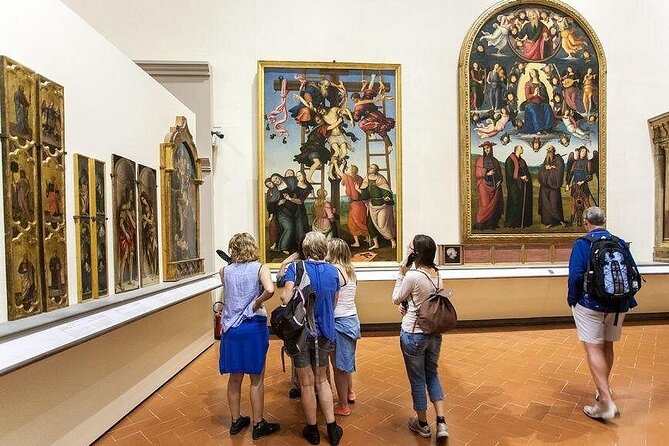
Here’s what you should expect from the experience itself: the Accademia isn’t just one statue, it’s a whole working world of sculpture, sketches in stone, and even instruments and religious art. You’ll get a host to help you enter, plus an optional in-app audio guide in several languages. Just plan for possible audio hiccups if you don’t bring your own earbuds, and be ready to follow the check-in instructions carefully.
In This Review
- Key highlights worth planning for
- Fast-track entry: finding the Italy Pass meeting point
- How the Accademia visit flows around Michelangelo
- David under the skylight: why it feels different in person
- The Hall of Prisoners and Michelangelo’s unfinished non-finito
- Beyond David: models, instruments, and gold-ground religious paintings
- The Hall of Models (Gipsoteca Bartolini)
- Museum of Musical Instruments
- Religious art, gold-ground paintings
- Audio guide reality check: earbuds and app codes
- Price and value: what $42 buys you in real time
- Who should book this Accademia ticket
- Should you book this tour or go DIY?
- FAQ
- Where is the meeting point for the Accademia ticket?
- Does this include skip-the-line entry?
- Is an audio guide included?
- What languages are available for the host and the audio guide?
- What should I bring for entry?
- What’s not allowed inside?
Key highlights worth planning for
- Skip-the-line ticketing to save precious Florence time
- Michelangelo’s David presented in a way photos simply can’t match
- The Hall of Prisoners (Slaves) and Michelangelo’s unfinished non-finito approach
- Gipsoteca Bartolini plaster casts that feel like a sculptor’s studio window
- Museum of Musical Instruments with treasures tied to the Medici and Lorraine families, including a Stradivarius violin
- Audio guide in-app format available in multiple languages, with strong advice to bring earbuds
Other Accademia visits we have walked through in Florence
Fast-track entry: finding the Italy Pass meeting point
The biggest practical move here is location. Your check-in starts at the Italy Pass store at Via dei Pucci 37/39 (red sign). From there, you’ll meet a host/greeter who helps you get into the gallery.
This is the kind of ticket that can feel smooth… or a little chaotic at the start, depending on timing. One common snag: the office area and waiting space can feel tight, and the check-in steps can take longer than you expect if the app download or code entry doesn’t go cleanly the first time. If you’re the type who hates being rushed, show up with a buffer, not right on the minute.
Plan for a quick rhythm: check in, confirm your audio option (if you chose it), then move on to the Accademia entrance. You’re not arranging transport or a hotel pickup here, so your day timing is fully on you—which is fine as long as you keep it simple.
Also note the essentials that often catch people:
- No oversize luggage
- No selfie sticks
- No flash photography
- No smoking or pets (assistance dogs allowed)
How the Accademia visit flows around Michelangelo
Once you’re inside, the visit has a natural arc that makes sense even if you don’t have a guide leading you by the sleeve. The Accademia is organized so you can build a story as you walk: unfinished sculpture, then the finished icon, then the “other worlds” around the main act.
A good way to think about it: you’re watching Michelangelo’s thinking happen in stages. The gallery doesn’t just show you what he made. It shows you what he was trying to solve—how a body should feel when stone refuses to bend.
If you pick the audio guide package, the in-app commentary is designed to accompany you through the rooms. That helps because some of the most interesting details—like why certain figures look like they’re breaking free—are easier to understand when someone explains what you’re seeing while you’re seeing it.
Timing tip: don’t treat it like a statue-and-run mission. If you want David and also want the Slaves and the extra collections, give yourself a full chunk of time. The ticket window is listed as 4 hours to 1 day, but your best pace will depend on how long you linger at each room.
David under the skylight: why it feels different in person
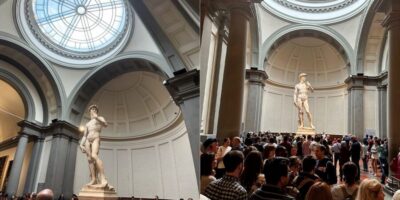
Yes, everyone knows David is famous. But knowing it doesn’t prepare you for scale and gaze.
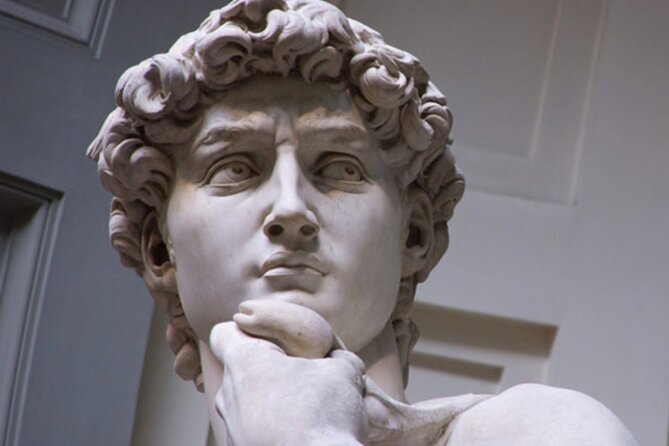
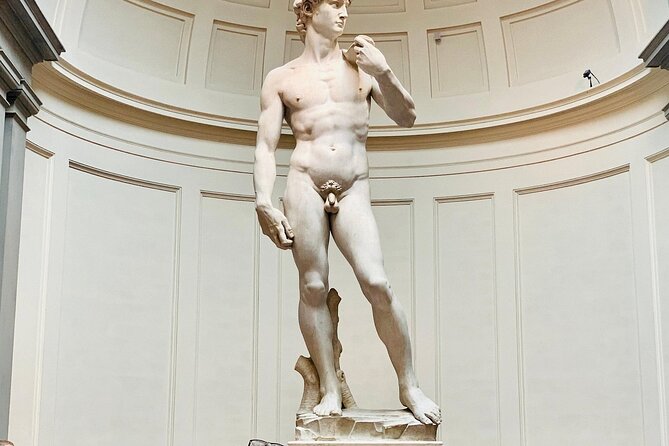
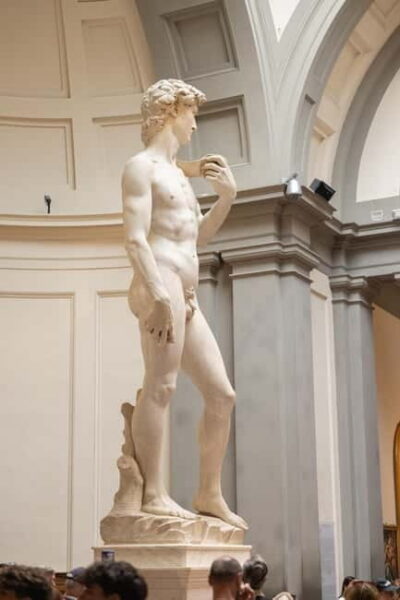
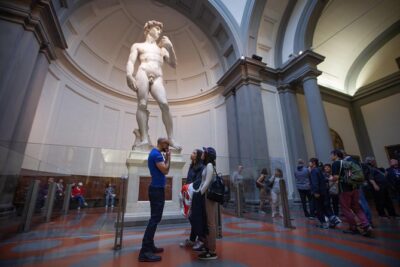
In the Accademia, David stands over 17 feet tall, and the display area uses a dramatic natural skylight. That matters. The lighting and spacing make the statue feel like a real presence, not a museum object.
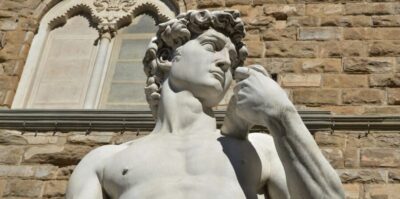
Up close, details that your phone camera struggles with become the story: the tension in his hands, the concentrated watchfulness in his face, and the subtle way his expression reads differently as you move around him. Photos flatten that. In the room, you notice how controlled the carving is—how Michelangelo made stone behave like skin and posture.
If you’re choosing between a standard entry and an audio guide, David is the one stop where the audio can add value quickly. Even if you mostly care about the icon, a few minutes of context can help you look more deliberately instead of just staring.
The Hall of Prisoners and Michelangelo’s unfinished non-finito
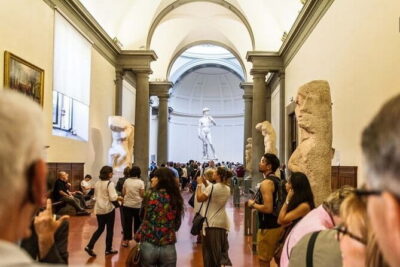
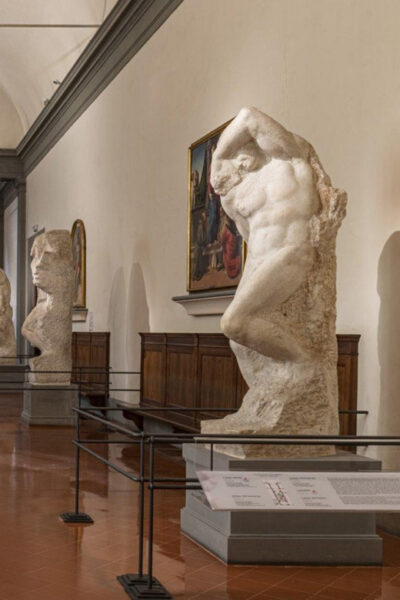
Right after you enter, the experience starts with a set of unfinished marble works often associated with Michelangelo’s Slaves (also referred to as Prisoners). This is a standout part of the Accademia because it shows you how “not finished” can still be powerful.
Here’s what you should look for:
- Figures appear to strain against their blocks
- Muscles and forms seem to emerge where stone still resists
- The tension between surface and structure becomes part of the art
This room is special because it teaches you a different way to judge sculpture. You’re used to the idea that art is about finishing. The Accademia flips that. Michelangelo’s non-finito technique lets you see the process and the problem-solving—how the human body can feel alive even when the work is incomplete.
If you like Renaissance craftsmanship, this is where you’ll slow down. If you mostly want the “big famous statue,” you may be tempted to rush. Don’t. These figures are often the most moving for people who decide to look beyond the headline.
Beyond David: models, instruments, and gold-ground religious paintings
A lot of tickets sell David. This one gives you an excuse to see more, and that “more” is genuinely worth your time.
More Florence tickets and timed entries to book
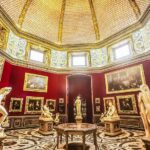




The Hall of Models (Gipsoteca Bartolini)
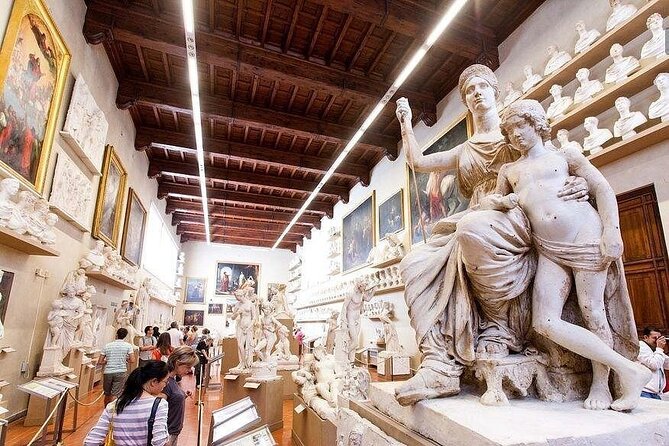
You’ll find a collection of plaster casts known as the Gipsoteca Bartolini. These are 19th-century models that feel like you’re peeking into a sculptor’s working world. Instead of thinking of art as magic, these casts make it feel like a craft with steps you can study.
If you’ve ever wondered how sculptors plan proportions and movement, this hall gives you a practical visual education. It’s not just filler between major rooms.
Museum of Musical Instruments
Then there’s the Museum of Musical Instruments, including treasures connected to the Medici and Lorraine families. The headline you’ll see mentioned is a Stradivarius violin.
This stop is great if you like cultural context. It reminds you that Renaissance Florence wasn’t only painting and marble. Court life and patronage supported music too. Even if instruments aren’t your obsession, the presence of a Stradivarius is a good mental pivot: you’re in the broader world of elite arts, not a single-genre museum.
Religious art, gold-ground paintings
The gallery also includes gold-ground paintings by Florentine masters from the 13th to the 16th centuries. If you’re used to the Renaissance as mostly “bright secular genius,” the gold-ground work shifts your lens. It’s a different kind of attention—about devotion, symbolism, and sacred iconography.
This section tends to satisfy people who want at least one room that isn’t another sculpture. It also helps you understand why Florence’s art world wasn’t one narrow lane.
Audio guide reality check: earbuds and app codes
The audio option is an in-app guide with multiple languages: English, Spanish, French, German, and Italian (optional audio). The idea is smart: it gives you commentary without needing a live tour group.
But the practical reality matters. You’ll be told to bring your own earbuds for best audio quality and device compatibility. That advice is not just a nice-to-have.
Why? Because if the audio system is glitchy, earbuds can reduce the chance of poor sound quality on your device. And if anything goes wrong with the in-app code, you want to minimize other variables.
Also keep in mind how the experience starts if you chose audio:
- You may need to download an app
- You’ll likely use a code to access the guide
- If the code doesn’t work right away, it can add time before you even reach the first rooms
One more thing: the host/greeter helps you enter, but the audio guide isn’t the same as a live person talking to you in a room. If you rely on flawless audio narration, plan to troubleshoot calmly and give yourself extra time.
Price and value: what $42 buys you in real time
The listed price is $42 per person, with a ticket that includes prebooked access and a host to assist you to enter, plus an optional audio guide.
Value here comes from two places:
First, you’re paying to skip the ticket line. In Florence, minutes matter. If you want David today, not “sometime next,” fast-track access is the simplest way to protect your schedule.
Second, you’re getting more than a statue pass. You’re covering multiple collections: Prisoners/Slaves, David, plaster models, instruments, and gold-ground religious art. If you go straight to the iconic stop only, you’ll feel like you paid for a shortcut to one room. If you follow the full flow, your money spreads out.
You do have to bring your own expectations. This isn’t a private guided tour with a human explaining every work. It’s a guided-by-format experience: host at entry, then audio (if you chose it). If you prefer a live guide to answer questions on the fly, you might consider other tour styles. If you like structured freedom—walk at your pace and still get context—this works well.
Who should book this Accademia ticket
This ticket style fits best if you:
- Want David without wasting time
- Like using audio in your own rhythm
- Want more than one stop inside the Accademia (because the gallery gives you that)
It’s especially handy if you’re traveling with a friend or partner and you don’t want to be separated, but you also don’t want a rigid group pace.
It may be less ideal if you:
- Hate app-based check-in steps
- Get stressed when the meeting point process is slow
- Depend on perfect audio playback without any troubleshooting tolerance
And here’s a realistic tip: even when everything goes smoothly, you’ll want patience at the start because you’re coordinating an office check-in, an app, then museum entry. Build in time. You’ll enjoy the art more.
Should you book this tour or go DIY?
If your priority is Michelangelo’s David and you want to protect your schedule in Florence, I think booking this is a smart move—especially with the prebooked, skip-the-line setup. The gallery is too good to treat like a chaotic lunchtime errand.
If you’re choosing between standard entry and audio, my advice is simple: if you like to understand what you’re seeing, add the audio and bring earbuds. If you’re mainly chasing the main statue and you’re comfortable reading on your own, standard entry may be enough.
Go in with a little extra time for check-in, then enjoy the payoff: David in person, the Slaves as proof that process can be art, and a few extra collections that broaden the whole Florence picture.
FAQ
Where is the meeting point for the Accademia ticket?
The meeting point is at the Italy Pass store in Via dei Pucci 37/39 (red).
Does this include skip-the-line entry?
Yes. The ticket includes skip the ticket line, and you’ll also have a host to assist you to enter.
Is an audio guide included?
An audio guide is optional. The included items list prebooked tickets and a host to assist you to enter, and the audio guide is listed as optional.
What languages are available for the host and the audio guide?
The host/greeter is listed as English, French, Italian, and Spanish. The optional audio guide is listed as English, Spanish, French, German, and Italian.
What should I bring for entry?
You should bring your passport or an ID card for children.
What’s not allowed inside?
Oversize luggage, smoking, pets (assistance dogs allowed), selfie sticks, flash photography, and alcohol and drugs are not allowed.
More Florence Tickets & Entries
- Florence: Skip-The-Line Uffizi Gallery Timed Entry Ticket
★ 4.5 · 27,832 reviews - Florence: Leonardo Interactive Museum Entry Ticket
★ 4.5 · 12,957 reviews - Florence: Michelangelo’s David Skip-the-Line Entry Ticket
★ 4.5 · 12,764 reviews - Florence: Uffizi Priority Ticket & Masterpieces Audio App
★ 4.2 · 6,402 reviews - Florence: Hop-on Hop-off Bus Tour: 24, 48 or 72-Hour Ticket
★ 4.0 · 6,283 reviews
More Florence Tours We Have Reviewed
- Florence: Skip-The-Line Uffizi Gallery Timed Entry Ticket
★ 4.5 · 27,832 reviews - Tuscany Day Trip from Florence: Siena, San Gimignano, Pisa and Lunch at a Winery
★ 5.0 · 21,634 reviews - Florence: Timed Entry to Michelangelo’s David + Audio App
★ 4.6 · 19,496 reviews - Florence: Leonardo Interactive Museum Entry Ticket
★ 4.5 · 12,957 reviews - Florence: Michelangelo’s David Skip-the-Line Entry Ticket
★ 4.5 · 12,764 reviews
More Time With the Accademia
- Florence Accademia Gallery Tour with Entrance Ticket Included
★ 4.5 · 6,148 reviews - Florence: Accademia Gallery Guided Tour
★ 4.6 · 4,156 reviews - Uffizi & Accademia Timed Entry: Small Group Duomo Walking Tour
★ 4.5 · 3,630 reviews - Florence: Accademia Gallery Skip-the-Line Guided Tour
★ 4.8 · 3,044 reviews - Florence: Art Tour, Accademia Gallery and David
★ 4.5 · 2,407 reviews
Fresh from our Florence review desk
- Small-Group Pasta Cooking Class and Market Tour in Florence★ 5.0 · 3 reviews
- Palatina Gallery and Pitti Guided Tour in Florence★ 5.0 · 3 reviews
- Tuscan Evening Tour: Fiat 500, 8:30 to 10 PM★ 5.0 · 3 reviews
- Journey into Art: Florence’s Accademia★ 4.5 · 3 reviews
- Paint and Drink Florentine Hills★ 5.0 · 3 reviews
- Truffle hunting and lunch experience, with Vinci and winery.★ 4.5 · 3 reviews
Accademia Gallery Tours, compared.
 ★ 4.5Florence Accademia Gallery Tour with Entrance Ticket IncludedFrom $456,148 reviews
 ★ 4.6Accademia Gallery Guided TourFrom $534,156 reviews
 ★ 4.5Uffizi & Accademia Timed Entry: Small Group Duomo Walking TourFrom $503,630 reviews
 ★ 4.8Accademia Gallery Skip-the-Line Guided TourFrom $413,044 reviews
 ★ 4.5Art Tour, Accademia Gallery and DavidFrom $582,407 reviews
 ★ 4.6Accademia Gallery Guided Tour with Entry TicketFrom $492,253 reviews
 ★ 4.8Uffizi Gallery and Accademia Gallery Guided TourFrom $1402,028 reviews
 ★ 4.5Michelangelo’s David, Accademia & Uffizi Small Group TourFrom $471,986 reviews
Browse the lists this tour appears in