
Reviewed · UFFIZI GALLERY TOURS
Museums special: Accademia & Uffizi combo tour – monolingual small group tour
Two great Florentine museums, one guided flow. This Accademia + Uffizi combo turns a long, crowded museum day into a tighter plan: skip-the-line entry, a guide who points out what to notice, and a quick orientation walk where you’ll get your bearings fast around central Florence. You’ll also get the option to keep going inside the Uffizi after the tour ends.
I especially like the way the visit is organized around major works. The Accademia segment is focused on Michelangelo’s story, starting with the Hall of Prisoners and building toward David. Then the Uffizi portion guides you through key Renaissance landmarks (including Botticelli), with the structure designed so you don’t just wander in circles.
One consideration: this is still a popular, time-limited highlights style day. Even with reservations, you can hit short delays on busiest days, and the Uffizi portion may not cover every corner of the museum if you’re hoping for a slow, floor-by-floor art history tour.
In This Review
- Key things that make this tour worth your attention
- A 4-hour Renaissance hit: Accademia meets the Uffizi
- Meeting point and timing: where the day can go smoothly or not
- Accademia Gallery: Prisoners first, then David
- The Hall of Prisoners and the idea of non-finito
- David: the moment you understand why people line up
- How much time you’ll actually get
- Extra Accademia stops: Sabines and Renaissance masters
- Uffizi Gallery walkthrough: from Gothic roots to Renaissance style
- Botticelli and big-name paintings you don’t want to miss
- Uffizi storytelling stops: International Gothic to early spatial experiments
- What this tour does well vs what it leaves out
- Price and logistics: is $130.97 good value?
- Who this tour fits best
- Should you book this Accademia & Uffizi combo tour?
- FAQ
- What’s included in the tour tickets?
- How long is the tour, and how big is the group?
- Is the tour offered in English?
- Where do I meet the guide, and where does the tour end?
- Do I need my passport or ID for the Uffizi?
- Can I stay inside the Uffizi after the guided portion ends?
Key things that make this tour worth your attention
- Accademia skip-the-line entry: less waiting, more looking time for Michelangelo and the major sculptures.
- David with real context: the guide’s commentary helps you understand why the piece matters.
- Uffizi guided in chronological order: you move through periods instead of jumping randomly.
- Small group size (max 15): easier listening and smoother pacing than big-bus tours.
- Earphones for larger groups: better for hearing the guide clearly.
- You can stay after the tour in the Uffizi: useful if you want extra time with Botticelli.
More ways into the Uffizi, ranked by Florence visitors
A 4-hour Renaissance hit: Accademia meets the Uffizi
This tour is built for people who want the big museums without turning the day into a logistics puzzle. You’re looking at about 4 hours, in an English small group (maximum 15). It includes reservations and tickets for both the Accademia Gallery and the Uffizi Gallery, so you don’t burn your trip energy standing in separate ticket lines all day.
The experience also makes a smart choice about priorities. In the Accademia, you get direct focus on Michelangelo’s works and the themes around unfinished sculpture. In the Uffizi, you get a guided walkthrough that points you toward the paintings most travelers talk about—while still giving you enough historical framing to make those famous pieces click.
Meeting point and timing: where the day can go smoothly or not
The tour starts at Via Camillo Cavour, 18, 50122 Firenze FI, Italy. That’s close enough to the center that you can build the day around it without a long commute, and it’s described as near public transportation.
It ends at Uffizi Galleries, Piazzale degli Uffizi, 6, 50122 Firenze FI, Italy. That end point matters because once you’re done with the guided portion, you’re already where you want to be to keep browsing.
Here’s the practical reality: reservations help, but they don’t always erase every wait. The tour notes that on the busiest days, entrance may still involve some short delays. Based on that, I’d plan like a minimalist and avoid scheduling this for the busiest midday slot if you can. Morning and later afternoon tend to feel less like a human traffic jam.
Also, arrive a little early. One common problem in Florence is being one street off and watching your group disappear. You’ll be happier if you check the meeting address twice.
Accademia Gallery: Prisoners first, then David
The Accademia segment is where the tour really earns its keep. After meeting, you walk roughly 5 minutes to the Accademia and enter with skip-the-line access.
The Hall of Prisoners and the idea of non-finito
The first real stop inside the Accademia is the Hall of Prisoners, where you’ll see Michelangelo’s famous unfinished sculptures. The guide’s job here is more than reciting facts—it’s translating the emotion. You’ll learn about non-finito, the approach where forms remain partially blocked out in marble.
Even if you’re not a sculpture person, this section has an advantage: it trains your eye. You look at the chisel marks and the incomplete edges and start to see how the unfinished state can still communicate movement, tension, and story.
David: the moment you understand why people line up
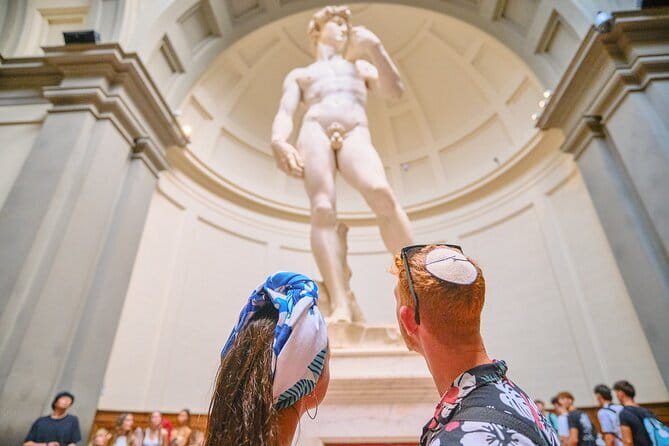
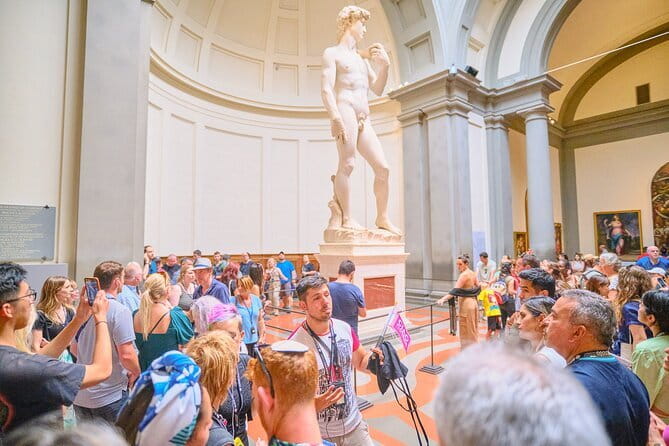
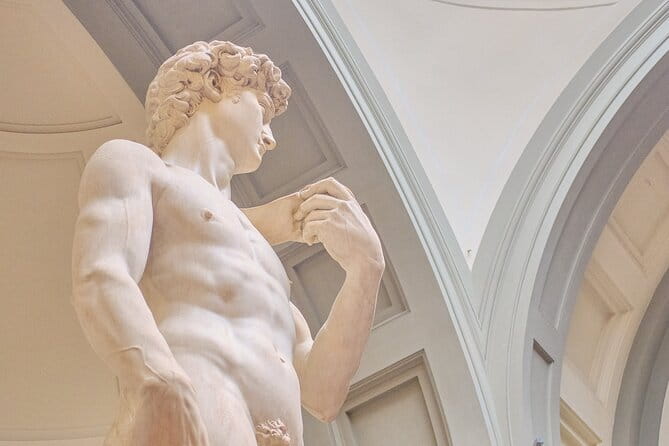
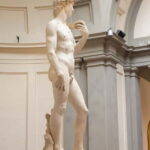
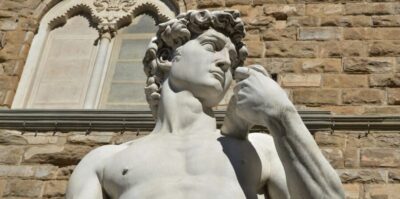
Then the guide brings you to David, the centerpiece that dominates above the visitors. You’ll hear the scale—about 12,000 pounds and roughly 17 feet—plus the striking detail that Michelangelo was 26 when he finished the sculpture.
What you get with a guide is the “why” behind what you’re seeing. It’s not just a photo moment; the commentary helps you understand how Michelangelo’s choices connect to his life and era. If you’re going to spend a few minutes on one sculpture, it should be this one—because it’s the one that teaches you how to look at the rest of the Accademia.
Other Accademia visits we have walked through in Florence


How much time you’ll actually get
You’ll typically spend about 35 minutes on the Accademia’s key highlights before moving on. That’s enough to absorb David and the related works, but it’s not enough to treat the Accademia like a museum you can wander freely. If you want slow reading of labels and lots of side chambers, plan extra time on your own later.
Extra Accademia stops: Sabines and Renaissance masters
After David, you don’t just exit into the next ticket line. The guide takes you to other important works, including Giambologna’s Rape of the Sabines, which gives you a different sculptural voice than Michelangelo.
You’ll also see paintings and sculpture works associated with Renaissance names like Botticelli, Jacopo di Cione, and Pacino di Buonaguida. That mix is useful because it keeps the Accademia visit from becoming a single-piece obsession. You start the day thinking Michelangelo is the story, and then you leave with a broader sense of who else shaped Florence’s Renaissance mindset.
One more benefit: the Accademia is smaller than the big-ticket giants. That can make pacing feel friendlier, especially with a guide controlling the flow.
Uffizi Gallery walkthrough: from Gothic roots to Renaissance style

Once you’re at the Uffizi, the tour switches from “one artist moment” to “big art timeline.” You’ll move through the museum starting with the 13th century and progress forward. The itinerary also notes that the order can change, so don’t count on a perfect script.
The Uffizi experience you’ll feel is guided, chronological, and selective. Between rooms, you’ll get chances to notice things beyond paintings—like ancient Roman and Greek sculptures, frescoed ceilings, and views from large windows.
This is a smart way to experience the Uffizi because it answers a common first-time problem: where do I even look? With a guide, you’re nudged toward the most important works and the connections between periods.
Botticelli and big-name paintings you don’t want to miss
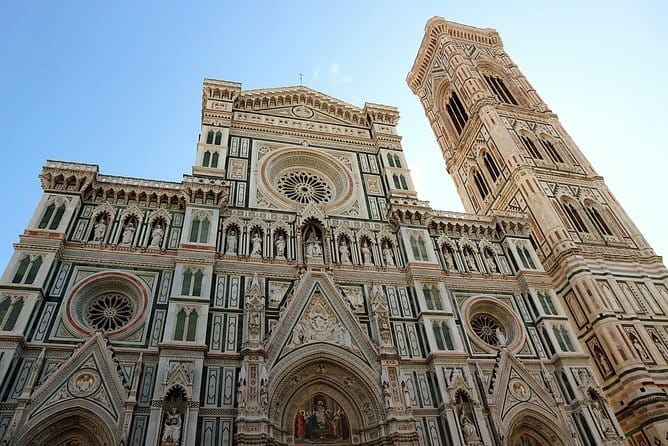
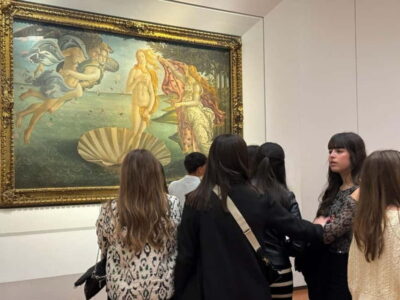
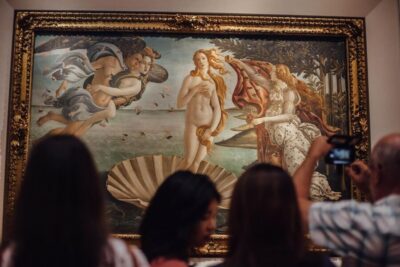
At the core of any Uffizi visit are the paintings everyone came for—and this tour gives you that focus. You’ll spend real time on the Botticelli collection, including The Birth of Venus and Primavera.
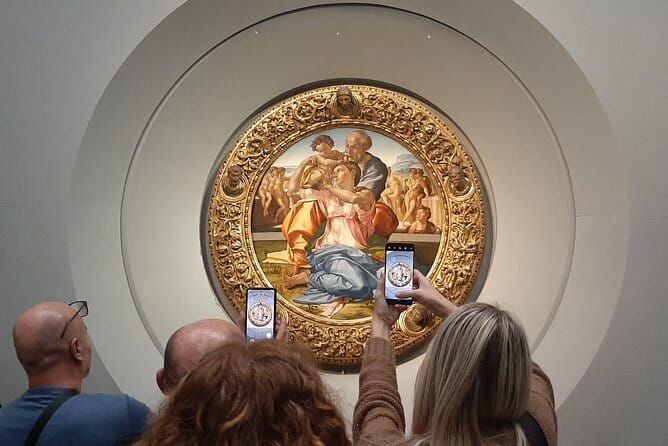
Then you’ll move into the heart of Renaissance greatness with art tied to big names such as Michelangelo and Leonardo da Vinci. In the tour’s route, you’ll encounter works including Tondo Doni (Michelangelo), and Leonardo pieces such as Baptism of Christ and The Annunciation.
Here’s why this matters for your time: the Uffizi has tons of masterpieces. If you try to “do it all,” you’ll end up tired and underwhelmed. This route keeps you on the highest-impact stops, so you leave with memorable images rather than label fatigue.
Uffizi storytelling stops: International Gothic to early spatial experiments
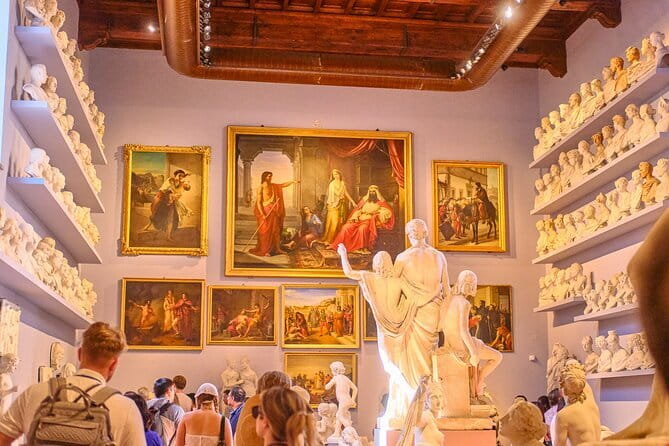
Later in the guided flow, you’ll see additional turning points rather than just the famous poster children. The route includes International Gothic works such as Adoration of the Magi by Gentile da Fabriano, where the guide’s storytelling helps you see art shifting toward clearer narrative.
You’ll also be pointed toward works representing a move toward more convincing space and depth—like Battle of San Romano by Paolo Uccello. And you’ll get names tied to idealized features and later influence, including Filippo Lippi (Madonna with Child and Two Angels) and Piero della Francesca (Dukes of Urbino).
This section is where a good guide really helps. If you’re only looking at brushstrokes, you might miss the point. With the commentary, you start to notice how artists changed techniques as the Renaissance developed.
What this tour does well vs what it leaves out
Let’s keep this balanced, because your expectations should match the format.
What it does well
- It uses the guide to do the hard part: choosing the most important works and explaining what to watch for.
- It prioritizes the most famous Accademia and Uffizi pieces without turning the day into a scavenger hunt.
- The small group size (max 15) makes it easier to hear the guide and stay together.
- The option to stay in the Uffizi after the tour is a practical safety valve if you want extra time with Botticelli or simply want more breathing room.
What it may not be
- If you’re hoping for a slow, floor-by-floor museum education, this won’t feel like that. The museum is huge, and the guided portion is still limited.
- Even with skip-the-line access, security and museum flow can still create short delays, especially at peak times.
My advice: treat this like a smart orientation plus a highlights pass. Then, if you have the energy, use the extra time inside the Uffizi after the tour to see what grabbed you most.
Price and logistics: is $130.97 good value?
At $130.97 per person, you’re paying for more than a guide. You’re also paying for tickets and reservations to both major museums. The Uffizi entrance is listed as €29, and the key point is that your ticketing and reservation work is handled for you so you don’t manage it on your own.
For many people, that’s the real value. Florence museums can be a timing game, and the benefit of an organized plan is that you lose less time to missed entry windows and wandering. The 4-hour length also helps: you get a full day’s worth of impact without the whole day getting swallowed by museums.
Where the price can feel less perfect is if you’re the type who wants to see everything slowly. For that style of traveler, you might need more time at the museums than this tour covers.
Who this tour fits best
This is a good fit if you:
- Want the two headline collections in one day: Michelangelo at the Accademia and the Uffizi’s Renaissance stars.
- Prefer a structured route with a guide who points out what matters.
- Travel with limited time and want to reduce uncertainty.
- Like the idea of finishing in the Uffizi and then choosing what to revisit on your own.
If you love deep art history and want to sit with paintings for long stretches, you may still enjoy it—but you’ll probably want to add extra independent time after the guided portion.
Should you book this Accademia & Uffizi combo tour?
I’d book it if your goal is fast clarity: you want to know which works to see, how they connect across time, and you want the efficiency of skip-the-line entry at two of Florence’s biggest museums. The format is built for “see the essentials well,” not for “see everything.”
Before you commit, do two things:
- Pick your time slot carefully and try to avoid the busiest midday window if you can.
- Double-check your booking details, because the Uffizi entry depends on your passport or ID matching the name on your booking, and full traveler names matter for ticketing.
If that sounds like your style, this combo is a smart way to turn a crowded city day into a guided Florence art highlight you’ll actually remember.
FAQ
What’s included in the tour tickets?
It includes Accademia Gallery and Uffizi Gallery tickets with reservations, plus a professional guide. Earphones are provided for bigger groups.
How long is the tour, and how big is the group?
The duration is about 4 hours, and the tour has a maximum of 15 travelers.
Is the tour offered in English?
Yes, it’s offered in English, and it’s described as a monolingual small group tour.
Where do I meet the guide, and where does the tour end?
You start at Via Camillo Cavour, 18, 50122 Firenze FI, Italy and end at Uffizi Galleries, Piazzale degli Uffizi, 6, 50122 Firenze FI, Italy.
Do I need my passport or ID for the Uffizi?
Yes. Each traveler must present a valid passport or ID document that matches the name provided at booking for entry to the Uffizi Gallery.
Can I stay inside the Uffizi after the guided portion ends?
Yes. The tour notes that you can remain inside the Uffizi for as long as you’d like after the tour finishes.
More Florence Tours We Have Reviewed
- Florence: Skip-The-Line Uffizi Gallery Timed Entry Ticket
★ 4.5 · 27,832 reviews - Tuscany Day Trip from Florence: Siena, San Gimignano, Pisa and Lunch at a Winery
★ 5.0 · 21,634 reviews - Florence: Timed Entry to Michelangelo’s David + Audio App
★ 4.6 · 19,496 reviews - Florence: Leonardo Interactive Museum Entry Ticket
★ 4.5 · 12,957 reviews - Florence: Michelangelo’s David Skip-the-Line Entry Ticket
★ 4.5 · 12,764 reviews
More Time With the Accademia
- Florence Accademia Gallery Tour with Entrance Ticket Included
★ 4.5 · 6,148 reviews - Florence: Accademia Gallery Guided Tour
★ 4.6 · 4,156 reviews - Uffizi & Accademia Timed Entry: Small Group Duomo Walking Tour
★ 4.5 · 3,630 reviews - Florence: Accademia Gallery Skip-the-Line Guided Tour
★ 4.8 · 3,044 reviews - Florence: Art Tour, Accademia Gallery and David
★ 4.5 · 2,407 reviews
The Uffizi, A Few More Ways In
- Florence: Skip-The-Line Uffizi Gallery Timed Entry Ticket
★ 4.5 · 27,832 reviews - Florence: Uffizi Priority Ticket & Masterpieces Audio App
★ 4.2 · 6,402 reviews - Uffizi Gallery: Renaissance Masterpieces Guided Tour
★ 4.6 · 6,070 reviews - Uffizi Gallery Small Group Tour with Guide
★ 4.5 · 4,923 reviews - Uffizi & Accademia Timed Entry: Small Group Duomo Walking Tour
★ 4.5 · 3,630 reviews
Fresh from our Florence review desk
- Small-Group Pasta Cooking Class and Market Tour in Florence★ 5.0 · 3 reviews
- Palatina Gallery and Pitti Guided Tour in Florence★ 5.0 · 3 reviews
- Tuscan Evening Tour: Fiat 500, 8:30 to 10 PM★ 5.0 · 3 reviews
- Journey into Art: Florence’s Accademia★ 4.5 · 3 reviews
- Paint and Drink Florentine Hills★ 5.0 · 3 reviews
- Truffle hunting and lunch experience, with Vinci and winery.★ 4.5 · 3 reviews
Uffizi Gallery Tours, compared.
 ★ 4.5Skip-The-Line Uffizi Gallery Timed Entry TicketFrom $3027,832 reviews
 ★ 4.2Uffizi Priority Ticket & Masterpieces Audio AppFrom $316,402 reviews
 ★ 4.6Uffizi Gallery: Renaissance Masterpieces Guided TourFrom $886,070 reviews
 ★ 4.5Uffizi Gallery Small Group Tour with GuideFrom $764,923 reviews
 ★ 4.5Uffizi & Accademia Timed Entry: Small Group Duomo Walking TourFrom $503,630 reviews
 ★ 4.2Uffizi Gallery Timed Entry Ticket & Audio GuideFrom $332,794 reviews
 ★ 4.8Uffizi Gallery and Accademia Gallery Guided TourFrom $1402,028 reviews
 ★ 4.7Uffizi Gallery Small-Group Guided Tour with TicketFrom $762,003 reviews
Browse the lists this tour appears in