
Reviewed · FLORENCE DUOMO TOURS
San Gimignano Cathedral & Museum of Sacred Art Entry Ticket
San Gimignano feels like a time capsule, and the Cathedral makes that idea real fast. I love how the interior is covered wall-to-wall in medieval frescoes, and I also like that this ticket includes a physical audio guide to help you read the stories as you look. One catch: you’ll still need to exchange your voucher at the ticketing office before you enter.
If you enjoy religious art that’s very specific—named artists, dated scenes, recognizable biblical episodes—this stop is built for you. The cathedral isn’t just a pretty building; it’s a carefully designed space where architecture and painting work together, so slowing down for the main viewpoints really pays off.
In This Review
- Key highlights to look for
- Where to start at Piazza Pecori (and what to do first)
- A cathedral interior designed like a storybook
- The New Testament on the right: Lippo and Federico Memmi
- Old Testament stories on the left: Bartolo di Fredi’s 1367 work
- Medieval details: columns, vaults, and striped arch intrados
- Santa Fina’s Chapel: Renaissance art inside a medieval setting
- Making your audio guide work for you (not against you)
- How the Museum of Sacred Art fits into the visit
- Nearby churches and convents you can add on
- Price and value: is $11 worth it?
- Best for: who should book this ticket
- Should you book this ticket?
- FAQ
- Where is the meeting point for the voucher exchange?
- What does the ticket include?
- How long is the experience?
- Which languages are available for the audio guide?
- Is this experience wheelchair accessible?
- How much does it cost?
Key highlights to look for
- Right wall New Testament frescoes by Lippo and Federico Memmi
- Left wall Old Testament stories painted in 1367 by Bartolo di Fredi
- Four octagonal + ten round columns shaping the nave space
- Painted-blue cross vault and striped arch details showing classic Tuscan medieval taste
- Chapel of Santa Fina with major Renaissance artists: Giuliano, Benedetto, and Domenico
Climbing the Duomo? Here are the other options
Where to start at Piazza Pecori (and what to do first)

Your visit begins in Piazza Pecori, on the left side of the San Gimignano Duomo. You’re looking for the ticketing office there, and you’ll need to exchange your voucher before entering.
This part is simple, but it matters: if you show up late expecting a ticket ready at the door, you’ll lose time. If you like to get your bearings quickly, step out of the square, orient yourself to the Duomo façade, then move straight to the counter so you can start the audio guide right away.
A cathedral interior designed like a storybook
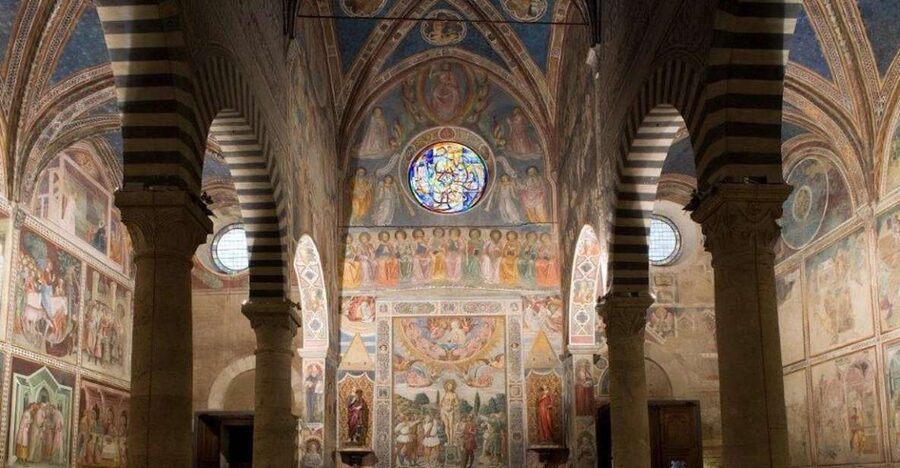
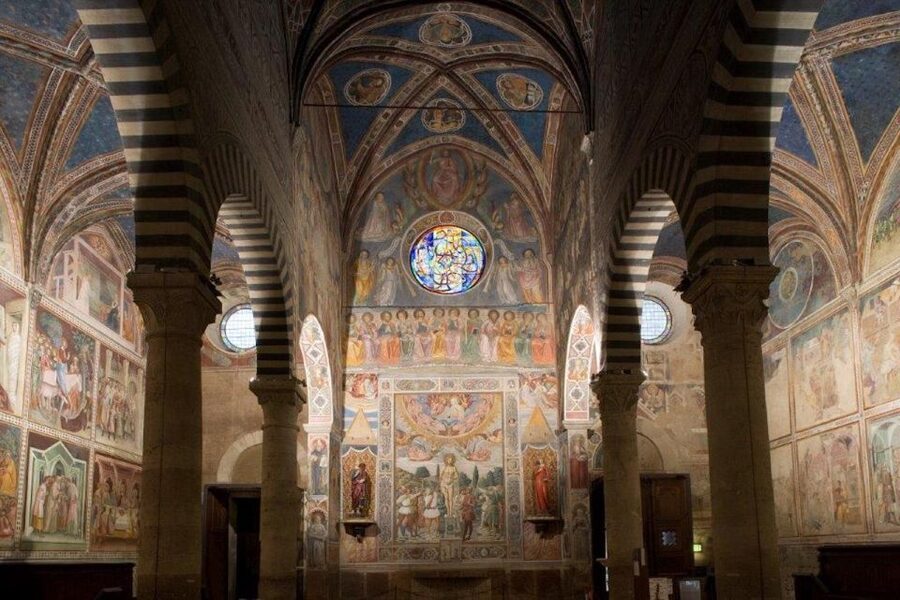
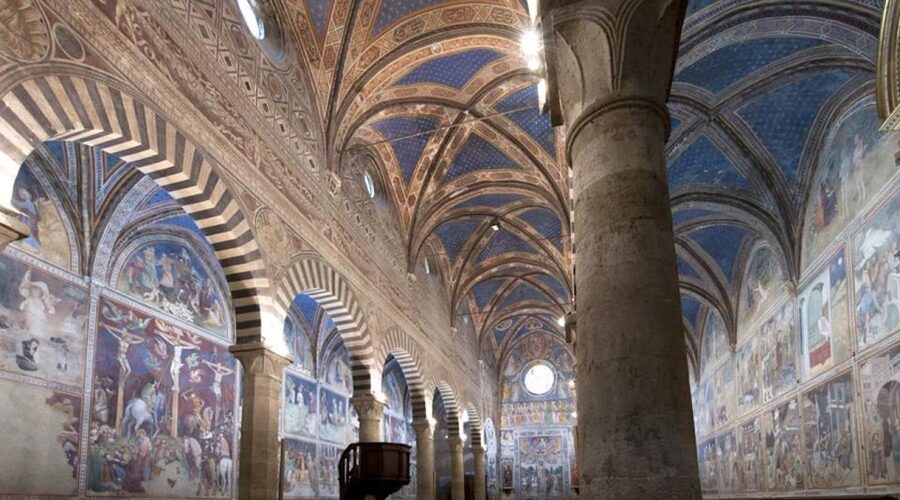
What I appreciate most about the San Gimignano Cathedral is how it turns the walls into an illustrated lesson. The church is lined with frescoes telling episodes from both the Old and New Testaments, painted by artists of the 14th-century Sienese school.
Inside, the space also feels deliberately structured. You’ll notice 14 classical Tuscan stone columns—10 round and 4 octagonal—which subtly guide you through the nave and toward the most important painting zones. Even if you’re not an art expert, the design helps you take the right path.
There are also medieval decorative touches that are easy to miss if you only look straight ahead. Keep an eye out for the polychrome decorations, including a painted-blue cross vault and striped motifs in the intrados of the arches between the nave and aisles.
The New Testament on the right: Lippo and Federico Memmi
When you enter, your first big “aha” moment comes from the fresco cycle on the church’s right wall. This section is a standout masterpiece by Lippo and Federico Memmi, and it’s where the cathedral really earns its reputation.
To get the most from it, don’t treat the paintings like a single wall panel. Instead, focus on how the scenes flow across the wall, since the storytelling logic is part of the artwork. With the audio guide playing, you’ll have names and context as you go, which makes the visuals far easier to follow.
Also, don’t rush past the border details and composition. These frescoes were painted to be read at walking pace, and the rhythm from one scene to the next is part of the experience.
Old Testament stories on the left: Bartolo di Fredi’s 1367 work
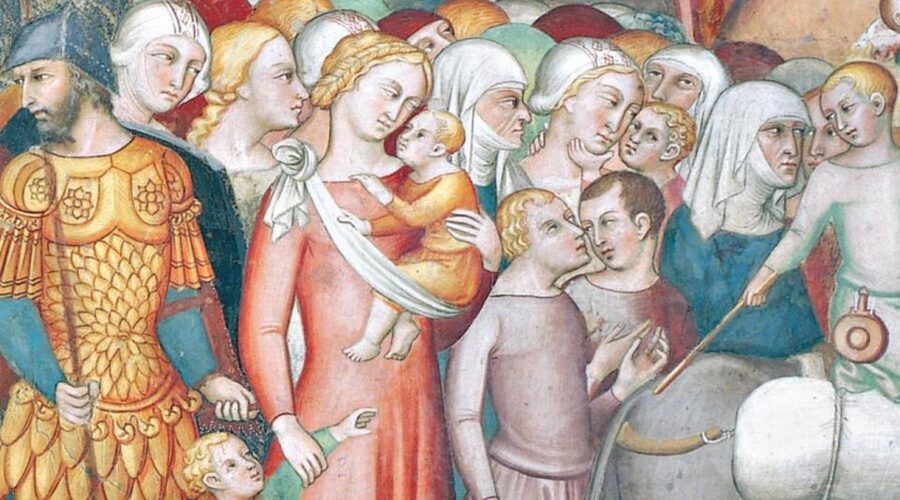
On the opposite side, the left wall offers the Old Testament cycle. Look for the Stories of the Old Testament painted in 1367 by Bartolo di Fredi—a specific date that gives you a concrete sense of the cathedral’s artistic timeline.
This is one of those places where the audio guide earns its keep. Even if your biblical knowledge is basic, the guide helps you connect what you’re seeing to what the scenes represent, so your eyes don’t wander just looking for “pretty” moments.
I like the Old Testament section because it feels more like a visual chain of teachings. You can actually feel how the artists built meaning across many panels, which is harder to notice when you visit without any guidance.
Medieval details: columns, vaults, and striped arch intrados
The cathedral isn’t only about frescoes. It’s also about the medieval way of using color, pattern, and geometry to make a sacred space feel ordered and powerful.
A few design elements are worth your attention:
- the painted-blue cross vault overhead
- the polychrome decorative style typical of medieval churches
- the intrados of the arches between the nave and aisles, decorated with a striped motif
These features help you see the building as a whole. The architecture sets the stage, and the fresco cycles act like the script.
If you tend to take photos, try to step back periodically and look without the camera. It’s easy to get stuck framing one section, but the cathedral’s power comes from how everything fits together.
More San Gimignano days out of San Gimignano



Santa Fina’s Chapel: Renaissance art inside a medieval setting
After you’ve taken in the main fresco storytelling, shift your attention to the cathedral’s major Renaissance highlight: the Chapel of Santa Fina. This chapel is a precious jewel within the church, and it’s dedicated to San Gimignano’s best-loved saint.
What makes this chapel special is the combination of artistic talent. Three famous Florentine artists contributed:
- architect Giuliano da Maiano
- sculptor Benedetto da Maiano
- painter Domenico Ghirlandaio
You don’t need to memorize who did what before you go, but knowing the three names makes the chapel feel more human. You’re basically walking into a mini collaboration, where architecture, sculpture, and painting all work for the same devotional purpose.
If you like art that changes periods in front of you, this chapel is your payoff. It also helps you understand that the cathedral didn’t freeze in one moment of time; it kept absorbing major artistic waves.
Making your audio guide work for you (not against you)
This ticket comes with a complimentary audio guide, and it’s available in several languages: English, French, German, Italian, Russian, and Spanish (physical guide, subject to availability).
Here’s how to use it so you actually get value. Start with the audio guide right when you enter, and let it guide you through the main fresco zones before you start wandering for extra details. Then, when you arrive at the Memmi and Bartolo di Fredi cycles, slow down and listen for the scene explanations so your eye has something to latch onto.
Also, give yourself a simple rhythm: look, listen, look again. Frescoes reward repetition, and this kind of guide helps you catch things you’d otherwise miss in a quick pass.
If you’re visiting with kids or someone who gets tired of standing still, audio guides can keep the visit moving. You can also pause between sections so you’re not stuck listening nonstop while walking.
How the Museum of Sacred Art fits into the visit
The ticket is for the San Gimignano Cathedral plus the Museum of Sacred Art area linked to the complex. That means you’re not limited to murals on walls; you should expect additional sacred artwork or devotional objects on-site as part of the same visit experience.
The best way to connect cathedral art to museum content is to keep your focus broad. In the cathedral, art is telling biblical stories and honoring saints. In the museum area, you’ll likely see how religious art supported daily devotion—so treat it as the “other side” of the same spiritual world.
If you want a practical strategy, spend enough time in the main church that you really understand the fresco cycles, then use the museum space as your slower, more contemplative wrap-up. Don’t try to speed through both. A calm pace makes the whole visit feel coherent.
Nearby churches and convents you can add on
Even if your ticket is centered on the cathedral, you’re in a town where sacred monuments are everywhere. The area around San Gimignano’s center makes it easy to keep the religious-art theme going with nearby stops such as the Collegiata, other churches, and convents.
I like adding one extra site after the cathedral for two reasons. First, it gives you a comparison point—how different churches interpret similar themes. Second, it helps you end your day without rushing, since you already did the cathedral’s big “must-see” work.
Price and value: is $11 worth it?
At about $11 per person, this ticket sits in the reasonable range for a major monument visit in Tuscany—especially because you’re getting more than entry. You also receive a physical audio guide, plus there’s a €1.5 booking fee included in what’s listed.
In plain terms, the value comes from two places:
1) you’re paying to access the cathedral’s major interiors and fresco cycles
2) the audio guide helps you understand what you’re looking at, which turns a quick glance into an actual art story
If you’re the type who reads interpretive panels and cares about context, the audio guide boosts your satisfaction. If you prefer to wander silently, you might feel you could do it cheaper—though the chapel and the fresco cycles are precisely the kind of art that benefits from guidance.
Best for: who should book this ticket
This is a strong choice if you:
- love medieval painting and want to see a complete fresco narrative
- enjoy named artists and specific dates (like 1367)
- want a structured visit without joining a long, rigid group tour
It also works well if you’re traveling with someone who doesn’t want a museum crawl but does want a memorable interior. The cathedral offers “big visuals” plus enough detail to keep your attention.
If you’re completely uninterested in religious art, you might find it less compelling. But if you even mildly like architecture, frescoes, or chapels, it’s a worthwhile anchor stop in San Gimignano.
Should you book this ticket?
Yes, I’d book it. The combination of the cathedral’s fresco cycles (Old and New Testament) with the Chapel of Santa Fina—and the included audio guide—means you’re not just seeing art. You’re understanding it while you look.
Book this one especially if you like to go at your own pace and still feel oriented. The only reason to hesitate is the practical step of exchanging your voucher at the ticket office first, so plan a bit of time at the start and you’ll be fine.
FAQ
Where is the meeting point for the voucher exchange?
In Piazza Pecori, on the left of the San Gimignano Duomo. You’ll find the ticketing office there and exchange your voucher before your visit.
What does the ticket include?
It includes the entry ticket and a €1.5 booking fee, plus a complimentary audio guide (physical), subject to availability at the attraction.
How long is the experience?
The duration is listed as 1 day. Starting times depend on availability.
Which languages are available for the audio guide?
The audio guide is available in English, French, German, Italian, Russian, and Spanish.
Is this experience wheelchair accessible?
Yes, it is listed as wheelchair accessible.
How much does it cost?
The price is listed as $11 per person.
More San Gimignano Tours We Have Reviewed
- Tuscan Cooking Class
★ 5.0 · 584 reviews - Visit Best Wineries in Tuscany – Wine Tasting & Tour
★ 4.5 · 263 reviews - San Gimignano: Lunch or Dinner at a Winery with Wine Tasting
★ 4.7 · 177 reviews - Wine and food tasting in an organic family winery
★ 5.0 · 170 reviews - San Gimignano: Wine and Oil Tasting with Tuscan Appetizers
★ 4.6 · 156 reviews
More San Gimignano Day Trips
- San Gimignano: Lunch or Dinner at a Winery with Wine Tasting
★ 4.7 · 177 reviews - San Gimignano: Wine and Oil Tasting with Tuscan Appetizers
★ 4.6 · 156 reviews - San Gimignano: 2-Day Pass – Torre Grossa and Duomo Tickets
★ 4.4 · 133 reviews - San Gimignano: Vineyard and Cellar Tour with Wine Tasting
★ 5.0 · 80 reviews - San Gimignano: Truffle Hunting with Lunch & Wine Tasting
★ 4.6 · 72 reviews
The Duomo, Keep Climbing
- San Gimignano: 2-Day Pass – Torre Grossa and Duomo Tickets
★ 4.4 · 133 reviews
Fresh from our San Gimignano review desk
- Golden Grains & Gourmet Pasta Cooking Class★ 5.0 · 3 reviews
- Extra Virgin Olive Oil Experience★ 4.5 · 3 reviews
- San Gimignano: Winery Visit with Picnic in Olive Grove★ 5.0 · 3 reviews
- San Gimignano: Wine Tasting Experience at Il Colombaio★ 4.7 · 3 reviews
- SAN GIMIGNANO: DEGUSTAZIONE CON VISTA SULLE TORRI★ 3.3 · 3 reviews
- Siena: Chianti Countryside Guided Bike Tour and Light Lunch★ 3.5 · 3 reviews
Florence Duomo Tours, compared.
 ★ 3.7Duomo Cathedral 60-Minute Guided TourFrom $96,829 reviews
 ★ 4.5Brunelleschi’s Dome Climb Entry Ticket & DuomoFrom $533,815 reviews
 ★ 4.1Duomo Guided Tour with Optional Dome Climb UpgradeFrom $253,706 reviews
 ★ 4.5Uffizi & Accademia Timed Entry: Small Group Duomo Walking TourFrom $503,630 reviews
 ★ 4.4Florence Duomo Guided Tour: Santa Maria del Fiore CathedralFrom $82,679 reviews
 ★ 4.6Brunelleschi’s Dome Reserved Entry Ticket & DuomoFrom $572,216 reviews
 ★ 4.7Duomo Complex with Tickets & City Walk Guided TourFrom $932,057 reviews
 ★ 4.5Best of Florence: Small Group Tour Skip-the-Line David & Accademia with DuomoFrom $781,422 reviews
Browse the lists this tour appears in