
Reviewed · AUDIO TOURS
Best of Santa Maria Novella Basilica: No-Wait Audio Tour
If Florence has a “quiet power” basilica, this is it. You get skip-the-line entry plus an official portable audio guide that keeps you moving through Santa Maria Novella’s art and stories at a comfortable pace. I especially like how the audio puts famous works in context and how the 2-hour flow helps you avoid the usual crowd-pressure. One drawback to plan for: this is self-guided, so you won’t have a live person to answer questions, and it is not suitable for wheelchair users.
Over the visit, you’ll connect the dots between medieval foundations, Renaissance breakthroughs, and the families who funded it all. Expect major names and big moments, from Masaccio and Giotto to Botticelli and Paolo Uccello, plus Dominican life that’s still part of the place. The key consideration is that you’ll need to manage your own timing—so wear shoes for standing and walking, and dress appropriately for a church.
In This Review
- Key highlights you’ll feel right away
- Santa Maria Novella’s real draw: art, faith, and power in one building
- Getting in: skip-the-line entry, clear meeting point, and fast start
- The portable audio guide: how to use it so you don’t miss the good parts
- Your route through Santa Maria Novella’s masterpieces (and what to look for)
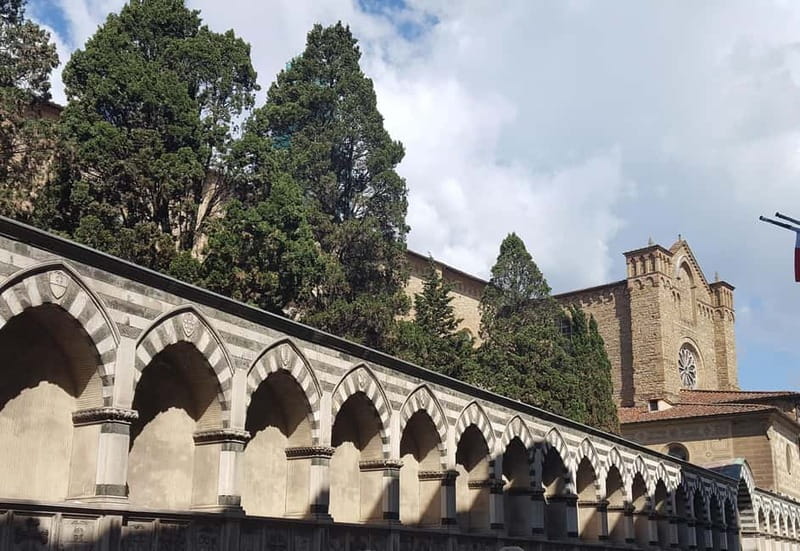
- The façade and what it signals
- Romanesque/Gothic to Renaissance harmony
- Masaccio’s Trinità: when painting starts behaving differently
- Giotto’s Crucifix: emotion you can actually feel
- Brunelleschi’s reinterpretation: structure with personality
- The Tornabuoni Chapel and Ghirlandaio’s human drama
- Cloisters and chapels: calm spaces with historical weight
- Botticelli’s Nativity: intimacy, not spectacle
- Paolo Uccello’s Green Cloister: a visual mood
- Strozzi and Medici stories: who had power, and what they bought
- A one-of-a-kind selfie moment
- The Santa Maria Novella district itinerary: extend the day beyond the basilica
- Practicalities that affect your enjoyment (and save you time)
- Price and value: is $29 a smart buy for Santa Maria Novella?
- Who this is best for (and who should think twice)
- Should you book Best of Santa Maria Novella Basilica: No-Wait Audio Tour?
- FAQ
- Where is the meeting point for this tour?
- How long does the experience last?
- What do I get with the ticket?
- Do I need to use my phone or bring earphones?
- Is there a live guide with you?
- Can I take photos with flash?
- Is this tour suitable for wheelchair users?
- What if I need to cancel?
Key highlights you’ll feel right away
- Priority access + separate entrance: start faster and spend more time inside.
- Official portable audio guide: clear explanations without needing your phone or personal earphones.
- Big-artist route: Masaccio (Trinità), Giotto (Crucifix), Botticelli, and Paolo Uccello’s Green Cloister.
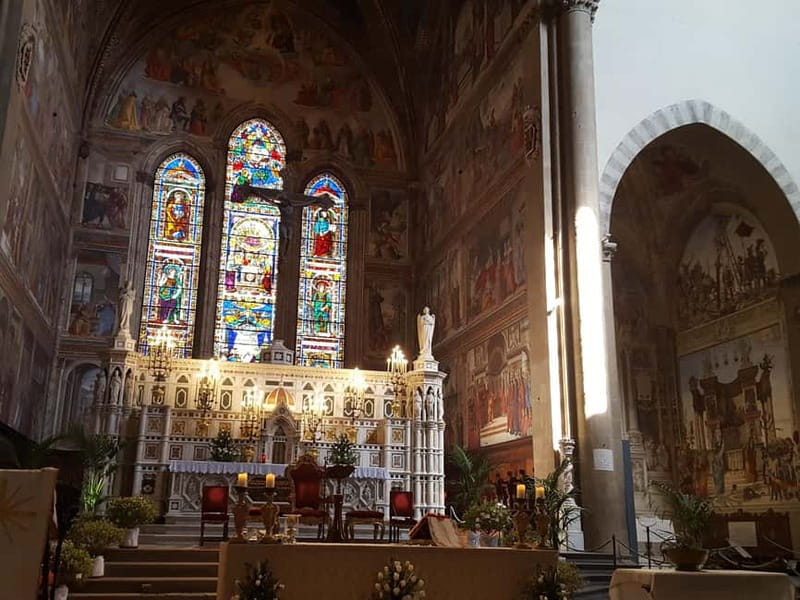
- Chapels with strong personalities: the Tornabuoni Chapel and Ghirlandaio’s work, plus the mentor link to young Michelangelo.
- Strozzi and Medici intrigue: stories of power, patronage, and politics behind the art.
- Bonus Santa Maria Novella district idea: a city app itinerary to admire nearby streets outside the basilica.
At your own pace, more self-guided Florence
Santa Maria Novella’s real draw: art, faith, and power in one building
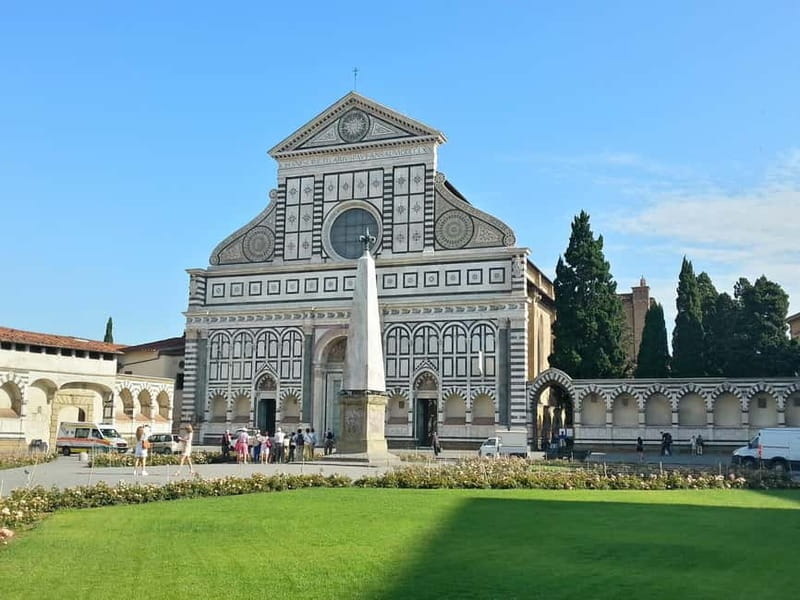
Santa Maria Novella is one of those Florence churches where the walls don’t just look beautiful—they explain things. You’re moving through layers: Romanesque and Gothic forms on the way in, then Renaissance harmony as the building’s artistic language evolves. What makes it worth your time is that you’re not only seeing masterpieces. You’re learning why they were commissioned, who paid for them, and what they meant to the people living in this part of the city.
I like that the audio guide doesn’t treat art like isolated museum pieces. It connects the dots between the Dominican setting—friars who still preach here—and the political and social world around them. That’s what turns a standard basilica visit into a “how did this happen?” experience, especially in a city like Florence where art and money have always been closely linked.
Getting in: skip-the-line entry, clear meeting point, and fast start
You meet at Piazza Stazione nr. 4, behind the basilica, at the Ticket Office. It’s a straightforward setup: show your voucher, get your ticket and your audio guide, and head in through the separate entrance designed to reduce waiting.
Skip-the-line access matters more than people think in Florence. Basilicas can be slow not because the building is huge, but because entry systems funnel everyone into the same points. By routing you through priority access, you spend your limited 2 hours seeing rather than waiting.
If you’re arriving during peak daytime hours, this also helps you avoid feeling rushed. You’ll still want to keep a steady pace, but you’re not constantly checking the clock.
The portable audio guide: how to use it so you don’t miss the good parts
This is a self-guided visit with an immersive official portable audio guide—no mobile application needed for the audio portion, and you do not need your own personal earphones. That’s a big deal for comfort and simplicity. You can focus on the building without juggling a phone in your hands.
How the audio adds value: it gives you a storyline for what you’re looking at. When you’re standing in front of key works—like Masaccio’s revolutionary Trinità or Giotto’s Crucifix—you’re not just reading names on labels. You’re getting the “why this mattered” angle: new thinking in art, emotional impact, and how Renaissance ideas took hold.
My practical tip: don’t start the audio and sprint. Stop for 20–40 seconds when the narration starts talking about a specific figure, chapel, or perspective. These spaces reward stillness. If you drift past while the audio is discussing a detail, you lose the payoff.
Your route through Santa Maria Novella’s masterpieces (and what to look for)
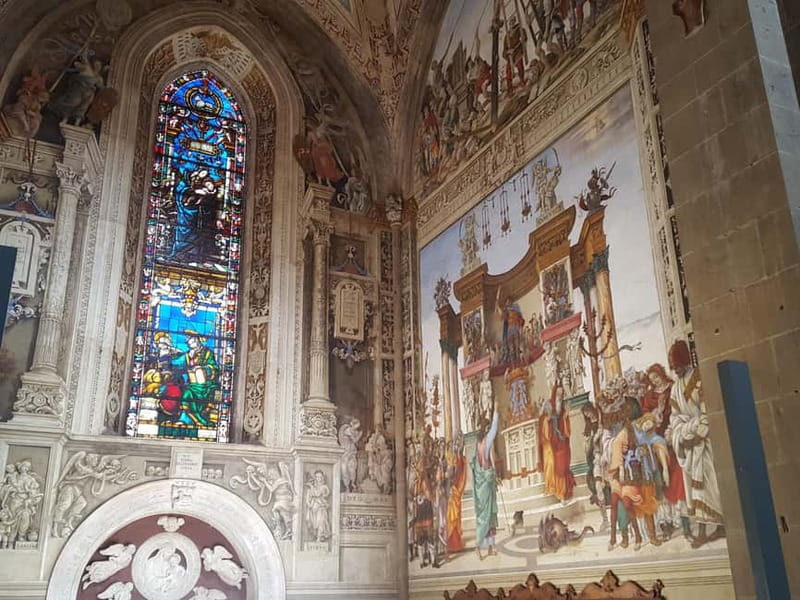
Santa Maria Novella is not laid out like a neat, single-gallery museum. It’s more like a conversation across chapels, cloisters, and changing architectural styles. With the no-wait access and audio pacing, you can follow that conversation without being trapped in a crowd.
The façade and what it signals
You begin beneath the iconic façade that inspired Michelangelo. Even before you’re fully inside, it gives you the right expectation: this church isn’t “plain and old.” It has ambition. You’re walking into a place designed to communicate meaning, power, and faith.
With an audio guide in your ear, more of Florence

Romanesque/Gothic to Renaissance harmony
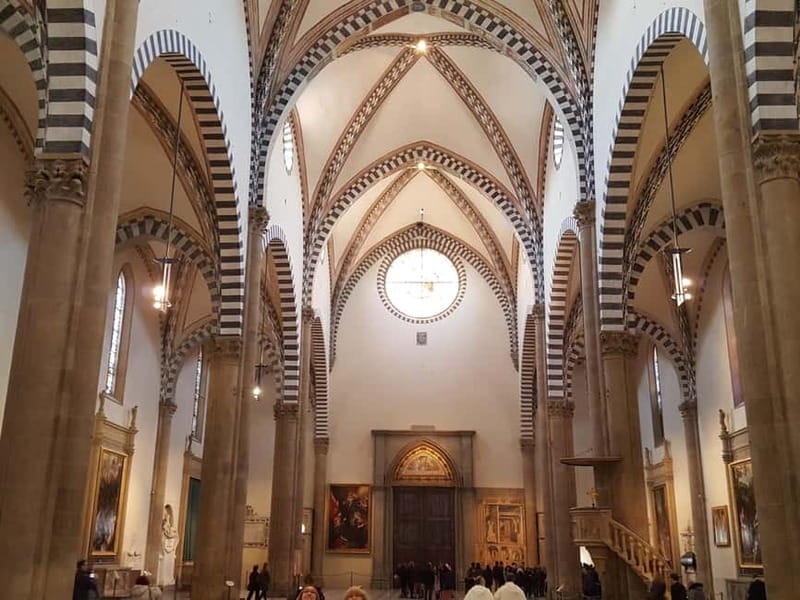
Inside, the building shifts in feel. Romanesque and Gothic forms meet Renaissance order and balance. The audio helps you notice this transition rather than treating it as background decoration.
Look for how the space directs you—where your eye is guided as the architecture and artwork gradually align into a more Renaissance way of thinking.
Masaccio’s Trinità: when painting starts behaving differently
Masaccio’s Trinità is the kind of work that changes how you see painting. The audio highlights why it was revolutionary—this is about a new approach to realism and structure, not just religious imagery.
When you’re in front of it, take a slow moment. You’re training your eye to see how Renaissance artists built convincing space and emotional intensity into religious subjects.
Giotto’s Crucifix: emotion you can actually feel
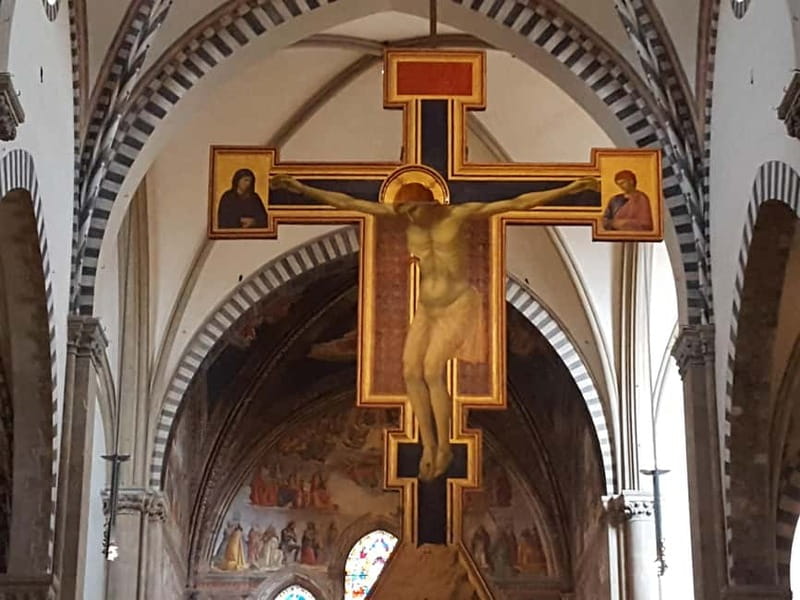
Giotto’s Crucifix is another anchor. This is where the church narrative turns human. The audio frames why the work hits emotionally—Giotto’s style often aims at clarity and feeling rather than distance.
Again, pause. Don’t rush to the next room. Let the emotional center land before you move on.
Brunelleschi’s reinterpretation: structure with personality
The visit also points you toward Brunelleschi’s elegant reinterpretation. Even if you don’t know the technical vocabulary, you can usually sense what the narration is pointing to: an interest in proportion, order, and reasoned design—Renaissance ideas made visible in stone and form.
If the space feels more controlled than you expected, that’s the point. You’re seeing Renaissance thinking at work in a religious setting.
The Tornabuoni Chapel and Ghirlandaio’s human drama
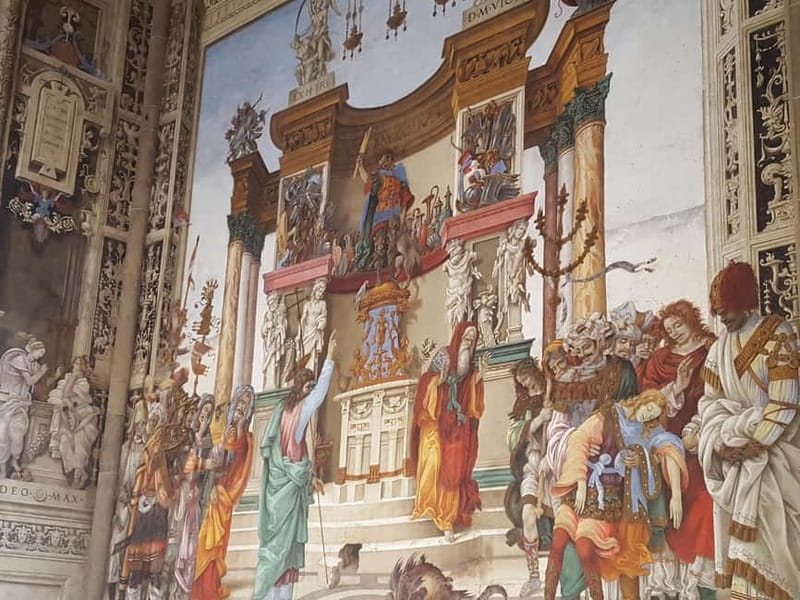
One of the strongest “stop and stay” parts is the Tornabuoni Chapel, featuring Ghirlandaio. The audio connects the work to Ghirlandaio as a mentor to young Michelangelo, which is a helpful way to understand the lineage of Florentine art.
When you’re inside this kind of chapel, look for how the artwork handles people—emotion, faces, body language. The story aspect of the audio guide really helps here because it gives you context for what you’re seeing beyond surface beauty.
Cloisters and chapels: calm spaces with historical weight
After the chapel-focused highlights, you move through cloisters and into chapels with ancient frescoes. The pace feels different here—more open, quieter, and easier to absorb.
I like the cloister section because it breaks the intensity. It also helps you understand the Dominican setting as lived space, not just an art display. You’re seeing the “in-between” areas where people once moved in and out of daily religious life.
Botticelli’s Nativity: intimacy, not spectacle
Botticelli’s Nativity is described as intimate, and that’s the right mindset. Instead of looking for large-scale drama, let your attention rest on how the work communicates closeness—religious story presented as something human-sized.
The audio makes this better by giving you a way to interpret what feels gentle or personal in the composition.
Paolo Uccello’s Green Cloister: a visual mood
Paolo Uccello’s Green Cloister is part of the route, and it’s known here by its ethereal character. That word choice matters: you should treat this as a place to slow down and watch how the space affects your eye.
If you tend to rush through architectural features, this is where you’ll benefit from actually listening and pausing, because the “mood” is part of the point.
Strozzi and Medici stories: who had power, and what they bought
The audio guide also brings in the political and social story—how artists were commissioned and how elite families shaped what you see. You’ll hear about the Strozzi and Medici, plus the broader connection between upper-class portraits and Renaissance life.
For me, this is one of the most valuable parts of the tour. Art in Florence isn’t just art; it’s a record of ambition. When you understand that, even famous names feel newly alive.
A one-of-a-kind selfie moment
The experience includes a selfie opportunity, the kind of spot that makes it easier to create a memorable photo without standing in random tourist traffic. I won’t guess where it is, because the exact framing depends on the internal flow and what’s permitted at the moment you arrive. But treat it as a prompt: keep your camera ready and ask yourself where the composition looks best.
The Santa Maria Novella district itinerary: extend the day beyond the basilica
This visit isn’t only about what’s inside. You also get a Florence city app guide with exclusive alternative itineraries, including one dedicated to uncovering the hidden gems of the Santa Maria Novella district—the historic center area you can admire outside the basilica’s doors.
Here’s the practical value: once you learn how the neighborhood’s faith and power influenced art, it makes sense to walk the streets afterward. You’ll understand what you’re seeing from street level: the context that art history books usually skip.
Even if you’re not turning it into a full second walk, the app can help you pick where to go next so you don’t just wander until you’re tired.
Practicalities that affect your enjoyment (and save you time)
A few practical details make or break this kind of visit:
- Wear comfortable shoes. You’ll be standing and walking around chapels and cloisters.
- Dress for a church: no shorts or sleeveless tops.
- Flash photography isn’t allowed. Plan on using normal camera/phone lighting and avoid blinding others.
Because this is self-guided, your timing is in your hands. If you’re the type who likes to read every inscription, you might stretch the 2 hours. If you’re more of a “listen, look, move” person, you’ll get a clean, satisfying circuit.
Also, if you’re expecting a live guide to interpret everything for you, adjust your expectations. There is a portable audio guide, but no physical guide is included.
Price and value: is $29 a smart buy for Santa Maria Novella?
At $29 per person for a 2-hour visit, the value is mainly in two places: priority access and the official portable audio guide. If you tried to do this on your own, you’d likely lose time at entry and you’d spend extra effort figuring out what matters most inside.
This ticket also includes entry to the basilica and cloisters, plus agency fees and a pre-booking reservation. For a top-tier Florence church, that adds up to a low-friction experience. You’re not paying just for the right to enter; you’re paying to make the visit feel purposeful.
Is it worth it if you love wandering slowly? If you like museum-label reading and you already know the major artists and themes, you might not need the audio. But if you want your time spent standing in the right places while someone helps you interpret what you’re seeing, this price looks fair.
Who this is best for (and who should think twice)
This works well if you:
- want to see major artworks without feeling trapped in a crowd
- like having context while you look
- prefer controlling your own pace
- enjoy architecture and chapels, not just one “main” highlight
Think twice if you:
- need wheelchair access (it is not suitable for wheelchair users)
- want a person to answer questions on the spot
- dislike self-guided experiences where you manage your route and timing
It’s also a good fit for first-time Florence visitors who want something meaningful but manageable—2 hours, targeted highlights, and clear instructions to find the meeting point.
Should you book Best of Santa Maria Novella Basilica: No-Wait Audio Tour?
If you want a smoother entry, a focused look at the biggest names, and stories connecting art to faith and elite patronage, I’d book it. The audio guide approach is the heart of the value, and the way it supports your eye—Masaccio, Giotto, Botticelli, Paolo Uccello, and the chapel spaces—makes your visit feel like more than a quick walk-through.
If you prefer a full guided lecture or need wheelchair-friendly access, then it’s not the best match. For everyone else, it’s a smart way to experience Santa Maria Novella with less waiting and more meaning per minute.
FAQ
Where is the meeting point for this tour?
You meet at Piazza Stazione nr. 4 (behind the Basilica), at the Ticket Office.
How long does the experience last?
The duration is 2 hours.
What do I get with the ticket?
You get entry to Santa Maria Novella Basilica and Cloisters, priority access, and an official portable audio guide, plus a Florence city app guide with an alternative itinerary.
Do I need to use my phone or bring earphones?
No. The portable audio guide is provided, and no mobile applications or personal earphones are required for the audio experience.
Is there a live guide with you?
No. This is self-guided, and no physical guide is included.
Can I take photos with flash?
No. Flash photography is not allowed.
Is this tour suitable for wheelchair users?
No. It is not suitable for wheelchair users.
What if I need to cancel?
Free cancellation is available up to 24 hours in advance for a full refund.
More Self-Guided Florence
- Florence: Timed Entry to Michelangelo’s David + Audio App
★ 4.6 · 19,496 reviews - Florence: Uffizi Priority Ticket & Masterpieces Audio App
★ 4.2 · 6,402 reviews - Florence: Uffizi Gallery Timed Entry Ticket & Audio Guide
★ 4.2 · 2,794 reviews - Florence: Michelangelo’s David Entrance Ticket and Audio App
★ 4.3 · 1,901 reviews - Florence: Uffizi & Accademia Priority Tickets with Audio App
★ 4.4 · 1,253 reviews
More Florence Tours to Weigh Up
- The Best tour in Florence: Renaissance & Medici Tales – guided by a STORYTELLER
★ 5.0 · 12,316 reviews - The Best Tour in Florence: Renaissance and Medici Tales
★ 5.0 · 10,810 reviews - Florence: Chianti Wineries Tour with Wine Tasting
★ 4.5 · 10,071 reviews - Florence: Duomo Cathedral 60-Minute Guided Tour
★ 3.7 · 6,829 reviews - Florence: Hop-on Hop-off Bus Tour: 24, 48 or 72-Hour Ticket
★ 4.0 · 6,283 reviews
More Florence Tours We Have Reviewed
- Florence: Skip-The-Line Uffizi Gallery Timed Entry Ticket
★ 4.5 · 27,832 reviews - Tuscany Day Trip from Florence: Siena, San Gimignano, Pisa and Lunch at a Winery
★ 5.0 · 21,634 reviews - Florence: Timed Entry to Michelangelo’s David + Audio App
★ 4.6 · 19,496 reviews - Florence: Leonardo Interactive Museum Entry Ticket
★ 4.5 · 12,957 reviews - Florence: Michelangelo’s David Skip-the-Line Entry Ticket
★ 4.5 · 12,764 reviews
Fresh from our Florence review desk
- Small-Group Pasta Cooking Class and Market Tour in Florence★ 5.0 · 3 reviews
- Palatina Gallery and Pitti Guided Tour in Florence★ 5.0 · 3 reviews
- Tuscan Evening Tour: Fiat 500, 8:30 to 10 PM★ 5.0 · 3 reviews
- Journey into Art: Florence’s Accademia★ 4.5 · 3 reviews
- Paint and Drink Florentine Hills★ 5.0 · 3 reviews
- Truffle hunting and lunch experience, with Vinci and winery.★ 4.5 · 3 reviews
Audio Tours, compared.
 ★ 4.6Timed Entry to Michelangelo’s David + Audio AppFrom $3319,496 reviews
 ★ 4.2Uffizi Priority Ticket & Masterpieces Audio AppFrom $316,402 reviews
 ★ 4.2Uffizi Gallery Timed Entry Ticket & Audio GuideFrom $332,794 reviews
 ★ 4.3Michelangelo’s David Entrance Ticket and Audio AppFrom $381,901 reviews
 ★ 4.4Uffizi & Accademia Priority Tickets with Audio AppFrom $921,253 reviews
 ★ 4.6Eco-Friendly Golf Cart City Tour with Audio GuideFrom $671,094 reviews
 ★ 4.4Palazzo Vecchio Entry Ticket with Audio GuideFrom $36837 reviews
 ★ 3.5Florence Duomo Cathedral with Host & Audio Guide (Interior Only)From $7702 reviews
Browse the lists this tour appears in