
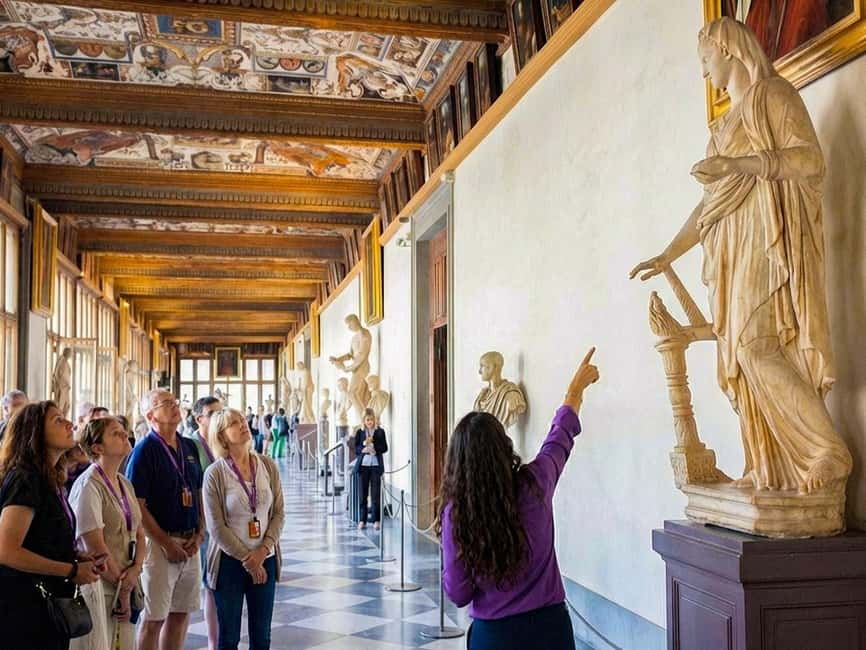
Reviewed · UFFIZI GALLERY TOURS
Florence: Small Group Uffizi Tour – Untold Stories
Botticelli hides puzzles in plain sight. This small-group Uffizi tour turns Renaissance art into something you can actually read, using hidden geometry and symbolic clues to explain what you’re seeing. You’ll walk away with answers for why figures look posed, why scenes feel uneasy, and why some details matter more than the obvious beauty.
I especially like how the guide makes technique feel practical. You’ll get solid explanations for Leonardo’s optics and Michelangelo’s anatomy, not just a list of famous works. The priority entry also helps—less time in line means more time with the paintings.
One consideration: this tour is intellectually intensive. If you want a casual, slow stroll with light commentary, the focus on iconography, philosophy, and technique may feel like a lot in 1.5–2 hours.
In This Review
- Key takeaways
- Enter the Uffizi with a “read-the-painting” mindset
- Getting there: Piazzale degli Uffizi, Door #3, and the Leonardo statue
- Stop 1: Giotto’s Ognissanti Madonna and the idea of visual gravity
- Botticelli’s halls: Venus, but also Neoplatonism and the sadness behind the faces
- Leonardo’s Annunciation: optics, anatomy tricks, and the idea of painting air
- Michelangelo’s Tondo Doni: serpentine bodies and cangiante power
- Raphael’s Madonna of the Goldfinch: the High Renaissance feel-good ending
- Uffizi Terrace and Brunelleschi’s Dome: a break that pays off
- The real value of $35 for 1.5–2 hours
- Who should book this Uffizi tour
- A practical tip: plan time to go back in on your own
- Should you book? My take
- FAQ
- How long is the Florence small group Uffizi tour?
- Where do we meet for the Uffizi tour?
- Does the tour include skip-the-line access?
- What language is the guide?
- Is the tour wheelchair accessible?
- Is it free cancellation, and can I reserve without paying now?
Key takeaways
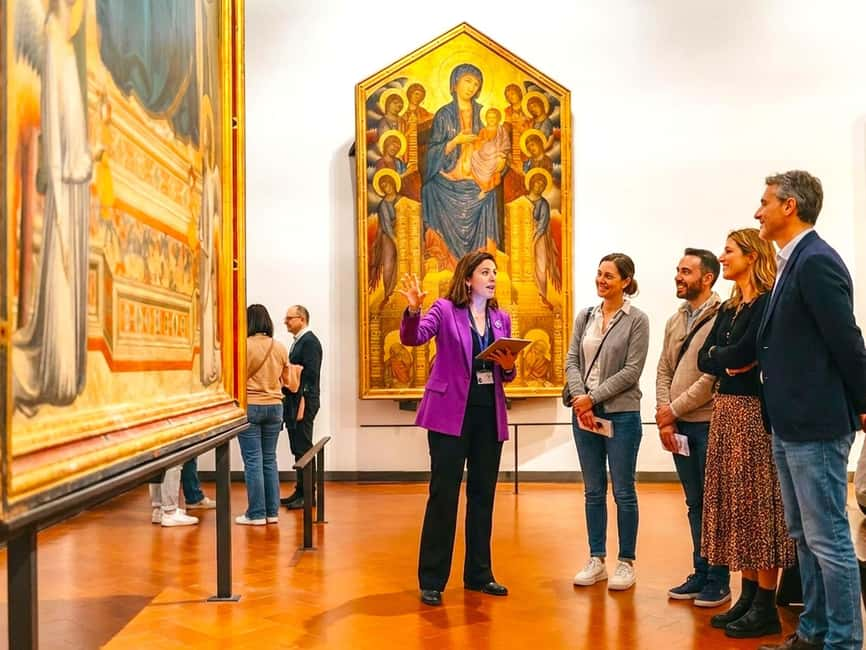
- Pagan symbolism meets Christian meaning in the Renaissance, with clear examples tied to specific masterpieces
- Leonardo’s visual tricks are explained as optics, including a perspective detail designed for a specific viewing angle
- Michelangelo’s human body as math and motion, with figura serpentinata and color choices like cangiante
- Botticelli as more than Venus, using Neoplatonism and Simonetta Vespucci to decode mood and symbolism
- Uffizi Terrace gives you a real break with a view of Brunelleschi’s Dome
More ways into the Uffizi, ranked by Florence visitors
Enter the Uffizi with a “read-the-painting” mindset
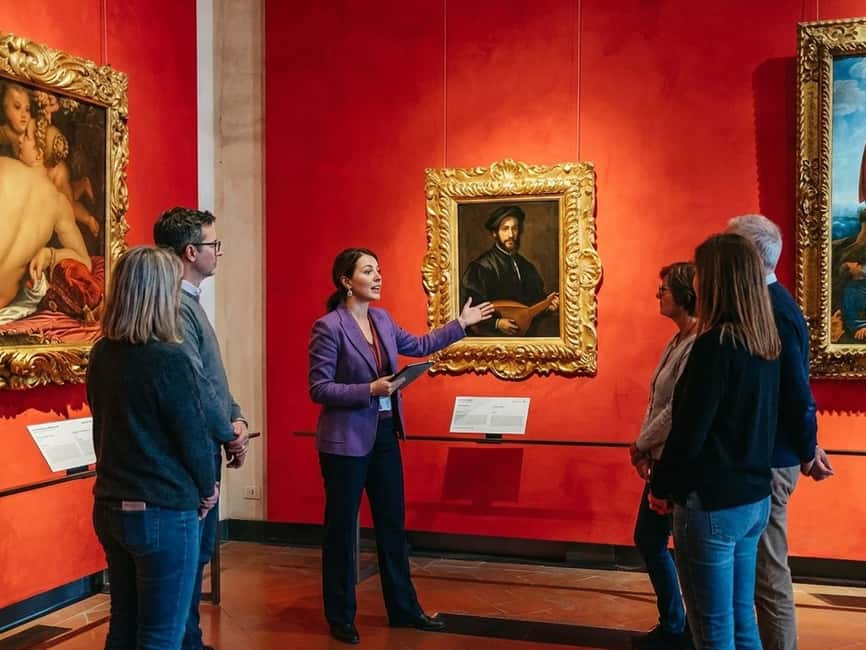
The Uffizi can feel like a lot—bright rooms, famous names, and a fast-moving crowd. What makes this tour work is the way it changes your job from admiring to interpreting. Instead of treating Botticelli, Leonardo, and Michelangelo like distant giants, the guide gives you tools to notice what they’re doing on purpose.
You’ll spend your time on major works, yes. But the real value is the focus on meaning and method: iconography (what symbols mean), philosophy (how ideas shape art), and technique (how forms and colors are built). That combination is what makes the Uffizi stop being a check-the-box museum day.
Also, you get the practical win of priority entry and a separate entrance for faster access. With a tour lasting only about 1.5–2 hours, every minute inside the gallery counts.
Getting there: Piazzale degli Uffizi, Door #3, and the Leonardo statue
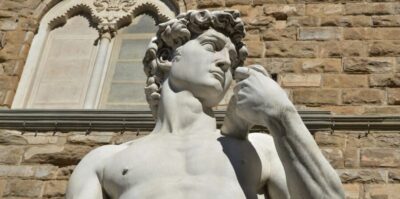
Plan to meet at Piazzale degli Uffizi, 1, in the courtyard on the right side of the Uffizi entrance. You’ll look for a representative holding a Florence with Locals Tours flag under the statue of Leonardo da Vinci. The statue sits opposite Door #3 of the gallery.
Two practical points that matter:
- There’s no hotel pickup, so you’ll be doing your own transit to the meeting spot.
- The tour runs on a tight schedule, so aim to arrive a bit early to find the right location and settle your bearings.
The group setup is private or small groups available, so you’re not stuck in a massive cattle line. That matters at the Uffizi, where your ability to see details depends on how close you can get.
Stop 1: Giotto’s Ognissanti Madonna and the idea of visual gravity
The tour starts by placing you at the point where Western painting starts acting more like the real world. You begin with Giotto’s Ognissanti Madonna, where the key lesson is that the artwork gives the holy figure physical weight—a shift toward presence.
Why this matters for you: Renaissance art can look mysterious until you realize it’s reacting to earlier changes. Starting with Giotto helps your brain understand a timeline of observation and realism. It also sets up the tour’s bigger theme: artists weren’t just decorating. They were solving problems—how to make images feel convincing, how to guide your eye, and how to communicate ideas without words.
If you like art explanations that connect style to reason, this first stop does that job well.
Botticelli’s halls: Venus, but also Neoplatonism and the sadness behind the faces
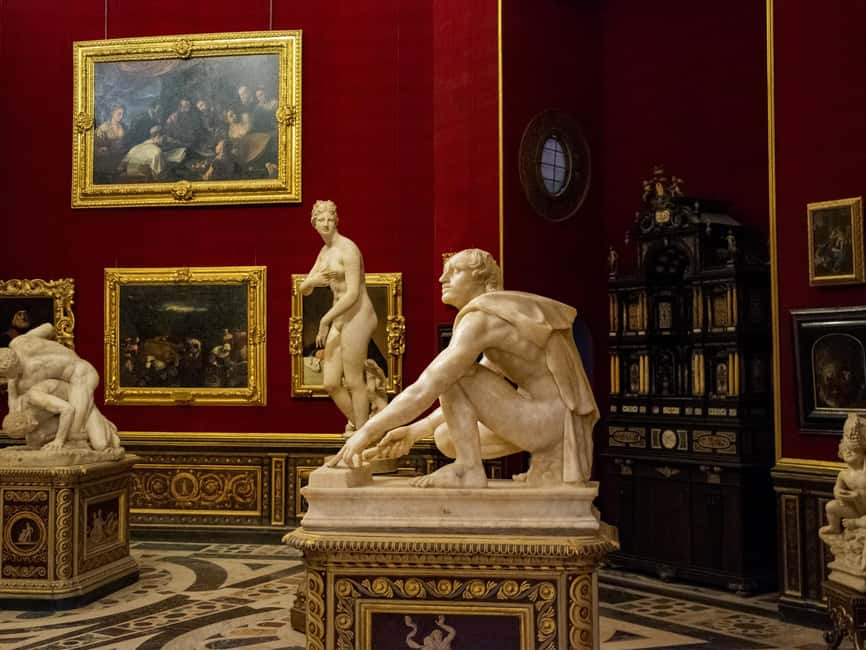
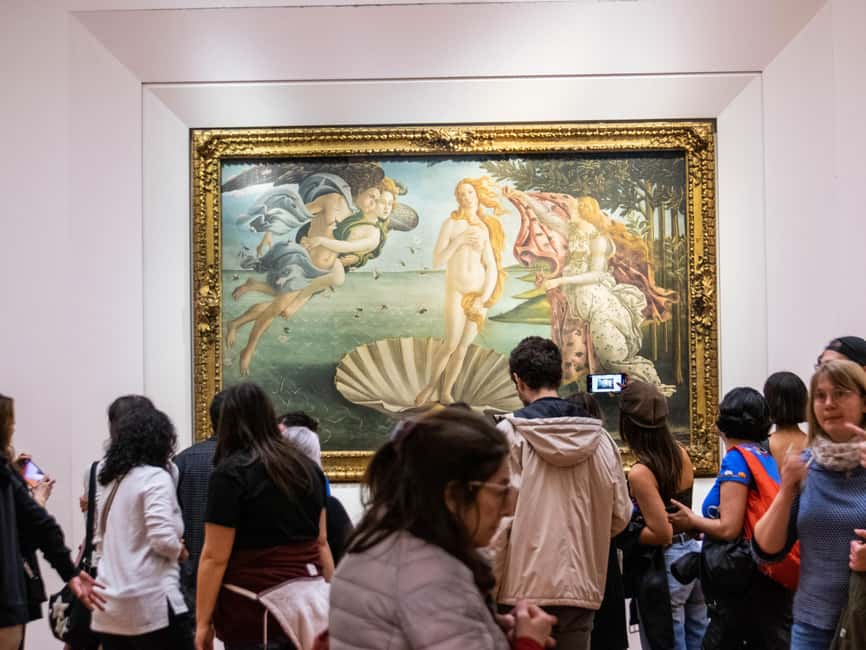
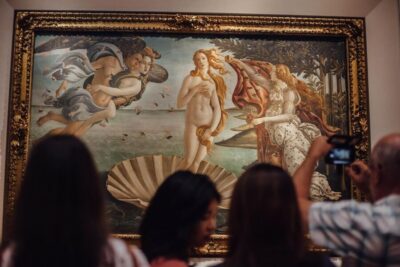
When you move into Sandro Botticelli’s main rooms, the tour makes a smart choice. It doesn’t treat The Birth of Venus or Primavera as pop-culture posters. Instead, it treats them like philosophical projects.
You’ll learn a way to read Primavera that goes beyond mythology as entertainment. The guide frames it as a complex treatise connected to Neoplatonism—the attempt to reconcile ancient Greek mythology with Christian thought. That’s a big deal because it explains why the scenes feel layered. The “meaning” isn’t just in who’s standing where. It’s in the worldview the painting is trying to express.
Then comes the emotional thread: Simonetta Vespucci, often described as the Queen of Beauty, and the way her early death seems to haunt Botticelli’s faces. The tour links her likeness to both Venus and the Virgin Mary, and connects that to the Renaissance obsession with melancholy.
Here’s what I’d watch for as you listen:
- How beauty can be presented with distance, not joy
- How the mood of a face can become a symbol
- How the same ideal image can appear in sacred and pagan contexts
And here’s the practical benefit: once you understand Botticelli’s mood-language, other details start making sense. You stop asking only what you recognize—and start asking why the artist chose that look.
Leonardo’s Annunciation: optics, anatomy tricks, and the idea of painting air
Next you shift from Botticelli’s symbolic world to Leonardo’s world of observation and math. Standing before The Annunciation, you’re not just told what happens in the scene. You’re taught to watch how Leonardo creates credibility.
The tour highlights optics—how sightlines and perspective shape what you experience. One of the most memorable parts is an explanation of an anatomical distortion in the Virgin Mary’s arm. The guide presents it as a perspective trick designed for a specific viewing angle, showing that Leonardo cared about the geometry of seeing more than traditional expectations.
Then you get a lesson that feels almost modern: how Leonardo painted the air. You’ll examine the hazy, atmospheric background and learn how it separates him from artists who came before. The atmosphere isn’t just background texture. It’s a way of organizing depth and creating a sense of space that feels lived-in.
For you, this is a confidence builder. After listening, you’ll understand that “softness” and “haze” are not accidental. They’re tools.
If you like when art history comes with a little science, this is the segment that usually wins people over.
- The Best tour in Florence: Renaissance & Medici Tales – guided by a STORYTELLER
★ 5.0 · 12,316 reviews



Michelangelo’s Tondo Doni: serpentine bodies and cangiante power
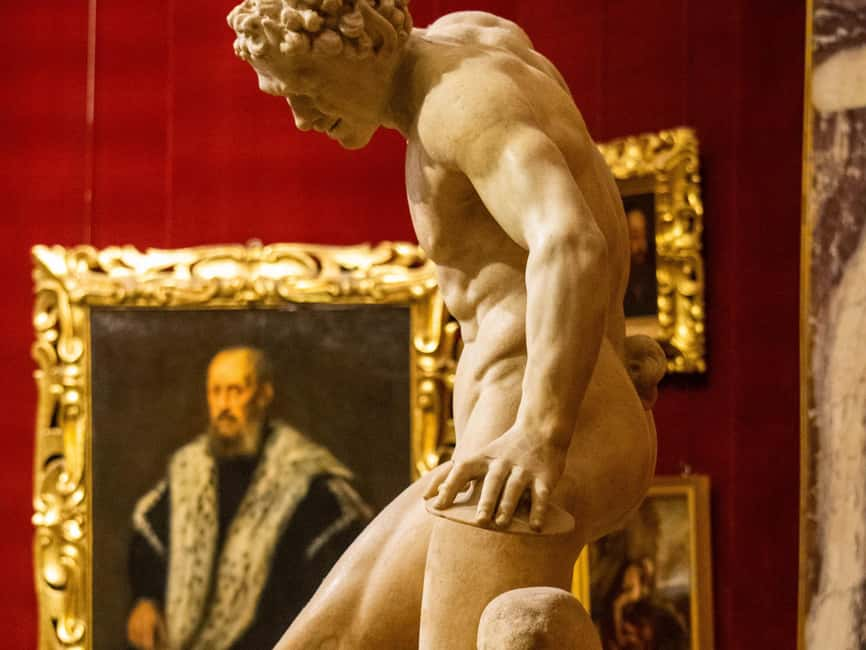
Then the tour moves into Michelangelo territory, and it doesn’t go timid. You’ll look at the Tondo Doni, described as the only finished panel painting by Michelangelo in the world. That alone gives the stop weight, but the guide focuses on what Michelangelo was trying to prove through the human form.
The centerpiece concept is figura serpentinata—the serpentine figure. The tour frames it as evidence of Michelangelo’s unmatched knowledge of human anatomy and how bodies can twist with force while staying believable.
Color also gets attention. You’ll hear about cangiante, meaning changing colors—paired with vivid choices like neon oranges and metallic tones that reject naturalism in favor of raw power. The guide explains that these choices anticipate the coming Mannerist movement, where artists intentionally bend classical expectations.
Here’s the practical way to enjoy this section:
- Don’t only stare at the most dramatic pose. Look for how the body’s structure supports it.
- Notice where color feels “too intense” for realism—because the tour makes a case that it’s deliberate emphasis, not a failure to match reality.
- Listen for the difference between what Michelangelo depicts and what he’s really doing to your eye.
After Michelangelo, you’ll understand the tour’s headline promise: technique, not trivia.
Raphael’s Madonna of the Goldfinch: the High Renaissance feel-good ending
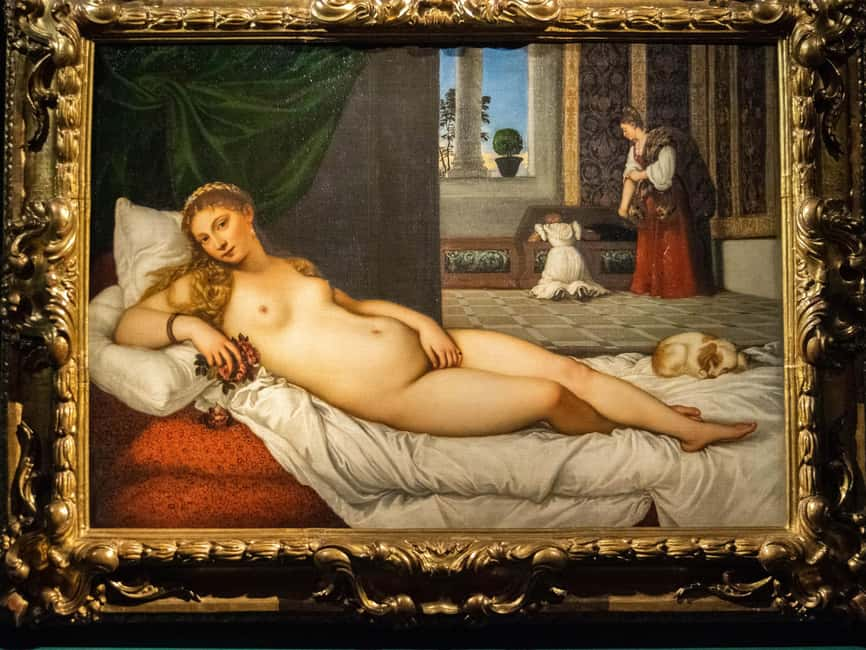
By the time you reach Raphael’s Madonna of the Goldfinch, the tour brings you to resolution. After the torment of Michelangelo and the puzzle of Leonardo, Raphael is presented as the artist who achieves balance.
The guide explains how Raphael synthesizes methods from his rivals to create a defining High Renaissance style. For you, the takeaway is that Raphael’s calm isn’t boring. It’s designed—an equilibrium built from earlier breakthroughs.
If you tend to prefer harmony over drama, this is where you’ll feel your brain exhale.
Uffizi Terrace and Brunelleschi’s Dome: a break that pays off
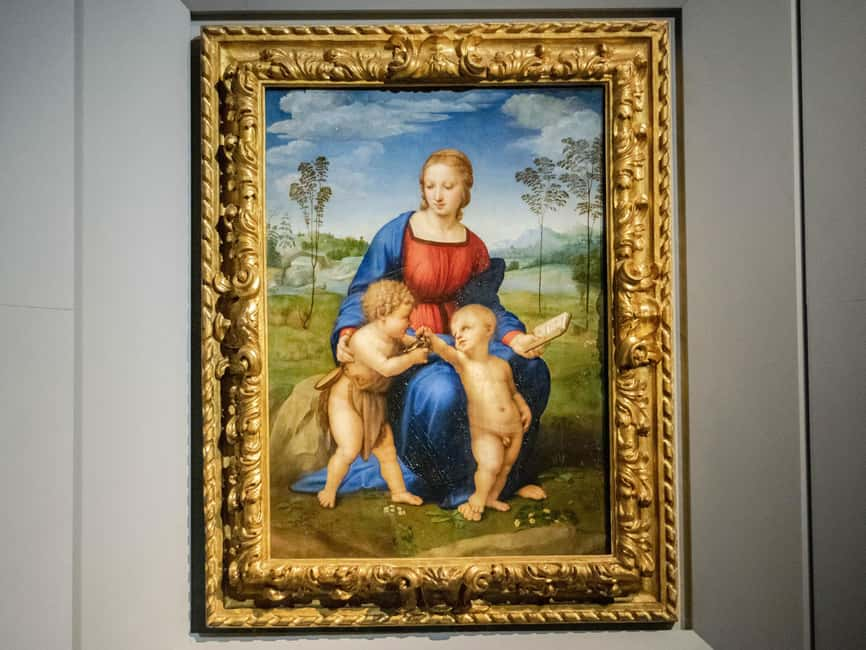
One of the listed highlights is a view of Brunelleschi’s Dome from the Uffizi Terrace. You get that outside-the-paintings moment, which is smart. After 1.5–2 hours of symbol-work and technique talk, a skyline view helps reset your perspective.
Also, it helps you connect the art to the city. Florence isn’t just a backdrop. Renaissance ideas were being argued and built right here, and the terrace view makes that feel real.
And yes, the tour stays focused enough that you’ll still have energy to explore afterward.
The real value of $35 for 1.5–2 hours
At $35 per person for 1.5–2 hours, this isn’t priced as a bargain, but it also isn’t priced like a premium luxury experience. The value comes from three things:
1) Time inside the Uffizi matters. The faster entry helps you spend more minutes with paintings instead of waiting.
2) You get explanation that changes how you look. Iconography, optics, and anatomy-focused technique turn famous works into something you can read.
3) The group format stays human. Small-group or private options keep you from feeling rushed or blocked.
If you’re the type who remembers art because someone taught you how to see it, this price is easier to justify. If you just want to wander and skim, a self-guided visit might cost less and feel more relaxed. But if you want meaning, this tour is built for that.
Who should book this Uffizi tour
This tour is a great fit if you:
- Want Botticelli, Leonardo, and Michelangelo explained through symbols and technique
- Like art commentary that connects philosophy to what you see
- Enjoy a tour with enough mental push to feel satisfying, not sleepy
I’d be cautious if you:
- Want a casual museum experience with minimal analysis
- Prefer lots of free time in one room instead of moving through major works with guided interpretation
It also helps to know that the tour is in English with a live guide, and it’s wheelchair accessible. If you need a private or small-group option, that’s available.
A practical tip: plan time to go back in on your own
One pattern I like for museum days in Florence: take the guided hit, then return to favorite rooms with fresh context. The tour’s packed schedule is designed to give you a framework fast. After the guided portion, you’ll understand what to look for if you stay longer.
My advice: once the tour ends, don’t rush out. Give yourself time to see the works again without the pressure of the next stop. You’ll catch details you couldn’t notice while listening.
Should you book? My take
If you’re heading to the Uffizi for the big names and you want more than surface-level facts, this is the kind of tour that pays you back. The strongest parts are the symbol decoding in Botticelli, the optics and perspective thinking around Leonardo, and the anatomy-and-color logic in Michelangelo.
It’s also worth booking if you’re short on time and want priority entry to reduce wasted waiting. For a first Uffizi visit, you’ll get a guided map for how to read Renaissance art.
If your idea of a great museum day is quiet wandering, you might feel mentally crowded in 1.5–2 hours. But if you like your art explanations sharp and specific, you’ll probably leave the Uffizi seeing the paintings differently.
FAQ
How long is the Florence small group Uffizi tour?
The tour lasts about 1.5–2 hours, depending on the starting time you choose.
Where do we meet for the Uffizi tour?
Meet at Piazzale degli Uffizi, 1, in the courtyard on the right side of the Uffizi Gallery entrance. Look for your representative holding a Florence with Locals Tours flag under the Leonardo da Vinci statue, opposite Door #3.
Does the tour include skip-the-line access?
Yes. The experience includes priority entry tickets and skip the line through a separate entrance.
What language is the guide?
The live tour guide speaks English.
Is the tour wheelchair accessible?
Yes, the tour is listed as wheelchair accessible.
Is it free cancellation, and can I reserve without paying now?
The tour offers free cancellation up to 24 hours in advance for a full refund, and there is reserve now & pay later (you can book a spot and pay nothing today).
More Florence Tours to Weigh Up
- The Best tour in Florence: Renaissance & Medici Tales – guided by a STORYTELLER
★ 5.0 · 12,316 reviews - The Best Tour in Florence: Renaissance and Medici Tales
★ 5.0 · 10,810 reviews - Florence: Chianti Wineries Tour with Wine Tasting
★ 4.5 · 10,071 reviews - Florence: Duomo Cathedral 60-Minute Guided Tour
★ 3.7 · 6,829 reviews - Florence: Hop-on Hop-off Bus Tour: 24, 48 or 72-Hour Ticket
★ 4.0 · 6,283 reviews
More Florence Tours We Have Reviewed
- Florence: Skip-The-Line Uffizi Gallery Timed Entry Ticket
★ 4.5 · 27,832 reviews - Tuscany Day Trip from Florence: Siena, San Gimignano, Pisa and Lunch at a Winery
★ 5.0 · 21,634 reviews - Florence: Timed Entry to Michelangelo’s David + Audio App
★ 4.6 · 19,496 reviews - Florence: Leonardo Interactive Museum Entry Ticket
★ 4.5 · 12,957 reviews - Florence: Michelangelo’s David Skip-the-Line Entry Ticket
★ 4.5 · 12,764 reviews
The Uffizi, A Few More Ways In
- Florence: Skip-The-Line Uffizi Gallery Timed Entry Ticket
★ 4.5 · 27,832 reviews - Florence: Uffizi Priority Ticket & Masterpieces Audio App
★ 4.2 · 6,402 reviews - Uffizi Gallery: Renaissance Masterpieces Guided Tour
★ 4.6 · 6,070 reviews - Uffizi Gallery Small Group Tour with Guide
★ 4.5 · 4,923 reviews - Uffizi & Accademia Timed Entry: Small Group Duomo Walking Tour
★ 4.5 · 3,630 reviews
Fresh from our Florence review desk
- Small-Group Pasta Cooking Class and Market Tour in Florence★ 5.0 · 3 reviews
- Palatina Gallery and Pitti Guided Tour in Florence★ 5.0 · 3 reviews
- Tuscan Evening Tour: Fiat 500, 8:30 to 10 PM★ 5.0 · 3 reviews
- Journey into Art: Florence’s Accademia★ 4.5 · 3 reviews
- Paint and Drink Florentine Hills★ 5.0 · 3 reviews
- Truffle hunting and lunch experience, with Vinci and winery.★ 4.5 · 3 reviews
Uffizi Gallery Tours, compared.
 ★ 4.5Skip-The-Line Uffizi Gallery Timed Entry TicketFrom $3027,832 reviews
 ★ 4.2Uffizi Priority Ticket & Masterpieces Audio AppFrom $316,402 reviews
 ★ 4.6Uffizi Gallery: Renaissance Masterpieces Guided TourFrom $886,070 reviews
 ★ 4.5Uffizi Gallery Small Group Tour with GuideFrom $764,923 reviews
 ★ 4.5Uffizi & Accademia Timed Entry: Small Group Duomo Walking TourFrom $503,630 reviews
 ★ 4.2Uffizi Gallery Timed Entry Ticket & Audio GuideFrom $332,794 reviews
 ★ 4.8Uffizi Gallery and Accademia Gallery Guided TourFrom $1402,028 reviews
 ★ 4.7Uffizi Gallery Small-Group Guided Tour with TicketFrom $762,003 reviews
Browse the lists this tour appears in