
Reviewed · FLORENCE
The not-touristy Florence with Camilla, local art historian
Florence can feel like a theme park when you stick to the big sights. This private walk routes you through the quieter parts that still feel unmistakably Florentine, with an art historian guide named Camilla. I love how the whole tour is built around religious and medieval stops that change the way you read the city.
Two things I especially like: Camilla’s approach to art history feels clear and personal, not lecture-y, and the route avoids crowd traps by choosing squares and churches that most visitors skip. I also like that the pace is designed for thinking, not rushing.
One possible drawback: it depends on good weather, and it’s a walking tour. If you’re hoping for a low-effort, all-indoor experience, this won’t be the right fit.
In This Review
- Key things that make this tour worth your time
- Why this not-touristy Florence walk feels different
- Meet Camilla: an art historian guide you can actually follow
- Your two-hour route from Piazza Santa Croce to Santa Trinita
- Stop 1: Piazza Santa Croce for art, beauty, and flowers
- Stop 2: Piazza San Firenze and the quieter corners
- Stop 3: Piazza della Repubblica, crossing Dante’s district, and medieval rules
- Stop 4: Basilica di Santa Trinita for a quiet, reflective finish
- Price and what about $610 buys you in Florence
- Timing, weather, and how to plan without overthinking
- Who this tour is best for
- Should you book this Camilla walk?
- FAQ
- How long is the Florence not-touristy walking tour?
- What does the tour cost?
- Is this a private tour or a group tour?
- Who is the guide?
- Where does the tour start and end?
- What ticket do I receive?
- What stops are included during the walk?
- Is the tour affected by weather?
- What is the cancellation policy?
Key things that make this tour worth your time
- Camilla, a local art historian: you get context that helps you “see” what you’re standing in front of
- Small-group size (max 15): enough attention for real questions, without feeling crowded
- Off-the-main-path route: medieval squares and churches beyond the loudest walking circuits
- A religious finish at Santa Trinita: you end somewhere quieter and more reflective
- A route with narrative links: Dante’s district, Beatrice, and medieval rules of life connect the dots as you walk
Still comparing? These are the other Florence tours travellers book most.
Why this not-touristy Florence walk feels different
Florence is full of art, sure. But it’s also full of everyday texture: squares that held debates, churches that shaped routine, and neighborhoods where ideas circulated like gossip. This tour leans into that lived-in side of the city.
What makes it work is the combination of guide skill and stop selection. The route starts with major Florentine landmarks, then gradually shifts into places that feel more local than postcard. You spend your time where stories stick—especially around art, religion, and the medieval world that built Florence’s “why.”
If you’re the type who gets tired of hearing the same three facts outside the same three facades, you’ll likely appreciate the way Camilla connects what you see to what people believed, made, and feared.
Meet Camilla: an art historian guide you can actually follow
Camilla is a local art historian, and that matters. In Florence, you’ll see a lot of stone. The question is whether the stone has a story in your head while you look at it. Camilla’s job is to make that happen.
Based on what people highlight most, the strongest part is how Camilla explains art with meaning. The vibe isn’t about memorizing dates. It’s about learning how Florence’s religious sites, public squares, and artistic culture connect. That’s why a private walking format helps: you can pause, ask, and keep your attention on what’s in front of you.
You’ll also feel that her passion comes through. It’s the difference between a guide reading notes and a guide genuinely caring whether you “get it.”
Your two-hour route from Piazza Santa Croce to Santa Trinita
This experience runs about two hours, on foot, with a small group capped at 15. You start at Piazza di Santa Croce, then move through central medieval areas and end at Basilica di Santa Trinita in the adjacent piazza.
The tour is set up as a sequence of short stops with walking between them. Those short time windows are useful in Florence because you don’t overstay in any one spot. You get enough time to orient your brain, but the pacing keeps you from burning out while standing in the sun.
Also, you’ll get a mobile ticket, so you can keep things simple on your phone and spend less time juggling paper.
Stop 1: Piazza Santa Croce for art, beauty, and flowers
You begin at Piazza Santa Croce (Piazza di Santa Croce, 13) and get an intro that frames Florence through three lenses: art, beauty, and flowers. It’s a smart opener because it sets expectations for the rest of the walk.
Why this first stop matters: Florence’s identity is tied to more than famous paintings. It’s tied to how people decorated everyday life, expressed devotion, and used art as a form of public language. Even if you’ve visited Santa Croce before, starting here with context changes what you notice next.
Time on site is about 10 minutes. That’s short enough to keep momentum, but long enough to get a mental map. If you’re someone who likes to understand the “theme” of a tour before you wander, this works.
Possible consideration: since it’s the start, you may want to arrive a few minutes early. Florence can be a maze at the edges of major squares, and you’ll get more out of the intro if you’re already settled.
Stop 2: Piazza San Firenze and the quieter corners
Next you move to Piazza San Firenze, where the tour focuses on hidden and unmissable local character—small civic rhythms and church-adjacent atmosphere rather than the loudest tourist circuit.
This stop is listed for about 10 minutes. That matters because Piazza San Firenze is the type of place where you’ll either notice detail or you’ll walk past it quickly. With a guide, you’re more likely to spot the clues: the way the square sits, how it connects to surrounding streets, and how the area’s religious setting shaped daily life.
What I like about a stop like this is that it gives you a break from the “big monument” intensity. After Santa Croce, the route feels like it turns the volume down. Then you’re ready for the heavier storytelling ahead near Dante and Beatrice.
- The Best tour in Florence: Renaissance & Medici Tales – guided by a STORYTELLER
★ 5.0 · 12,316 reviews


Stop 3: Piazza della Repubblica, crossing Dante’s district, and medieval rules

Stop 3 is Piazza della Repubblica, and it comes after crossing the whole medieval city. That phrase matters—because the walking between stops is part of the lesson. You’re not just hopping from one highlight to the next; you’re moving through the Florence that grew over time.
Along the way, you’ll pass through Dante’s district and see Dante’s house. Then the guide brings in the idea of platonic love with Beatrice, plus the role of women in the Middle Ages.
This is the most “story heavy” section of the tour, and it’s exactly why it feels more meaningful than a standard sightseeing route. Florence isn’t only about art objects. It’s about ideas—love, virtue, social power—and how those ideas shaped the city’s public spaces and religious culture.
Time on this stop is about 15 minutes, which is longer than the earlier ones. If you’re going to ask questions, this is the best moment to do it. You’ll have more time to connect the art-and-belief framework to what you’re seeing around Piazza della Repubblica.
One more practical note: when tours include a notable route through central areas like Dante’s neighborhood, you’ll get plenty of foot traffic. The difference is that you’re moving with a plan, so crowds don’t feel like they’re running the day.
Stop 4: Basilica di Santa Trinita for a quiet, reflective finish
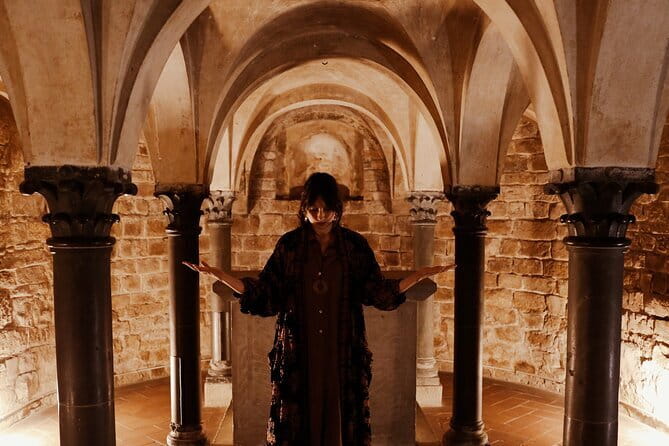
You finish at Basilica di Santa Trinita, reaching it after that walk through a more real, not tour-focused Florence. The last stop is about 10 minutes, and the goal is to conclude inside the church in a calmer mood.
This ending works because it matches what the earlier stops have been building: Florence’s public art and squares connect to religion, devotion, and the daily spiritual structure of medieval life. Ending in a holy place gives your head a place to settle.
Even if you don’t go deep into architecture, a church interior does something plain and useful. It changes your pace. It makes you look slower. It’s harder to talk over everything, and you start noticing proportions, light, and the way space affects your mood.
If you’re short on time, that last stop is a solid payoff. If you’re tired, it’s also a relief: you’re not adding another “must-see facade.” You’re taking in a space with a different tone.
Price and what about $610 buys you in Florence

At $610 for about two hours, this tour is clearly not aimed at bargain hunters. It’s priced for people who want a guided experience that feels personal, not packaged.
Here’s how I think about the value:
- You’re paying for a local art historian (Camilla), not just a route instructor.
- You’re paying for small-group handling (max 15), which usually means you get more attention and a better chance of questions.
- You’re paying for time efficiency. Two hours isn’t long, so every stop needs to count. This one is built around meaningful settings rather than a checklist.
If you’re the kind of traveler who enjoys museums but hates when information stops at facts, this format can be worth it. The guide’s explanations are the core product. The walk is the delivery system.
If you prefer to wander independently, you might not feel the price is justified. But if you like your city storytelling with structure, it’s a good fit.
Timing, weather, and how to plan without overthinking
This experience requires good weather. In Florence, that’s not a small detail. A walking tour depends on it, and rain can make churches and streets feel more crowded and less pleasant.
So plan this way:
- Pick clothing that handles walking and some sun.
- Expect short stops and movement between squares, so comfortable shoes are non-negotiable.
- If you’re booking close to your travel dates, keep an eye on weather forecasts and your willingness to reschedule if needed.
Cancellation is offered with free cancellation up to 24 hours before the start time. That’s useful because it gives you flexibility if your timing in Florence shifts.
Also, the start and end points are in central Florence, and it’s described as near public transportation. That helps if you want to pair the tour with other plans that day.
Who this tour is best for
This walk is a strong match if you:
- Want Florence without the constant pressure of crowds
- Enjoy art history but want it explained in plain language and connected to real places
- Like stories about love, ideas, and medieval life, not just famous names
- Prefer a guide-led pace for two focused hours instead of a longer day tour
It’s also a good choice for first-timers who feel overwhelmed by Florence’s “where do I even start” problem. The route gives you a centerline through the city and then turns you into quieter streets.
Most travelers can participate, and with a maximum of 15, it won’t feel like a moving wall of people.
Should you book this Camilla walk?
I’d book it if you want a Florence experience that feels like learning the city’s language instead of chasing landmarks. The biggest reason is Camilla’s art-historian storytelling paired with a route that doesn’t only live in the most photographed zones.
I’d skip it if you need long time in a few sites, want a fully indoor experience, or are trying to do Florence with zero walking. The tour is short, but it’s still a walking day.
If you’re deciding today, here’s my practical checklist:
- You like guided context more than self-guided wandering
- You’re open to churches and squares as the main content
- You want to finish at Santa Trinita and feel the tone shift
If that’s you, this is an excellent way to see Florence from the inside.
FAQ
How long is the Florence not-touristy walking tour?
It’s approximately 2 hours.
What does the tour cost?
The price is $610.
Is this a private tour or a group tour?
It’s a small-group tour with a maximum of 15 travelers.
Who is the guide?
The guide is Camilla, a local art historian.
Where does the tour start and end?
It starts at Piazza di Santa Croce, 13, 50122 Firenze FI, Italy and ends at Basilica di Santa Trinita, Piazza di Santa Trinita, 50123 Firenze FI, Italy.
What ticket do I receive?
You’ll receive a mobile ticket.
What stops are included during the walk?
The listed stops are Piazza Santa Croce, Piazza San Firenze, Piazza della Repubblica, and Basilica di Santa Trinita.
Is the tour affected by weather?
Yes. The experience requires good weather.
What is the cancellation policy?
You can cancel up to 24 hours in advance for a full refund. If you cancel less than 24 hours before the start time, the amount paid is not refunded.
More Florence Tours We Have Reviewed
- Florence: Skip-The-Line Uffizi Gallery Timed Entry Ticket
★ 4.5 · 27,832 reviews - Tuscany Day Trip from Florence: Siena, San Gimignano, Pisa and Lunch at a Winery
★ 5.0 · 21,634 reviews - Florence: Timed Entry to Michelangelo’s David + Audio App
★ 4.6 · 19,496 reviews - Florence: Leonardo Interactive Museum Entry Ticket
★ 4.5 · 12,957 reviews - Florence: Michelangelo’s David Skip-the-Line Entry Ticket
★ 4.5 · 12,764 reviews
Fresh from our Florence review desk
- Small-Group Pasta Cooking Class and Market Tour in Florence★ 5.0 · 3 reviews
- Palatina Gallery and Pitti Guided Tour in Florence★ 5.0 · 3 reviews
- Tuscan Evening Tour: Fiat 500, 8:30 to 10 PM★ 5.0 · 3 reviews
- Journey into Art: Florence’s Accademia★ 4.5 · 3 reviews
- Paint and Drink Florentine Hills★ 5.0 · 3 reviews
- Truffle hunting and lunch experience, with Vinci and winery.★ 4.5 · 3 reviews