
Reviewed · MICHELANGELO'S DAVID TOURS
3 hour Walking Tour Statue of David and Florence Highlights
Florence can feel huge fast, but this route keeps you focused on the big art hits. I love the combo of Michelangelo’s David plus a guided walk through the city’s most important squares, bridges, and church exteriors. You’ll get context that makes the stones feel like a story, not just a checklist.
Two standouts for me: you start at the Galleria dell’Accademia with skip-the-line entry, and you end at Santa Croce after seeing the open-air sculpture world of Piazza della Signoria. Also, the small group size (up to 19) and radio headsets (if your group is large enough) make it easier to hear the guide without constantly craning your neck.
One thing to plan around: the Accademia can still have lines at the reserved entrance because of security screening. On a rainy day, the “3 hours” can feel longer, since a lot of the time is outdoors and you’re moving between photogenic stops.
In This Review
- Key things to know before you go
- Does a 3-hour Florence highlights tour really deliver value for $3?
- Accademia Gallery: David tickets and how the “skip-the-line” part works
- From Piazza della Repubblica to the Duomo complex: what you see from the street
- Piazza della Repubblica, Orsanmichele, and the guild-era Florence you can still read
- Fontana del Porcellino: the wishing well break that actually works on a walking tour
- Ponte Vecchio: the bridge that survived and the Medici connection above
- Piazza della Signoria: Florence’s open-air sculpture museum
- Piazza San Firenze to Santa Croce: the skyline connections and your final exterior look
- Who this tour is best for (and who might want to go DIY)
- Should you book this Florence tour?
- FAQ
- Where does the tour start?
- Where does the tour end?
- How long is the walking tour?
- Is the Accademia ticket included?
- Can I enter the Duomo dome or Santa Croce church during the tour?
- Will I still wait in line at the Accademia?
- What’s included besides the guide and Accademia ticket?
- What should I wear for stops at churches?
- What rules should I know for the Accademia Gallery?
- Can I get a refund if I cancel?
Key things to know before you go
- Skip-the-line with a reality check: you may still queue briefly for security at the Accademia entrance.
- Small group pacing: up to 19 people means fewer bottlenecks and more time for questions.
- Art + city logic: the route connects David to Florence’s political and religious centers.
- Church dress matters: shoulders and knees need to be covered, or you could miss part of the tour.
- Museum rules are strict: no drinks inside Accademia, limited luggage size, umbrellas must be stowed.
- A coin ritual stop: you’ll toss (or flip) something at the pig fountain for a fun break in the middle.
Every route to the David, compared
Does a 3-hour Florence highlights tour really deliver value for $3?
Yes—if you want the fastest path to the “you came to Florence for this” sights, plus explanations that make them click. The price is strikingly low for what you get: a local English-speaking guide, Accademia Gallery skip-the-line tickets, and a guided walk that threads together Florence’s art, politics, and power centers.
Think of it like this: buying a standalone David ticket gets you the object. A tour like this helps you understand why David matters here, and then shows you the visual and architectural logic of the city right after. That makes a huge difference on a first day, when you’re still trying to build a mental map.
The tour is about 3 hours and capped at 19 people, which is a big deal in Florence. You’re not stuck in a giant crowd at every corner, and radio headsets are included depending on group size, so the guide’s voice doesn’t get swallowed by the street.
Accademia Gallery: David tickets and how the “skip-the-line” part works
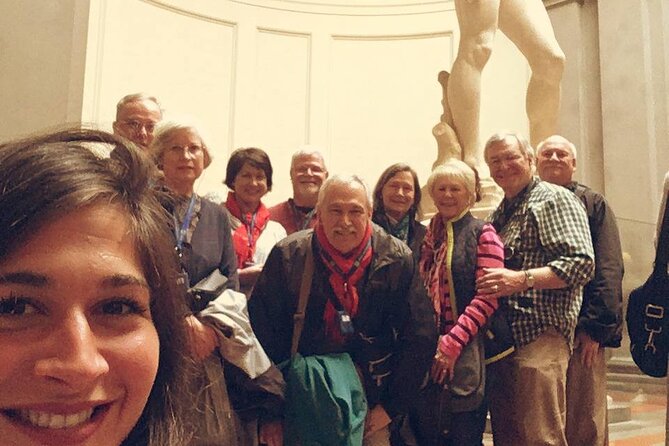
Your first big payoff is Galleria dell’Accademia, where you’ll enter with the tour’s skip-the-line access. Plan for it to still feel busy. Even with reserved entry, there can be a wait because the museum uses limited metal detectors and security checks every guest.
That said, you’re still likely saving time versus showing up without a reservation.
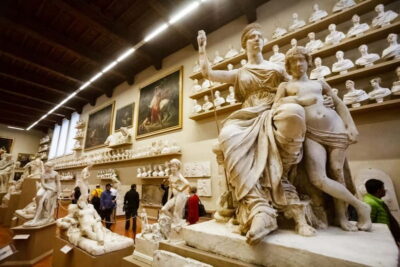
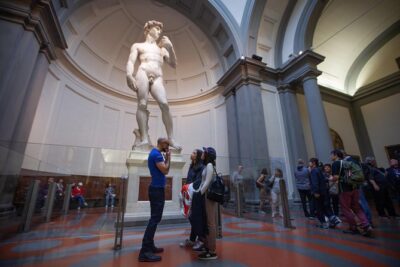
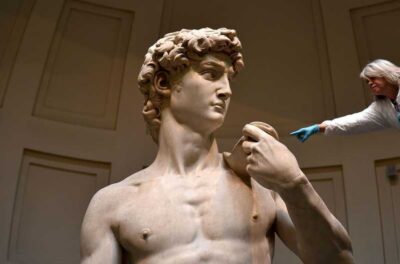
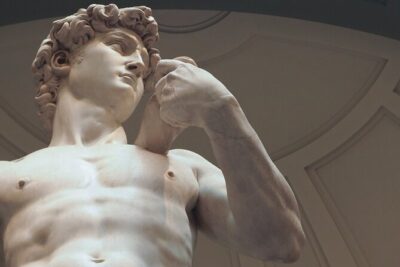
Inside, the headline is Michelangelo’s David. But the tour framing matters: the guide doesn’t just point and move on. You’ll learn how Florence used art as a statement—about leadership, ambition, and civic pride. Up close, David also hits differently than photos: the scale and realism feel more intense when you’re in the room and not scrolling past images.
Practical tips you’ll thank yourself for:
- Bring as little as possible. The museum doesn’t provide cloak room service, and bulky items over 40x30x18 cm aren’t allowed.
- No drinks are permitted inside, including cans or glass bottles. Water is allowed, but limited to bottles not over 0.5 liters.
- Umbrellas have rules too: you can’t bring ones that don’t close fully, and you’ll need to deposit umbrellas at the entrance stands.
If your time in Florence is short, this is the stop where the tour earns its keep.
From Piazza della Repubblica to the Duomo complex: what you see from the street
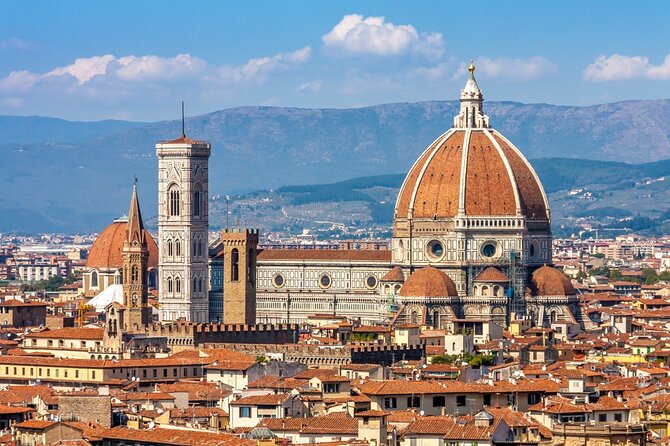
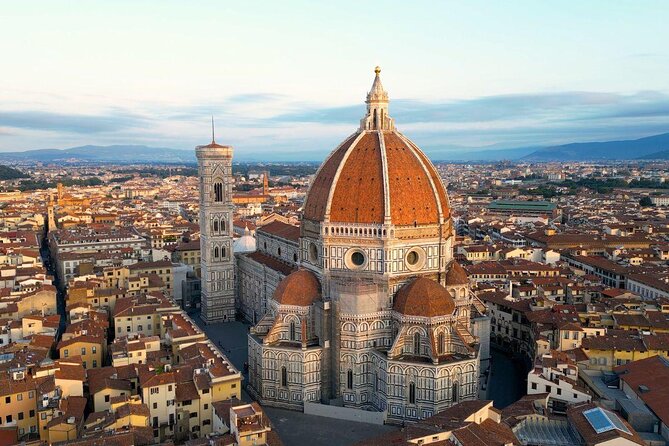
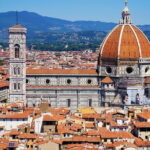
After Accademia, the pace shifts from “museum intensity” to “Florence in layers.” You’ll walk through the outer views of the Duomo complex—the Cathedral of Santa Maria del Fiore, the bell tower by Giotto, and Brunelleschi’s Dome.
Here’s the key detail: the tour does not include entry into the Cathedral/Dome interior. Instead, you’ll admire the complex from outside. That works well if your goal is overview and orientation, since the walking route keeps you moving toward other major sites without eating up your half-day.
You’ll also see the Baptistery of St. John from outside. It’s famous for its inlay marble decoration and the iconic bronze doors that helped ignite Renaissance artistic energy. Even from the outside, it’s one of those places where the craftsmanship is the point.
Why this outdoor focus is useful: Florence’s best moments often come from comparing viewpoints. Looking from the street lets you connect buildings to the squares and street lines around them—so the city layout starts to make sense.
Piazza della Repubblica, Orsanmichele, and the guild-era Florence you can still read
Next comes a string of locations that feel like separate postcards, but the guide ties them together.
At Piazza della Repubblica, you’re in the heart of the ancient Roman city of Florentia. It’s one of those moments where modern city life sits on older layers, and the tour helps you notice what you’d otherwise miss.
Then you’ll stop at the Church and Museum of Orsanmichele from the outside. The building has that unusual “how is this a church?” vibe—it was once a guild power space, and it now houses a gothic tabernacle. The tour also points out the connection to Donatello’s early Renaissance work, including the statue of St George (displayed there). Even without going inside, this stop is a great reality check: Florence wasn’t built only for art patrons—it was built by institutions, guilds, and local power networks.
If you’re the type who likes “why this building looks like this,” this stretch is one of the most satisfying parts of the route.
Fontana del Porcellino: the wishing well break that actually works on a walking tour
Between the big-ticket monuments, the tour gives you a short reset at Fontana del Porcellino. This is the famous wishing well with the boar fountain—very popular because it’s an easy, fun ritual you can do without breaking the schedule.
You’ll flip a coin in the pig’s mouth as part of the tradition, then watch what happens next. It’s a small thing, but it does two useful jobs:
1) It gets you out of full “architecture mode.”
2) It gives you a clean mental bookmark before you hit the river crossing.
If your feet are starting to feel the strain, this is also a good spot to stop and regroup—no long climb, just a breather in the middle of the route.
Stretch your legs on more Florence walking tours
Ponte Vecchio: the bridge that survived and the Medici connection above
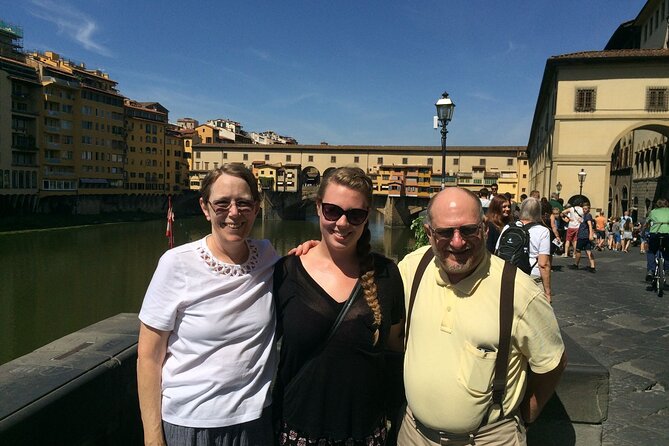
Then you reach Ponte Vecchio, one of Florence’s signature sights. A big reason it’s so celebrated: it’s the only bridge in Florence that survived World War II.
The guide also gives you the backstory of the bridge’s longer timeline, including how it was rebuilt after the flood of 1333. But the wow-factor here is what’s built on top of the bridge: a row of shops and the Vasari Corridor, a private passageway reserved for the Medici lords.
Standing on or near Ponte Vecchio, it’s easy to think of it as just a pretty crossing. The guide helps you see it as a control point—an architectural and political link between power and place. That’s the kind of context that turns a “photo stop” into something you remember.
Piazza della Signoria: Florence’s open-air sculpture museum
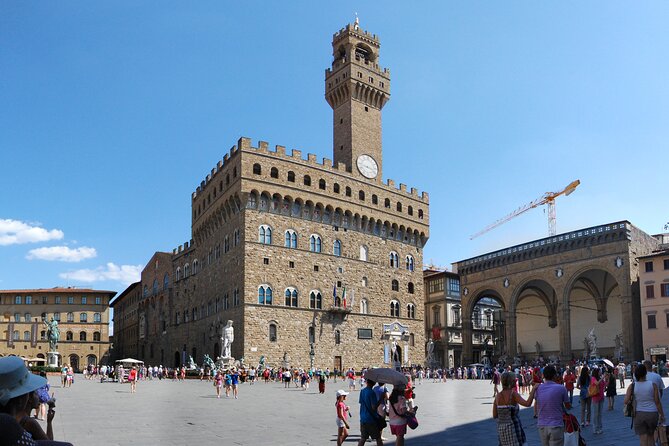
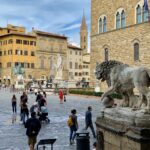
After the river, you arrive in Piazza della Signoria. This is the political center of Florence, and the tour treats it like an outdoor gallery—because it basically is.
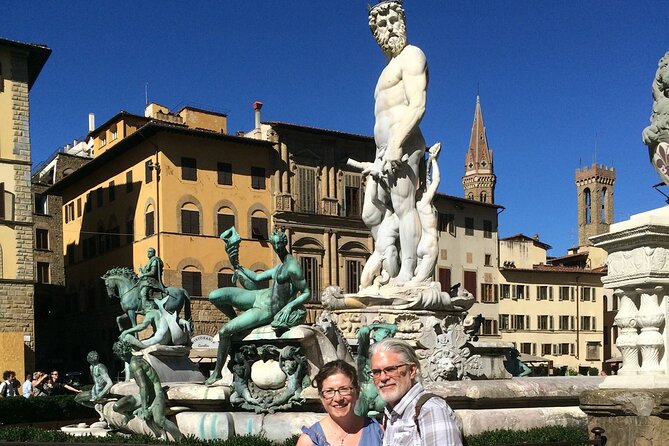
You’ll see major works presented in the square, including the Perseus by Cellini, the Fountain of Neptune, and the Ratto delle Sabine by Giambologna. The guide also connects the art here to Florence’s civic identity and political storytelling, so the sculptures aren’t just decorative. They’re statements.
This stop is one of my favorite parts of the whole route because it shows you how Florence used public space. Instead of putting everything behind museum doors, the city displayed art where power was practiced.
Tip: if you’re traveling during a busy season, take a second to stand slightly back. Let the crowd move through, then you’ll get a clearer view of the sculpture lines and details.
Piazza San Firenze to Santa Croce: the skyline connections and your final exterior look
Before the finish, you pass Piazza San Firenze. From here, you get sightlines toward places like the Bargello palace and tower, the church of San Firenze, and Palazzo Gondi. The tour even notes the claim about Da Vinci living there when he painted the Monna Lisa—that kind of link helps you understand why Florence feels like it’s constantly cross-referencing itself.
Your finale is Santa Croce, and again, it’s an exterior stop only. You’ll see the Tuscan-Gothic architecture built in 1296, and the guide points out the area associated with tombs of important names including Michelangelo, Machiavelli, and Galileo.
Why the exterior finish still feels worth it: Santa Croce is visually strong from the outside, and ending here sets you up nicely for the rest of your day. You can head off to nearby cafés or keep exploring without being locked into another timed ticket.
One more important reminder: if the route passes places of worship, you’ll need clothing that covers shoulders and knees. If you don’t meet that, you might miss part of the tour. If you’re in a light outfit, carrying a scarf can save your day.
Who this tour is best for (and who might want to go DIY)
This walking tour is a strong fit if:
- it’s your first day in Florence and you want major highlights in a tight timeframe
- you’d rather have context than just photos
- you want David plus the city’s “why” in about 3 hours
- you like small-group pacing (up to 19 people)
It’s less ideal if:
- you already know Florence’s art history and just want maximum time at the Accademia (and you’re happy to wait with no guide)
- you’re very sensitive to rain or crowds. The route is mostly outdoors, and one of the practical drawbacks people mention is that rainy weather can make the walking less fun.
For most people, though, it’s a smart “set your base knowledge fast” move.
Should you book this Florence tour?
I’d book it if you want a fast, well-structured Florence overview anchored on David, with a guided walk that connects the Duomo area, Ponte Vecchio, and the sculpture-filled Piazza della Signoria. The value is especially good at the listed price—what makes it feel like a deal isn’t just the ticketing, it’s the way the guide turns separate stops into a single story.
If you do book, go in with realistic expectations:
- expect possible short lines at the Accademia security check even with reserved entry
- dress with church rules in mind (shoulders and knees)
- keep luggage small for the museum’s restrictions
- pick a drier day if you can, because you’re outside a lot
If that sounds like your kind of half-day, this is a solid way to get your Florence bearings fast.
FAQ
Where does the tour start?
It starts at the equestrian statue of Cosimo I at Piazza della Signoria (50122 Firenze FI, Italy).
Where does the tour end?
It ends at Piazza di Santa Croce (open in Google Maps), specifically near the Santa Croce church area.
How long is the walking tour?
The tour runs for about 3 hours.
Is the Accademia ticket included?
Yes. You get skip-the-line tickets for the Galleria dell’Accademia.
Can I enter the Duomo dome or Santa Croce church during the tour?
No. The tour involves the Duomo complex and Santa Croce from the outside only, not interior visits.
Will I still wait in line at the Accademia?
Even with skip-the-line access, there can still be lines at the reserved entrance because security screening is required for every traveler.
What’s included besides the guide and Accademia ticket?
Included items are a local professional English-speaking guide, radio headsets depending on group size, and a small group up to 19 travelers.
What should I wear for stops at churches?
You need clothing appropriate for places of worship: shoulders and knees must be covered. If you don’t comply, you might miss part of the tour.
What rules should I know for the Accademia Gallery?
You can’t bring drinks into the museum (water up to 0.5 liters is allowed). Umbrellas must be able to close and are deposited at the entrance. There is no cloak room service, and bulky items over 40x30x18 cm are not allowed.
Can I get a refund if I cancel?
Yes. Cancellation is free up to 24 hours before the experience start time for a full refund. Canceling within 24 hours is not refunded.
More Florence Tours to Weigh Up
- The Best tour in Florence: Renaissance & Medici Tales – guided by a STORYTELLER
★ 5.0 · 12,316 reviews - The Best Tour in Florence: Renaissance and Medici Tales
★ 5.0 · 10,810 reviews - Florence: Chianti Wineries Tour with Wine Tasting
★ 4.5 · 10,071 reviews - Florence: Duomo Cathedral 60-Minute Guided Tour
★ 3.7 · 6,829 reviews - Florence: Hop-on Hop-off Bus Tour: 24, 48 or 72-Hour Ticket
★ 4.0 · 6,283 reviews
More Florence Tours We Have Reviewed
- Florence: Skip-The-Line Uffizi Gallery Timed Entry Ticket
★ 4.5 · 27,832 reviews - Tuscany Day Trip from Florence: Siena, San Gimignano, Pisa and Lunch at a Winery
★ 5.0 · 21,634 reviews - Florence: Timed Entry to Michelangelo’s David + Audio App
★ 4.6 · 19,496 reviews - Florence: Leonardo Interactive Museum Entry Ticket
★ 4.5 · 12,957 reviews - Florence: Michelangelo’s David Skip-the-Line Entry Ticket
★ 4.5 · 12,764 reviews
Standing Before David, Again
- Florence: Timed Entry to Michelangelo’s David + Audio App
★ 4.6 · 19,496 reviews - Florence: Michelangelo’s David Skip-the-Line Entry Ticket
★ 4.5 · 12,764 reviews - Florence: Timed Entry Ticket to Michelangelo’s David & eBook
★ 4.6 · 4,049 reviews - Florence: Art Tour, Accademia Gallery and David
★ 4.5 · 2,407 reviews - Michelangelo’s David, Accademia & Uffizi Small Group Tour
★ 4.5 · 1,986 reviews
Fresh from our Florence review desk
- Small-Group Pasta Cooking Class and Market Tour in Florence★ 5.0 · 3 reviews
- Palatina Gallery and Pitti Guided Tour in Florence★ 5.0 · 3 reviews
- Tuscan Evening Tour: Fiat 500, 8:30 to 10 PM★ 5.0 · 3 reviews
- Journey into Art: Florence’s Accademia★ 4.5 · 3 reviews
- Paint and Drink Florentine Hills★ 5.0 · 3 reviews
- Truffle hunting and lunch experience, with Vinci and winery.★ 4.5 · 3 reviews
Michelangelo's David Tours, compared.
 ★ 4.6Timed Entry to Michelangelo’s David + Audio AppFrom $3319,496 reviews
 ★ 4.5Michelangelo’s David Skip-the-Line Entry TicketFrom $4512,764 reviews
 ★ 4.6Timed Entry Ticket to Michelangelo’s David & eBookFrom $374,049 reviews
 ★ 4.5Art Tour, Accademia Gallery and DavidFrom $582,407 reviews
 ★ 4.5Michelangelo’s David, Accademia & Uffizi Small Group TourFrom $471,986 reviews
 ★ 4.6Accademia Gallery & David Skip-the-Line TicketFrom $411,905 reviews
 ★ 4.3Michelangelo’s David Entrance Ticket and Audio AppFrom $381,901 reviews
 ★ 4.5David & Accademia Guided Tour with Time Entry TicketFrom $371,705 reviews
Browse the lists this tour appears in