
Reviewed · WALKING TOURS
Essential Florence Walking Tour with an Expert Local Guide
Florence can feel like a giant art book. This tour turns the pages with an expert local guide, linking places to stories—from Florence’s guild culture to Medici power—and slowing down just enough to make sense of it all. You’ll cover big-name sights without doing the usual tourist shuffle.
Two things I really like: the itinerary is packed but not frantic, and you get built-in context for what you’re actually looking at. Guides Andrea, Becky, and Lisa come up again and again in the feedback for their storytelling style and their ability to guide you through the city without wasting time.
One consideration: it’s a walking tour with frequent stops, so if you’re hoping for long museum time or lots of sit-down breaks, you’ll want to plan other activities after. Comfortable shoes are not optional. And do expect a bit of crowding around the most famous piazzas.
In This Review
- Key points that make this tour worth your time
- Why this 3-hour Florence walk works so well
- Small groups, easier conversations
- The route: from Piazza della Repubblica to Piazza della Signoria
- Stop-by-stop: what you’ll actually see and why it matters
- Orsanmichele: the grain-loggia turned arts church
- Passing Dante’s world at Museo Casa di Dante
- Piazza del Duomo: Santa Maria del Fiore, Baptistery, and Giotto
- Santa Maria Novella: a Dominican focal point
- Palazzo Rucellai: Renaissance design you can see from the street
- Palazzo Strozzi: power and scale, with an expensive price tag
- Santa Trinita: frescoes by Ghirlandaio
- Palazzo Pitti: from banker Luca Pitti to Medici and beyond
- Santa Felicita: an older church between major landmarks
- Vasari Corridor: the elevated route that made rulers feel safe
- What the price buys you: value per hour in Florence
- Practical tips for a smoother walk
- Wear comfy shoes and dress for the weather
- Expect brief reset moments
- Guides can make it or break it
- Who should book this tour
- Should you book Essential Florence Walking Tour?
- FAQ
- How long is the tour?
- How much does the Essential Florence Walking Tour cost?
- Where does the tour start?
- Where does the tour end?
- What time does the tour begin?
- What is the maximum group size?
- Are tickets needed for the stops?
- Are service animals allowed?
- What happens if the weather is bad?
- Is there a cancellation option with a refund?
Key points that make this tour worth your time

- 3 hours, ~12 major stops: enough coverage for orientation without dragging into the whole day
- Donatello and Ghiberti originals at Orsanmichele: sculpture you can connect to the city’s guild roots
- Duomo complex overview (cathedral, baptistery, Giotto bell tower): the backbone of the Piazza del Duomo scene
- Renaissance power in palaces: from Palazzo Rucellai and its Alberti facade ideas to the Medici era at Palazzo Pitti
- Oltrarno to the Vasari Corridor: you get the “behind-the-scenes” grand-ducal route story before you go look on your own
Stretch your legs on more Florence walking tours
Why this 3-hour Florence walk works so well
This tour is built for the moment you land in Florence and think: Where do I even start? Instead of treating sights like disconnected checkboxes, your guide ties them together with clear explanations—politics, religion, commerce, art, and architecture—so the city starts to click.
The pace also matters. With a 3-hour run and short, focused time at each stop, you get a “first pass” that helps you return later with better questions. It’s also scheduled in the morning (starting at 9:00 am), which is a smart move if you want the Duomo area and central streets before the day gets too thick.
Small groups, easier conversations
The tour caps at 20 travelers, and the overall tone from the guide praise is that groups tend to feel manageable. A smaller group means you can hear the guide without playing I-Spy for their voice across a crowd—and it’s easier to keep up when you’re weaving through piazzas.
If you’re the type who asks questions, you’ll probably appreciate that setup. Several people highlight how friendly the guides are and how they answer on the spot.
The route: from Piazza della Repubblica to Piazza della Signoria
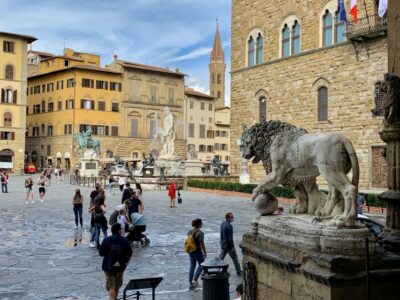
The tour starts at Piazza della Repubblica and ends at Piazza della Signoria. That’s a great arc. You begin in the central city core and finish in one of Florence’s most energetic landmark squares—so by the time you’re done, you’re already in the right part of town to continue exploring, grabbing lunch, or hopping to another neighborhood.
Starting location also helps: Piazza della Repubblica is easy to reach using public transportation, which matters in Florence where walking is fun but distances add up fast.
And because you end in Piazza della Signoria, you’re well-positioned to keep going toward the river, museums, or the evening passeggiata (that slow stroll that makes Florence feel like Florence).
Stop-by-stop: what you’ll actually see and why it matters
Orsanmichele: the grain-loggia turned arts church
Orsanmichele is one of those Florence stops that feels like a secret even when it’s in plain sight. The building started as a loggia for storing and marketing grain and later became a church connected to the ancient Florentine guilds—especially the Arts.
The payoff is upstairs: the museum houses original sculptural works from the external niches, including famous statues by Donatello and Ghiberti. That detail is big, because it shifts Orsanmichele from “pretty church” to “this is how Florence organized talent and money.”
If you like when buildings come with a backstory, this is your kind of stop.
With a local guide, more of Florence to explore
- The Best tour in Florence: Renaissance & Medici Tales – guided by a STORYTELLER
★ 5.0 · 12,316 reviews

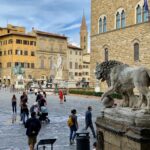
Passing Dante’s world at Museo Casa di Dante
From Orsanmichele you’ll move toward Museo Casa di Dante. Even though you’re not hanging out for a long museum session, the point here is orientation: you learn about Dante’s life, work, and the city he inhabited.
It’s a clever inclusion. Florence’s major sights can feel like separate islands—Dante adds a cultural thread that connects literature to the streets you’re walking.
Piazza del Duomo: Santa Maria del Fiore, Baptistery, and Giotto
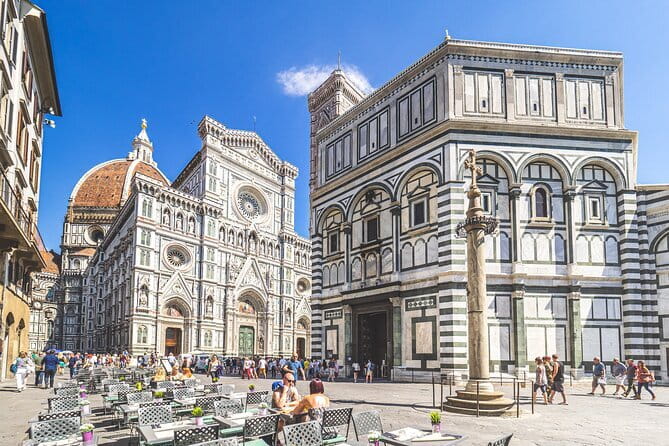
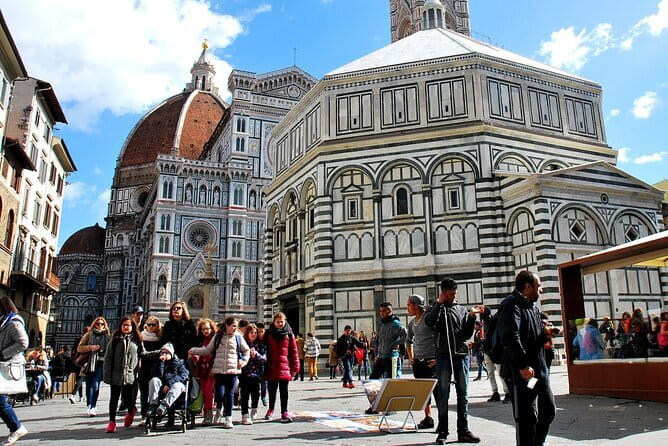
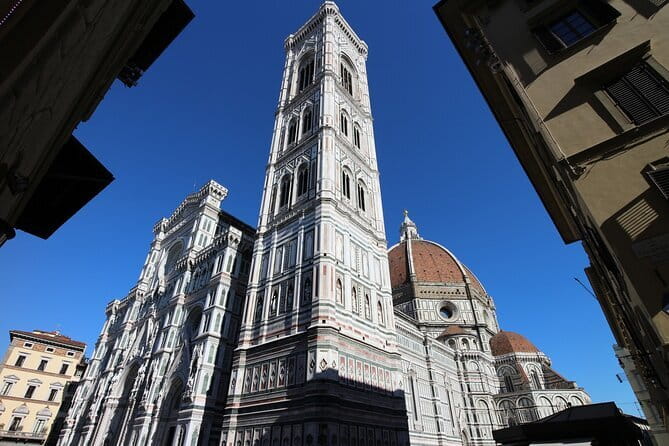
This is the Florence “spine” area. You spend time at the Cathedral of Santa Maria del Fiore—the main cathedral of the city—plus the Baptistery of St. John and Giotto’s bell tower.
The cathedral explanation is more than trivia. You’re told what makes it famous, including the scale and the fact that its masonry dome is still the standout story. You also learn it’s built on earlier foundations, with worship happening on the site since Roman times, and specifically on the foundation of the earlier cathedral of Santa Reparata.
Then it continues into the spiritual and civic side of the same square through the baptistery:
- It’s dedicated to Florence’s patron saint, St. John the Baptist
- It was the place where Florentines were baptized for centuries
- It also ties to civic ceremony, like investiture of knights and poets
- Dante’s connection is part of the story too, since he was baptized there
Finally, you look up at Campanile di Giotto, the bell tower of the cathedral. Even if you’ve seen photos, hearing how it fits into the cathedral complex makes it easier to read the skyline when you’re later exploring on your own.
Santa Maria Novella: a Dominican focal point
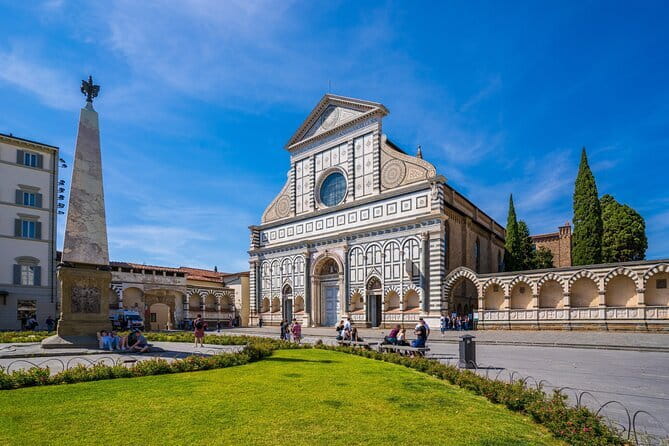
Next is Santa Maria Novella, one of Florence’s most important churches. This stop is especially useful if you’re interested in how Florence’s religious life shaped the city’s power and street layout.
You’ll hear how the basilica acted as a reference point for the Dominicans, the mendicant order that influenced education and preaching across many European cities. It’s not just about the building itself; it’s about why this place mattered to the people who lived around it.
Palazzo Rucellai: Renaissance design you can see from the street
Then the tour shifts into pure architecture. At Palazzo Rucellai, the story centers on the Renaissance revival of classical design and how it was used in a high-status Florentine context.
Most scholars tie the facade to Leon Battista Alberti (with Giovanni di Paolo Rucellai as patron) from 1446 to 1451, and with execution at least partly by Bernardo Rossellino. You’re given a key lens to look through: the facade uses pilasters and entablatures in proportional relationship to each other—an early and clear statement of the new Renaissance architectural language.
If you like architecture that actually has rules behind it, this will be one of your favorite stops.
Palazzo Strozzi: power and scale, with an expensive price tag
Palazzo Strozzi is next, and it comes with a strong “how they did it” story: the size was so big that 15 buildings were destroyed to make room for it.
That detail helps you understand the stakes. This wasn’t just a home. It was a statement of wealth and control over the urban map. You also get to spot the facade logic—three identical portals on every side—which gives you something tangible to look for as you walk.
Santa Trinita: frescoes by Ghirlandaio
At Basilica di Santa Trinita, you get more than an exterior glance. You enter to see impressive frescoes by Ghirlandaio.
This stop works well because it reminds you that Florence isn’t only grand in scale—it’s also intimate in detail. The frescoes are an immediate payoff for your walking effort, even if you don’t spend hours inside.
Palazzo Pitti: from banker Luca Pitti to Medici and beyond
Then you cross into the Oltrarno side via Palazzo Pitti, one of the big “this is how rulers lived” landmarks in Florence.
Here’s the key timeline you’ll hear:
- The original building nucleus dates to 1458, connected to banker Luca Pitti
- The Medici bought it in 1549
- It became the main residence of the grand dukes of Tuscany
- The line continued with Habsburg-Lorraine from 1737
- After Italy unified, it served as the royal palace for the House of Savoy during Florence’s capital years (1865–70)
That makes Palazzo Pitti feel less like an isolated palace and more like a long-running political machine. You’re seeing a building that repeatedly changed hands as power shifted.
Santa Felicita: an older church between major landmarks
Right after Pitti, you go to the Church of Santa Felicita in Oltrarno, between Ponte Vecchio and Palazzo Pitti.
This church is notable for age—it’s described as one of the oldest churches in Florence—and the location makes it a nice counterpoint. After the heavy palace story, Santa Felicita brings you back to the slower, older rhythm of religious Florence.
Vasari Corridor: the elevated route that made rulers feel safe
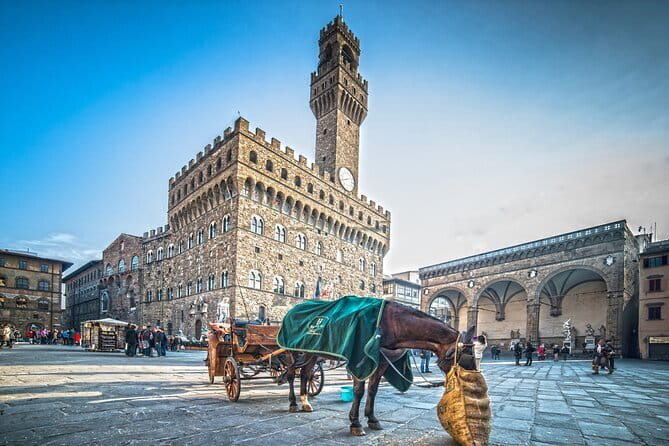
The final “wow” stop is the Vasari Corridor, an elevated path connecting Palazzo Vecchio and Palazzo Pitti.
You learn why it exists: it let the grand dukes travel freely and without danger from their residence to the government palace, in a period when public support for the new duke and system wasn’t guaranteed.
The corridor also links key landmarks in its route: it passes through the Uffizi and goes over Ponte Vecchio. Even if you’re not spending time inside, the idea changes how you think about the river crossing and the whole city layout.
What the price buys you: value per hour in Florence
At $40.12 per person for about 3 hours, this tour is priced like a “serious orientation” experience—especially because the listed stops are marked as free admission.
That matters. You’re paying mainly for:
- A guide who can explain what you’re seeing in plain language
- A tight route that saves time
- The ability to connect themes—guilds, cathedral power, Renaissance design, Medici rule—while you walk
If you’re only doing one paid guided activity in Florence, this is the kind that tends to pay you back on future days. You’ll recognize the places later and know what you’re looking at.
Practical tips for a smoother walk
A few things will make your day better.
Wear comfy shoes and dress for the weather
The tour covers a lot of ground. There’s a clear reminder to wear comfy walking shoes, and the schedule assumes you’ll keep moving between stops.
Also: it requires good weather. If the weather’s poor, the tour may be canceled and you’ll be offered another date or a refund.
Expect brief reset moments
You’ll have time for bathroom breaks on the route. One of the recurring positives in the feedback is that the guides build in a short rest/coffee moment during the 3 hours. It’s not a long break, but it’s enough to keep the tour from turning into a march.
Guides can make it or break it
The best feedback isn’t just about facts. It’s about delivery: guides like Andrea and Becky are praised for being engaging, and Lisa is highlighted for tying history to stories in a way that keeps people interested.
If you can request a specific guide, it’s worth it. If you end up with a different guide, you’ll still likely get the same core idea: structured stops, clear explanations, and smart routes around the center.
Who should book this tour
This is a strong fit if you:
- Want first-day orientation in Florence
- Prefer a guided route that connects major sights instead of hopping randomly
- Like history told through buildings and civic life
- Don’t want to commit to a half-day museum strategy
It’s also a good “family-and-all-ages” type of outing. Several people mention adults and even younger travelers enjoying the pace and stories.
If you’re the kind of traveler who wants to linger for long periods inside specific churches or museums, pair this with extra time on a later day. Think of it as your map and context builder, not your entire Florence plan.
Should you book Essential Florence Walking Tour?
Yes—if you want a smart, high-value introduction to Florence’s most important landmarks in a single morning block.
Book this tour if:
- You’re short on time and want the key places linked to real stories
- You want to avoid guesswork later
- You like the idea of free-entry stops paired with expert commentary
Skip it (or add a second plan) if:
- You’re chasing deep museum time at one site
- You dislike walking in crowds around the Duomo area and major piazzas
- You want long, sit-down breaks
FAQ
How long is the tour?
It runs for about 3 hours.
How much does the Essential Florence Walking Tour cost?
The price is $40.12 per person.
Where does the tour start?
The meeting point is Piazza della Repubblica, 50123 Firenze FI, Italy.
Where does the tour end?
The tour ends in Piazza della Signoria (P.za della Signoria, 50122 Firenze FI, Italy).
What time does the tour begin?
The start time is 9:00 am.
What is the maximum group size?
The tour has a maximum of 20 travelers.
Are tickets needed for the stops?
The tour’s listed stops are marked as free admission.
Are service animals allowed?
Yes, service animals are allowed.
What happens if the weather is bad?
The experience requires good weather. If it’s canceled due to poor weather, you’ll be offered a different date or a full refund.
Is there a cancellation option with a refund?
Free cancellation is available. You can cancel up to 24 hours in advance for a full refund.
More Florence Walks
- Florence: Highlights Walking Tour with Expert Guide
★ 4.6 · 4,662 reviews - Uffizi & Accademia Timed Entry: Small Group Duomo Walking Tour
★ 4.5 · 3,630 reviews - Florence: Duomo Complex with Tickets & City Walk Guided Tour
★ 4.7 · 2,057 reviews - Florence: Guided Walking Tour
★ 4.6 · 1,602 reviews - Florence: Renaissance and Medici Tales Guided Walking Tour
★ 4.8 · 1,549 reviews
More Florence Tours to Weigh Up
- The Best tour in Florence: Renaissance & Medici Tales – guided by a STORYTELLER
★ 5.0 · 12,316 reviews - The Best Tour in Florence: Renaissance and Medici Tales
★ 5.0 · 10,810 reviews - Florence: Chianti Wineries Tour with Wine Tasting
★ 4.5 · 10,071 reviews - Florence: Duomo Cathedral 60-Minute Guided Tour
★ 3.7 · 6,829 reviews - Florence: Hop-on Hop-off Bus Tour: 24, 48 or 72-Hour Ticket
★ 4.0 · 6,283 reviews
More Florence Tours We Have Reviewed
- Florence: Skip-The-Line Uffizi Gallery Timed Entry Ticket
★ 4.5 · 27,832 reviews - Tuscany Day Trip from Florence: Siena, San Gimignano, Pisa and Lunch at a Winery
★ 5.0 · 21,634 reviews - Florence: Timed Entry to Michelangelo’s David + Audio App
★ 4.6 · 19,496 reviews - Florence: Leonardo Interactive Museum Entry Ticket
★ 4.5 · 12,957 reviews - Florence: Michelangelo’s David Skip-the-Line Entry Ticket
★ 4.5 · 12,764 reviews
Fresh from our Florence review desk
- Small-Group Pasta Cooking Class and Market Tour in Florence★ 5.0 · 3 reviews
- Palatina Gallery and Pitti Guided Tour in Florence★ 5.0 · 3 reviews
- Tuscan Evening Tour: Fiat 500, 8:30 to 10 PM★ 5.0 · 3 reviews
- Journey into Art: Florence’s Accademia★ 4.5 · 3 reviews
- Paint and Drink Florentine Hills★ 5.0 · 3 reviews
- Truffle hunting and lunch experience, with Vinci and winery.★ 4.5 · 3 reviews
Walking Tours, compared.
 ★ 4.6Highlights Walking Tour with Expert GuideFrom $274,662 reviews
 ★ 4.5Uffizi & Accademia Timed Entry: Small Group Duomo Walking TourFrom $503,630 reviews
 ★ 4.7Duomo Complex with Tickets & City Walk Guided TourFrom $932,057 reviews
 ★ 4.6Guided Walking TourFrom $271,602 reviews
 ★ 4.8Renaissance and Medici Tales Guided Walking TourFrom $21,549 reviews
 ★ 4.7Uffizi & Accademia Small Group Walking TourFrom $1481,380 reviews
 ★ 5.0Skip-the-Line Florence Highlights and David Walking TourFrom $1171,127 reviews
 ★ 4.6Dark Mysteries and Legends Guided Walking TourFrom $21,081 reviews
Browse the lists this tour appears in