
Medici secrets move through Florence’s streets, step by step. This private 1 hour 30 minute walking tour starts at Santa Maria Novella and leads you to the Duomo complex, Piazza della Signoria, and the best Medici-linked stops along the way. I like that the route is tight and story-driven, so you’re not just looking at famous stone—you’re learning why it mattered.
Two things I especially like: you get a strong visual sequence from Santa Maria del Fiore to Giotto’s Bell Tower, and then you swing into civic power at Piazza della Signoria, where statues and rivalries connect directly to the people who shaped the city. I also appreciate the guide style—hands-on, clear, and based on what you can actually see on the street.
One consideration: ticket visits are not included, and Florence weather can change fast. If the day is rough, the tour may require a date change or refund, but past guests report the team provided umbrellas when conditions weren’t great.
In This Review
- Key highlights you won’t want to miss
- From Santa Maria Novella to Duomo: the “why” behind the biggest stones
- San Lorenzo and the Medici seat of power: church, artists, and authority
- Piazza della Signoria: where statues act like a political press
- Palazzo Vecchio and Michelangelo’s hidden mark
- Oltrarno on foot: the artisan side of Florence
- Ponte Vecchio finish: the Arno views and the Vasari Corridor story
- How long is enough? Time, pace, and what you get for $192.81
- Weather and tickets: the two things to plan around
- Private tour feel: why being just your group helps
- Who this tour suits best (and who should pass)
- Should you book Steps Through Time in Florence?
- FAQ
- Where does the tour start and end?
- How long is the Florence walking tour?
- Is this tour private?
- Is the tour ticket included?
- What language is the guide?
- What happens if the weather is bad?
Key highlights you won’t want to miss
- Santa Maria Novella start at a major Renaissance landmark, setting the tone for your walk
- Duomo complex views timed with a guided look at the Cathedral, Baptistery, and Giotto’s Bell Tower area
- Medici connections in multiple neighborhoods, not just one museum moment
- Piazza della Signoria storytelling, including political rivalry around major civic art
- Michelangelo detail at Palazzo Vecchio, including a secret carving spot to look for
- Ponte Vecchio finish over Arno views, with the Medici-era Vasari Corridor explained as you cross
Stretch your legs on more Florence walking tours
From Santa Maria Novella to Duomo: the “why” behind the biggest stones
I love how this tour starts in the right place. You meet in front of Santa Maria Novella Church, near Piazza della Stazione, which means you can orient fast before you even leave the area. That first stretch matters: Florence can feel like a maze, and a good start reduces that stress right away.
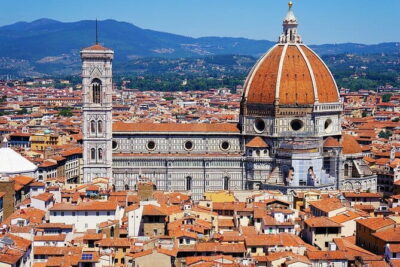
Then the walk moves you toward the Duomo complex—the Cathedral of Santa Maria del Fiore, plus the Baptistery and Giotto’s Bell Tower. The point here isn’t only the wow factor (though it’s real). It’s the way your guide connects form, power, and civic identity: why this area became the stage for Florence’s pride and ambition.
A practical note: even when your time at each stop is shorter than a full museum visit, seeing the Cathedral area as a guided sequence helps a lot. Stand where you can understand scale, and you’ll spend less time guessing what you’re looking at. The time you get here is ideal for first-timers who want structure without spending half a day in lines.
If you’re hoping for long interior time inside churches, keep expectations realistic. The tour is designed as a walking tour across key sights. Ticket visits aren’t included, so if you plan to go inside certain areas on your own later, this walk works great as your framework.
San Lorenzo and the Medici seat of power: church, artists, and authority
After the Duomo area, the route shifts to San Lorenzo Church. This isn’t a random stop—it’s the Medici family’s parish church, and that detail sets up everything that comes next. You’ll also learn that the church was designed by Brunelleschi and decorated by Donatello, which gives you two major artist names to anchor what you’re seeing.
What I like most about this part is how it ties religion to influence. San Lorenzo isn’t only a beautiful church stop; it’s a living symbol of how the Medici used patronage and faith to cement their role in public life.
The tour also points you toward the Medici Chapels area, where you can see Michelangelo’s sculptures. Even if you don’t spend ages inside, knowing what’s there before you look changes your experience. You’re no longer scanning for decoration—you’re looking for specific connections between artists and the people who funded their work.
Because ticket visits aren’t included, you should be ready to treat this as a guided viewing and orientation stop unless you add entry separately. If your goal is to make Florence feel personal and specific, this church-and-chapels section is a strong “anchor” moment in the overall walk.
Piazza della Signoria: where statues act like a political press
From San Lorenzo, the tour brings you into the civic heart of Florence with Piazza della Signoria. This square works like an open-air history lesson, and your guide’s job is to translate what you see into what it meant.
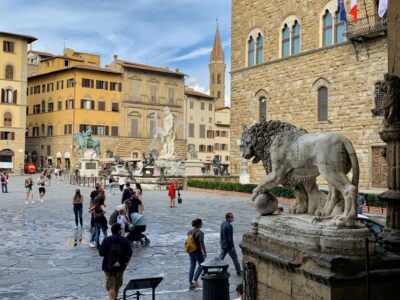
You’ll spend time in and around the square’s statues, which are more than ornament. They reflect power, rivalry, and betrayal—ideas that sound abstract until someone points to how the art functioned in public life. You also connect the dots to the Medici family and their political intrigue, which helps you understand why Florence’s art and politics were never separate.
Here’s the practical value: Piazza della Signoria can be overwhelming on your own. There are many faces, many monuments, and plenty of tourists taking quick snapshots. With a guide, you’re given a roadmap: where to look, what details signal authority, and how these works relate to later events and family dominance.
A standout detail you’ll specifically be guided to is the Michelangelo carving connected to Palazzo Vecchio. The tour includes time to spot this hidden carving, which is exactly the kind of moment that makes a short tour feel smarter. Instead of only seeing the obvious masterpieces, you learn where the subtle surprise lives.
Palazzo Vecchio and Michelangelo’s hidden mark
Palazzo Vecchio is one of those buildings that looks important from far away, but it’s even more interesting when you know what to watch for. In this tour, your time in the Palazzo Vecchio area is tied directly to the Piazza della Signoria stories and the broader theme of Medici-era influence.
Your guide also points out Michelangelo’s secret carving you can spot on Palazzo Vecchio. Even if you don’t catch every tiny detail immediately (Florence stone is not always easy in daylight), you’ll at least know what you’re hunting for. That single shift—having a target—makes the stop feel interactive rather than passive.
This section is also a good example of how the tour balances landmark viewing with “human scale” history. You’re not only hearing dates and names. You’re seeing how rivalry and power were performed in public spaces and recorded in stone.
If you’re the type who likes to understand how Florence worked, this is where you’ll feel your questions getting answered. If you only want classic sights and you prefer minimal interpretation, you might find this portion more talk-heavy than you expect—but the tour stays time-efficient.
Oltrarno on foot: the artisan side of Florence
After the power-squared stops, the tour shifts gears into Oltrarno, the more local-feeling side of Florence. This is where the walk becomes less about official monuments and more about the city’s day-to-day character.
You’ll have time to wander in Oltrarno, and the tour frames it as an area where artisans keep traditional craftsmanship alive. I like this kind of contrast because it prevents your trip from turning into a nonstop parade of grand buildings. It gives you a breather while still staying in the story of Florence as a working place, not just a gallery.
Also, walking through Oltrarno makes your final stretch feel more rewarding. When you’re later standing on Ponte Vecchio, the city doesn’t feel like a set of separate postcards. It feels like one connected place—work, art, politics, and architecture all in motion.
Because you’re on foot and time is limited (about 20 minutes here), don’t expect a deep neighborhood exploration. Instead, use this segment to get bearings. If you love the vibe, you’ll be able to come back later with a clearer idea of what to seek.
Just your group: more private Florence tours



Ponte Vecchio finish: the Arno views and the Vasari Corridor story
The tour ends at Ponte Vecchio, and it’s a smart ending. The bridge is one of Florence’s most loved landmarks, and arriving there at the end means you’re ready to slow down. You also get views out toward the Arno River as you conclude the journey, which is exactly the kind of visual payoff a walking tour should deliver.
The guide also explains the Medici connection to the Vasari Corridor as you cross. That detail adds a layer you won’t get from looking at the bridge alone. It’s a reminder that the city’s glamour and its control systems were linked—sometimes literally—into one continuous power network.
If you’ve only seen Ponte Vecchio from far away, finishing here will change your understanding. You’ll know what you’re looking at, why it mattered, and how it fits into the bigger Medici story you followed earlier. It’s one of those moments where the city stops feeling like a list of famous spots and starts feeling like a lived-in map.
One more practical point: Ponte Vecchio can be crowded, especially at peak times. Because your tour ends here, consider hanging around for a short while if you can. Give yourself time to take in the river views without rushing immediately to the next stop.
How long is enough? Time, pace, and what you get for $192.81
This is a private tour, lasting about 1 hour 30 minutes, and the price is $192.81 per person. For Florence, that cost makes sense if you value two things: a guide who interprets what you’re seeing, and a tight route that hits multiple “must-know” themes in one go.
The value is best if you fit into one of these groups:
- First-time Florence visitors who want a guided backbone fast
- Families looking for a story-friendly format that keeps kids engaged
- Travelers who want Medici context without committing to a full-day museum itinerary
- Anyone who prefers walking with interpretation instead of reading guidebooks alone
It’s less of a value match if you mainly want independent time. This tour is designed to be efficient, so you’ll move between stops and you’ll need to keep your energy up for the full stretch.
The tour also uses a mobile ticket, which is convenient. You’ll still want to bring your own snacks and water if you’re doing this during a longer sightseeing day, since this walk is focused and doesn’t build in a rest stop.
Weather and tickets: the two things to plan around
Florence weather can swing quickly, and this experience requires good weather. Based on past feedback, the operator has provided umbrellas when it got gray and rainy. That’s a nice touch, but still pack accordingly: a light rain layer can save your day.
Tickets are another key factor. Ticket visits are not included. Some stops may be accessible as viewing time rather than paid entry, but if you want interiors or timed entries, plan to handle those separately. The good news: this tour gives you context, so when you do pay to go inside later, you’ll know what you’re looking at.
Because it’s a private tour, it’s also worth remembering that the experience requires a minimum number of travelers. If that minimum isn’t met, you may be offered another date or a refund.
Private tour feel: why being just your group helps
A private format changes the experience in small but meaningful ways. Your guide can shift pacing to your questions, and you’re not competing with a larger group to hear the story or spot key details like Michelangelo’s carving focus points.
It’s also easier to handle weather in a private group. If visibility drops or streets get slick, you can generally keep moving in a way that feels less chaotic than joining a big tour wave.
If you like tours where the guide and your group are partners for the day, this format is a good fit.
Who this tour suits best (and who should pass)
I think this tour fits best if you want a guided overview that still feels personal. It’s ideal for people who enjoy history when it’s tied to what they can see right now—especially with the Medici angle running through multiple stops.
You might want to skip or pair differently if:
- You’re mainly interested in long museum interior time
- You want to spend lots of solo wandering without stopping for explanations
- You dislike walking as a primary mode of sightseeing
If you’re somewhere in the middle, this walk is a smart starter. It can even help you plan what to do next, since you’ll leave with a clearer sense of what you care about most.
Should you book Steps Through Time in Florence?
Yes, if you want a focused Florence walk that connects the dots between Duomo grandeur, Medici influence, and the artisan-feeling mood of Oltrarno, all in about 90 minutes. The price may not be cheap, but the structure is efficient, and the guide-led detail—especially the Palazzo Vecchio Michelangelo clue—makes it feel like more than just a checklist route.
Book it if you’re traveling as a group that appreciates stories and wants to get oriented fast. Consider it less if you plan to spend the whole day doing paid interiors and don’t want a guided pace.
Either way, if you pack for weather and treat ticketed entries as optional add-ons, this tour is a strong way to understand Florence with your feet on the ground.
FAQ
Where does the tour start and end?
The tour starts at Firenze Santa Maria Novella, Piazza della Stazione (50123 Firenze FI, Italy) and ends at Ponte Vecchio (50125 Firenze FI, Italy).
How long is the Florence walking tour?
It runs about 1 hour 30 minutes (approx.).
Is this tour private?
Yes. It’s a private tour/activity, so only your group participates.
Is the tour ticket included?
Ticket visit is not included. The tour includes time at major sights, but ticketed entry is not part of what you pay for.
What language is the guide?
The tour includes an English-speaking guide.
What happens if the weather is bad?
This experience requires good weather. If it’s canceled due to poor weather, you’ll be offered a different date or a full refund.
More Florence Walks
- Florence: Highlights Walking Tour with Expert Guide
★ 4.6 · 4,662 reviews - Uffizi & Accademia Timed Entry: Small Group Duomo Walking Tour
★ 4.5 · 3,630 reviews - Florence: Duomo Complex with Tickets & City Walk Guided Tour
★ 4.7 · 2,057 reviews - Florence: Guided Walking Tour
★ 4.6 · 1,602 reviews - Florence: Renaissance and Medici Tales Guided Walking Tour
★ 4.8 · 1,549 reviews
More Florence Tours to Weigh Up
- The Best tour in Florence: Renaissance & Medici Tales – guided by a STORYTELLER
★ 5.0 · 12,316 reviews - The Best Tour in Florence: Renaissance and Medici Tales
★ 5.0 · 10,810 reviews - Florence: Chianti Wineries Tour with Wine Tasting
★ 4.5 · 10,071 reviews - Florence: Duomo Cathedral 60-Minute Guided Tour
★ 3.7 · 6,829 reviews - Florence: Hop-on Hop-off Bus Tour: 24, 48 or 72-Hour Ticket
★ 4.0 · 6,283 reviews
More Florence Tours We Have Reviewed
- Florence: Skip-The-Line Uffizi Gallery Timed Entry Ticket
★ 4.5 · 27,832 reviews - Tuscany Day Trip from Florence: Siena, San Gimignano, Pisa and Lunch at a Winery
★ 5.0 · 21,634 reviews - Florence: Timed Entry to Michelangelo’s David + Audio App
★ 4.6 · 19,496 reviews - Florence: Leonardo Interactive Museum Entry Ticket
★ 4.5 · 12,957 reviews - Florence: Michelangelo’s David Skip-the-Line Entry Ticket
★ 4.5 · 12,764 reviews
Fresh from our Florence review desk
- Small-Group Pasta Cooking Class and Market Tour in Florence★ 5.0 · 3 reviews
- Palatina Gallery and Pitti Guided Tour in Florence★ 5.0 · 3 reviews
- Tuscan Evening Tour: Fiat 500, 8:30 to 10 PM★ 5.0 · 3 reviews
- Journey into Art: Florence’s Accademia★ 4.5 · 3 reviews
- Paint and Drink Florentine Hills★ 5.0 · 3 reviews
- Truffle hunting and lunch experience, with Vinci and winery.★ 4.5 · 3 reviews
Walking Tours, compared.
 ★ 4.6Highlights Walking Tour with Expert GuideFrom $274,662 reviews
 ★ 4.5Uffizi & Accademia Timed Entry: Small Group Duomo Walking TourFrom $503,630 reviews
 ★ 4.7Duomo Complex with Tickets & City Walk Guided TourFrom $932,057 reviews
 ★ 4.6Guided Walking TourFrom $271,602 reviews
 ★ 4.8Renaissance and Medici Tales Guided Walking TourFrom $21,549 reviews
 ★ 4.7Uffizi & Accademia Small Group Walking TourFrom $1481,380 reviews
 ★ 5.0Skip-the-Line Florence Highlights and David Walking TourFrom $1171,127 reviews
 ★ 4.6Dark Mysteries and Legends Guided Walking TourFrom $21,081 reviews
Browse the lists this tour appears in