
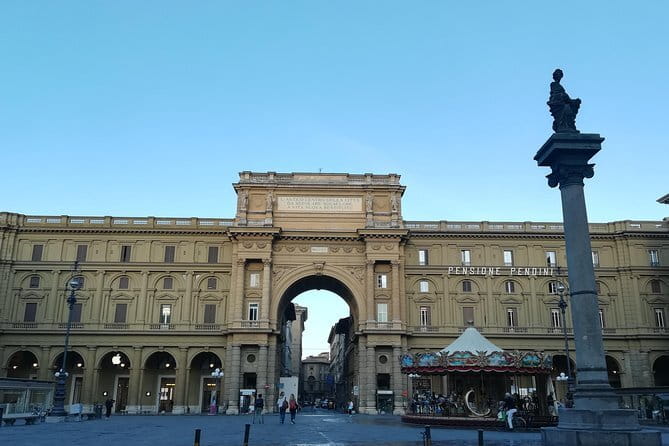
Reviewed · MEDICI & RENAISSANCE TOURS
Renaissance & Medieval Florence Guided Walking Tour plus mobile App
Florence is a lot in 90 minutes. This Renaissance and Medieval walking tour gives you a fast, logical route with an expert local guide and a clear story about how power shaped art, starting in the San Lorenzo area and sweeping to the Duomo Complex.
What I like most is the way the Medici connection turns sightseeing into context, especially around the Medici sites and church spaces tied to their influence. I also love how the walk keeps you moving past key landmarks so you can get your bearings fast for the rest of your trip.
One thing to consider: even when the tour is offered in English, some days run with mixed languages and that can slow the pace at crowded stops—so if you hate waiting, keep that in mind before you book.
In This Review
- Key highlights to expect
- The smartest way to start Florence: one guided loop
- San Lorenzo and the Medici story: where art starts with power
- Getting your Duomo Complex bearings without getting lost
- Il Porcellino at the Straw Market: quick luck stop, no pressure
- Piazza della Signoria: the outdoor sculpture floor plan
- Around the Uffizi and the Vasari Corridor: follow the line through town
- Ponte Vecchio: the famous bridge that actually feels old
- Pitti Palace and the other side: switching gears from big monuments to neighborhoods
- Medieval quarters: Dante’s streets, Bargello, and quiet contrasts
- Price and value: what $30.04 buys you
- Logistics that matter: pace, phones, and comfort
- Who should book this tour (and who might skip it)
- Guides and group experience: what quality looks like
- Should you book this Renaissance & Medieval Florence Walking Tour?
- FAQ
- How long is the guided walking tour?
- What language is the tour offered in?
- Where does the tour start and where does it end?
- Is the app included, and what do I need to use it?
- Are tickets to attractions included?
- What’s the maximum group size?
- Is admission included for the main stops?
- What’s the cancellation policy?
Key highlights to expect
- Medici Florence made practical: you’ll link politics, patronage, and the city’s art in real-world locations.
- Brunelleschi’s footprint: you’ll see Duomo-area landmarks and also reach the elegant cloister connected to the Medici quarter.
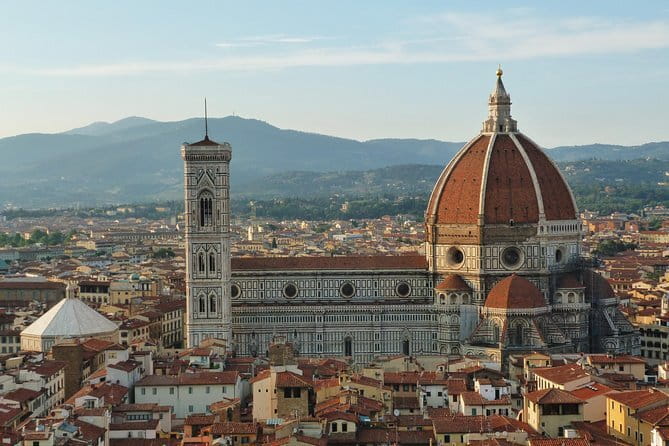
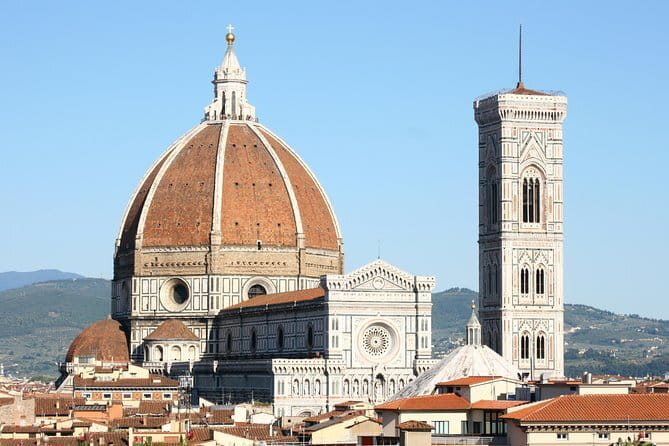
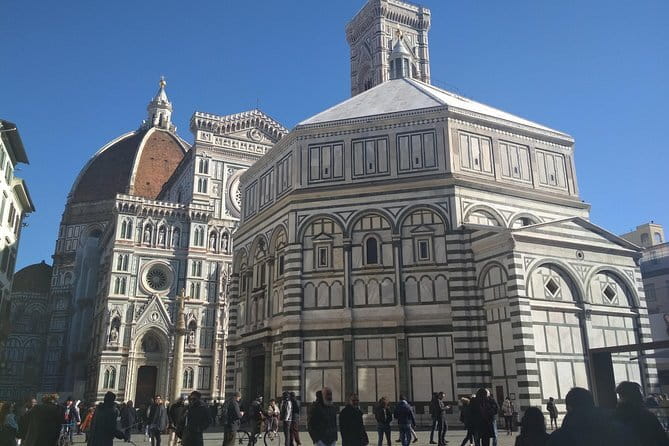
- Duomo Complex orientation: the Dome, Giotto’s bell tower, and the Baptistery fit together in your mind quickly.
- Piazza della Signoria’s sculpture lineup: Palazzo Vecchio plus major statuary help you understand what you’re looking at.
- Old Florence bridge views: Ponte Vecchio plus the route near the Uffizi area helps you connect neighborhoods across the Arno.
- VOX City self-guided follow-up: after the guided portion, you can keep exploring with audio commentary on your phone.
Deeper into Medici Florence and its Renaissance
The smartest way to start Florence: one guided loop
If it’s your first visit, Florence can feel like a museum you forgot to enter. This tour is designed to fix that. You start near Via de’ Martelli, then work through the historic center in a route that touches the Medici story, the Duomo area, and the main “photo-and-stare” squares and streets you’ll likely revisit later.
The timing matters. At about 1 hour 30 minutes, it’s long enough to build meaning, but short enough that you don’t lose half your day in line chaos. And the group size is capped at 20 travelers, which is about right for hearing a guide without feeling stuck behind a crowd wall the whole time.
The value piece is simple: you’re paying for a local guide plus audio support for later. The guided part gives you the story in the moment; the app part helps you keep going afterward with less guesswork.
San Lorenzo and the Medici story: where art starts with power
The tour opens in the San Lorenzo neighborhood, a part of Florence that mixes everyday life with big-ticket Renaissance patronage. You’ll get oriented around the Medici zone, and that theme shows up again and again as the route progresses.
Here’s what I’d pay attention to at this stage:
San Lorenzo is more than a church stop. It’s where you connect the Medici family to the city’s public image. The guide explains how the Medici shaped Florentine politics and art, which changes how you read what you see later in squares and palaces.
You’ll visit Basilica di San Lorenzo and spend time in the Medici church complex area, including the cloister designed by Brunelleschi. If you’ve ever wished for a quick breath of calm in a crowded city, you’ll understand why this kind of space earns attention. It’s described as a green oasis of peace right in the middle of the Medici district.
You’ll also hear about the Medici Chapels linked to major artists, including Michelangelo and Matteo Nigetti. Even if you can’t linger in every chapel the way you would on a museum day, the guide’s job is to give you a mental map: who did what, and why the Medici would want their legacy tied to the kind of art that signals authority.
A key add-on you’ll learn about is Palazzo Medici Riccardi and its courtyard. That courtyard detail is the sort of thing you often walk past without realizing it’s part of the “how power displays itself” story. With a guide, it clicks.
Getting your Duomo Complex bearings without getting lost
After San Lorenzo, the tour shifts to Florence’s architectural centerpiece: the Duomo Complex area around Piazza del Duomo.
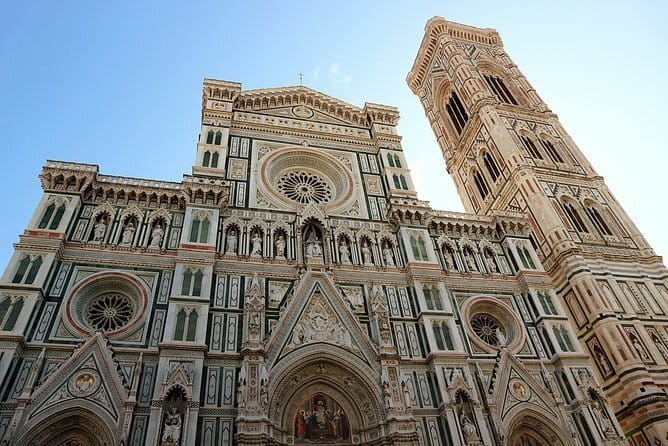
This is where a guided walk earns its keep. The Duomo is not one single thing—it’s a group of masterpieces that relate to each other. You’ll look at and learn about:
- Brunelleschi’s Dome (the headline shape)
- Giotto’s bell tower
- The Baptistery of San John and its famous Gates of Paradise concept
You’ll have about 20 minutes in this area. That’s a sweet spot for orientation. You’ll see the big forms, get the story of why the complex looks the way it does, and leave with a clearer idea of what to revisit if you want deeper time later.
One practical note: the Duomo area is popular and crowded. Your guide can help you decide where to stand for the views and how to avoid getting trapped in the densest pedestrian bottlenecks.
Il Porcellino at the Straw Market: quick luck stop, no pressure
Then you hit a smaller but memorable detour: Fontana del Porcellino, the bronze piglet at the Mercato della Paglia, also called the Straw Market.
This is one of those Florence moments where a tiny landmark has a big tourist ritual around it. You’ll hear about the tradition of touching/rubbing the piglet’s nose for luck. Even if you don’t believe in luck, it’s a fun pause between heavier architecture stops.
This section is about 10 minutes, so it won’t derail your day. It’s a good breather, and it also helps you feel the mix of Florence: Renaissance grandeur followed by a working market street vibe.
Piazza della Signoria: the outdoor sculpture floor plan
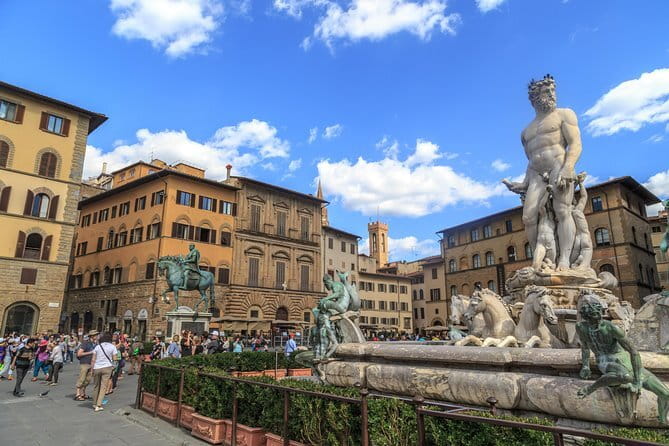
Next comes Piazza della Signoria, one of Florence’s most powerful open-air stages. The square is dominated by Palazzo Vecchio, and it’s also known for its cluster of famous sculptures.
You’ll see Giambologna’s Rape of the Sabine Women. That matters because it’s easy to just treat statues as backgrounds for photos. With a guide, you’ll understand why these works landed here, and how the square worked as a public statement space.
This stop is around 10 minutes. That’s short, but it’s enough time to absorb the big picture: the square is like an outdoor museum you can read from multiple angles, and the palace nearby sets the tone for why these sculptures mattered.
If you’re the kind of visitor who likes to take 10 photos from 5 angles, this is where you’ll have to pace yourself. The crowd can move fast.
Stretch your legs on more Florence walking tours





Around the Uffizi and the Vasari Corridor: follow the line through town
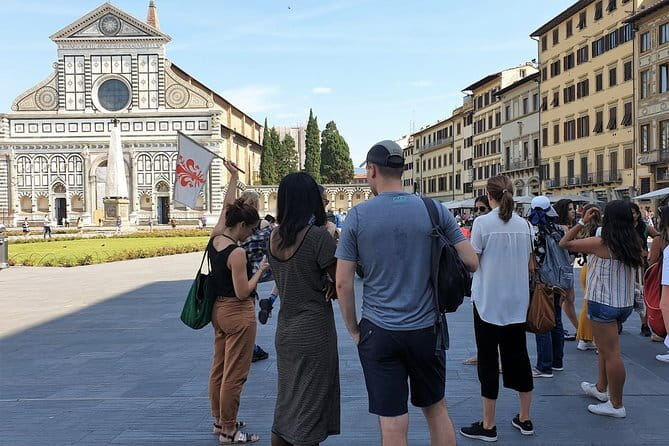
From Piazza della Signoria, your walk includes an external route that follows the celebrated Vasari Corridor path. You’ll pass near the Uffizi Gallery courtyard area, then work toward the Arno.
This part is valuable for two reasons. First, it connects major landmarks you’ll likely want to revisit later. Second, it turns a name you’ve heard (Vasari Corridor) into a spatial idea—something that links parts of Florence rather than sitting in your brain as a random trivia fact.
Even though you’re mainly viewing these spaces from the outside, the context helps. Once you can picture how corridors and city planning tied neighborhoods together, you’ll navigate Florence much more confidently on your own.
Ponte Vecchio: the famous bridge that actually feels old

Then you cross to Ponte Vecchio, the famous jewel bridge and the oldest bridge in Florence.
The big win here is perspective. You get to walk the bridge in a way that ties it to the route you just learned—so it doesn’t feel like you’re only walking for the view. Your guide’s comments help you understand why Ponte Vecchio remains such a defining line across the Arno.
You’ll spend about 15 minutes here, which is enough to do the two essentials:
1) get a good view of the river and skyline
2) understand why this bridge got protected and why it stayed culturally central
Also, if you’re traveling in peak season, expect crowds. The bridge is narrow and always busy.
Pitti Palace and the other side: switching gears from big monuments to neighborhoods
After Ponte Vecchio, the tour continues toward the Pitti Palace area. You’ll see it as part of the walk, not as a deep museum visit (entry isn’t included). Still, seeing it from the right direction helps. Pitti is tied to how power and patronage spilled into the other side of the Arno.
This stretch keeps your itinerary from becoming a checklist of just churches and squares. It adds a palace-neighborhood feel so you can understand Florence as a set of connected zones, not just isolated icons.
Medieval quarters: Dante’s streets, Bargello, and quiet contrasts
The final part shifts toward Florence’s medieval layers, where the vibe changes from Renaissance spectacle to older street logic.
You’ll reach areas associated with Dante Alighieri and see spots like Badia Fiorentina and the Bargello Palace. This is where Florence stops feeling like only a Renaissance headline and starts feeling like a real city with different eras living side-by-side.
This ending also works well for practical travel planning. Once you’ve seen these places, you can decide how much time you want to spend in the medieval core versus returning to the Duomo zone or heading back across the river later.
Price and value: what $30.04 buys you
At $30.04 per person for roughly 90 minutes, the price is fair for what you’re getting: a guided walk with a local professional guide plus access to a self-guided phone app.
Value comes from the combo:
- You get real-time explanations at the exact sites that make the stories make sense.
- After the tour, you can use the mobile guide with audio commentary to keep exploring with a plan.
One cost note: attraction entry tickets are not included. So think of this tour as a guided route plus orientation and exterior viewing (with some free-access areas in the flow). If you want to go inside museums or major sites, you’ll still need separate ticket planning.
Logistics that matter: pace, phones, and comfort
A few practical tips make this tour smoother:
Wear comfortable shoes. You’ll be walking through central Florence streets and squares, with a lot of standing and stopping.
You’ll need your own smartphone and headphones for the app portion after the guided walk. Headphones are not included. If you forget them, you’ll lose one of the benefits of finishing with the VOX City audio guide.
Expect some crowd pressure. This is Florence: even on a good day, your guide is managing people moving in tight spaces.
Also, the visit order can change. That’s normal in city walking tours, especially when crowds and timing at popular points shift.
Who should book this tour (and who might skip it)
This tour is a great fit if:
- it’s your first day in Florence and you want a fast mental map
- you like stories that connect politics, families, and architecture
- you want an easy starting point before choosing a few deeper visits later
- you value a small-group feel (up to 20)
You might think twice if:
- you only want an English-only experience and hate any chance of language switching
- you plan to do lots of paid museum entry that day and prefer a purely museum-focused plan
- you dislike stopping frequently for explanations and would rather roam on your own from the start
Guides and group experience: what quality looks like
The experience depends on the guide, and the positive pattern is clear: when the guide is strong, the whole city makes sense fast. You may encounter guides such as Marta, Helena, Larisa, Maximilian, or Sylvia—each described as attentive, friendly, and focused on connecting details to the bigger story.
When things don’t go perfectly, it’s usually not the route itself. It’s the pace when the group includes multiple languages. If you want the full amount of information per minute, consider timing your visit when your group is most likely to stay within your preferred language.
Should you book this Renaissance & Medieval Florence Walking Tour?
Book it if you want a smart, story-driven introduction to Florence with a clear path through the Medici quarter, the Duomo Complex, Piazza della Signoria, and the Arno crossing. For the price, the guided orientation plus the VOX City follow-up is a solid way to spend a short window in town.
Skip it only if language mixing would bother you a lot, or if you’d rather spend your first hours in Florence without scheduled stops. Otherwise, this is a strong launchpad. You’ll finish knowing where you are, why the landmarks matter, and what to chase next.
FAQ
How long is the guided walking tour?
It runs for about 1 hour 30 minutes.
What language is the tour offered in?
The tour is offered in English, and there is also multilingual audio commentary included.
Where does the tour start and where does it end?
The meeting point is Via de’ Martelli, 50, 50122 Firenze FI, Italy, and the tour ends at Ponte Vecchio, 50125 Firenze FI, Italy.
Is the app included, and what do I need to use it?
You get access to the self-guided mobile city guide. You need your own smartphone and headphones to enjoy the app audio afterward, and headphones are not included.
Are tickets to attractions included?
No. Entry to attractions is not included.
What’s the maximum group size?
There is a maximum of 20 travelers.
Is admission included for the main stops?
The tour notes that some stops list free admission, but attraction entry in general is not included, so you should expect to pay separately for anything that requires tickets.
What’s the cancellation policy?
You can cancel for a full refund up to 24 hours in advance.
More Florence Tours to Weigh Up
- The Best tour in Florence: Renaissance & Medici Tales – guided by a STORYTELLER
★ 5.0 · 12,316 reviews - The Best Tour in Florence: Renaissance and Medici Tales
★ 5.0 · 10,810 reviews - Florence: Chianti Wineries Tour with Wine Tasting
★ 4.5 · 10,071 reviews - Florence: Duomo Cathedral 60-Minute Guided Tour
★ 3.7 · 6,829 reviews - Florence: Hop-on Hop-off Bus Tour: 24, 48 or 72-Hour Ticket
★ 4.0 · 6,283 reviews
More Florence Tours We Have Reviewed
- Florence: Skip-The-Line Uffizi Gallery Timed Entry Ticket
★ 4.5 · 27,832 reviews - Tuscany Day Trip from Florence: Siena, San Gimignano, Pisa and Lunch at a Winery
★ 5.0 · 21,634 reviews - Florence: Timed Entry to Michelangelo’s David + Audio App
★ 4.6 · 19,496 reviews - Florence: Leonardo Interactive Museum Entry Ticket
★ 4.5 · 12,957 reviews - Florence: Michelangelo’s David Skip-the-Line Entry Ticket
★ 4.5 · 12,764 reviews
The Medici Story Continues
- The Best tour in Florence: Renaissance & Medici Tales – guided by a STORYTELLER
★ 5.0 · 12,316 reviews - The Best Tour in Florence: Renaissance and Medici Tales
★ 5.0 · 10,810 reviews - Uffizi Gallery: Renaissance Masterpieces Guided Tour
★ 4.6 · 6,070 reviews - Florence: Renaissance and Medici Tales Guided Walking Tour
★ 4.8 · 1,549 reviews - Guided Medici Tour Florence: Discover Mysteries & History
★ 4.3 · 1,077 reviews
Fresh from our Florence review desk
- Small-Group Pasta Cooking Class and Market Tour in Florence★ 5.0 · 3 reviews
- Palatina Gallery and Pitti Guided Tour in Florence★ 5.0 · 3 reviews
- Tuscan Evening Tour: Fiat 500, 8:30 to 10 PM★ 5.0 · 3 reviews
- Journey into Art: Florence’s Accademia★ 4.5 · 3 reviews
- Paint and Drink Florentine Hills★ 5.0 · 3 reviews
- Truffle hunting and lunch experience, with Vinci and winery.★ 4.5 · 3 reviews
Medici & Renaissance Tours, compared.
 ★ 5.0The Best tour in Florence: Renaissance & Medici Tales – guided by a STORYTELLERFrom $312,316 reviews
 ★ 5.0The Best Tour in Florence: Renaissance and Medici TalesFrom $310,810 reviews
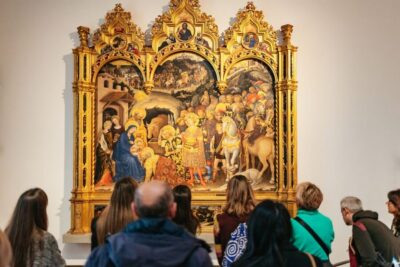 ★ 4.6Uffizi Gallery: Renaissance Masterpieces Guided TourFrom $886,070 reviews
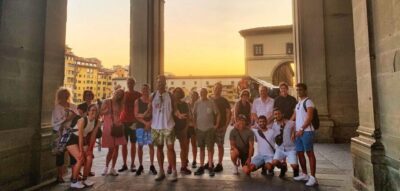 ★ 4.8Renaissance and Medici Tales Guided Walking TourFrom $21,549 reviews
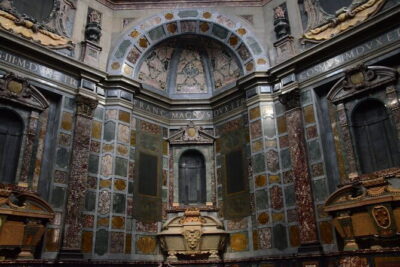 ★ 4.3Guided Medici Tour Florence: Discover Mysteries & HistoryFrom $571,077 reviews
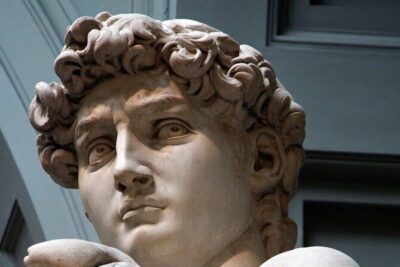 ★ 4.0Accademia Gallery: Michelangelo’s David and High Renaissance ArtFrom $43872 reviews
 ★ 4.7Guided Tour of Medici Family Secrets and ChapelsFrom $93512 reviews
 ★ 5.0Florence Private Tour: Renaissance, Famous Families & Hidden GemsFrom $199233 reviews
Browse the lists this tour appears in