
Reviewed · MEDICI & RENAISSANCE TOURS
The Medici family and the Renaissance with a local art historian
The Medici story turns Florence into a living classroom. This 2-hour walk with an art historian focuses on the people behind the Renaissance—especially the Medici—and then anchors those stories in the actual buildings you’ll see today. I love the storytelling-first approach, because it makes power, art, and politics feel connected instead of stuck in a textbook. I also like that you get a smart mix of stops where some entry costs are covered by the day’s layout, while other sites clearly need separate tickets. One possible drawback: a few of the stops require tickets you’ll buy separately, so you’ll want to plan a little time and budget for that.
You start in the Medici neighborhood, then walk toward Florence’s civic and religious heart. You’ll see how Renaissance influence shows up in stone facades, public squares, and the way the city organizes space. The guide’s job is not to recite dates. It’s to help you see why these places mattered—like how a family rose from humble roots to dominate European culture in a bit more than a century. The group stays small (up to 15), which makes it easier to ask questions and keep the pace comfortable.
A key consideration: the tour is weather-dependent and designed as a walking route. Come with comfortable shoes and water, and expect it to feel like a focused afternoon stroll rather than a sit-down museum day.
In This Review
- Key points to know before you go
- The Medici Story in 2 Hours: What You Really Get
- Piazza di San Lorenzo Start: Getting Your Bearings Fast
- Basilica di San Lorenzo: Renaissance Roots in Stone
- Palazzo Medici Riccardi: Why a Family Became a Cultural Force
- Duomo Time: A Majestic Giant Without the Ticket Stress
- Piazza della Signoria: Public Power and Medici Reach
- Palazzo Vecchio: Politics in Plain Sight, Color in the Stone
- Ponte Vecchio Finale: The Wow Factor by the River
- The Best Part: Art History Told Through People (Not Just Places)
- Price and Tickets: How This $100 Tour Maps to Real Costs
- Route Timing and Comfort: Make It Easy on Yourself
- Who Should Book This Medici and Renaissance Walk
- Should You Book This Tour?
- FAQ
- How long is the tour?
- How much does the tour cost?
- Where does the tour start and when?
- Where does the tour end?
- Is this a walking tour, and what should I bring?
- Is the ticket mobile?
- What’s the group size limit?
- Are admissions included for every stop?
- Is service animal access allowed?
- What happens if the weather is bad or I need to cancel?
Key points to know before you go
- Small group size (max 15) keeps the pace readable and the conversation possible.
- Storytelling art history connects Medici power to real buildings, not just famous names.
- 2-hour route hits major Renaissance waypoints without turning into a full-day grind.
- Some stops are ticket-free, so you control what to pay for and what to experience externally.
- You’ll end near Ponte Vecchio and the Uffizi area, perfect if you’re doing museum time later.
Deeper into Medici Florence and its Renaissance
The Medici Story in 2 Hours: What You Really Get
Florence is basically a city of arguments: art vs. power, faith vs. ambition, beauty vs. control. This tour gives you a clean way into that argument by centering the Medici family—the dynasty that helped shape Renaissance culture. In two hours, you won’t see every masterpiece. But you’ll get the big connections: who held influence, how art fit into that influence, and why specific places in Florence became stages.
At $100 for about two hours, the price makes sense if you think of it as a guide-driven interpretive walk. A self-guided stroll can get you the buildings. A guided version helps you understand what you’re looking at while you’re still in the spot—when the details actually matter. Also, this isn’t a giant group. With a cap of 15, the guide can keep the route moving while still answering questions.
This is the kind of experience that helps you return from Florence feeling like you learned something you can explain to others—without sounding like you memorized a list of dates.
Piazza di San Lorenzo Start: Getting Your Bearings Fast
You meet at Piazza di San Lorenzo, 13 in Florence at 2:00 pm. The start area is close to the action and easy to find. Since the tour is near public transportation, it’s not a logistics nightmare if you’re building a day around museum tickets.
The first minutes matter. Your guide sets the stage with Florence symbols and a quick map of what you’re about to see. I like this kind of warm-up because Florence can feel like you’re surrounded by history—until someone helps you connect the dots. You get oriented to the Renaissance theme early, so the rest of the walk feels purposeful.
Practical tip: wear comfortable shoes. This route is short, but it’s still Florence—stone streets, some uneven spots, and a steady walking rhythm.
Basilica di San Lorenzo: Renaissance Roots in Stone
Stop 1 is the Basilica di San Lorenzo, where the guide introduces the tour’s theme and Florence’s symbols. Expect a short window here (about 15 minutes). It’s not a deep architectural lecture. It’s more like a “here’s why this building matters” moment that prepares you for the next sites where the Medici connection becomes more obvious.
The itinerary notes that admission for this stop is not included. That’s a real-world detail worth planning for. You can still appreciate the exterior and the way the guide frames the place, but if you want to go inside, you’ll need the separate ticket on your own.
The upside of this stop is timing. A brief intro at the right moment helps you recognize what you’d otherwise walk past with zero context.
Palazzo Medici Riccardi: Why a Family Became a Cultural Force
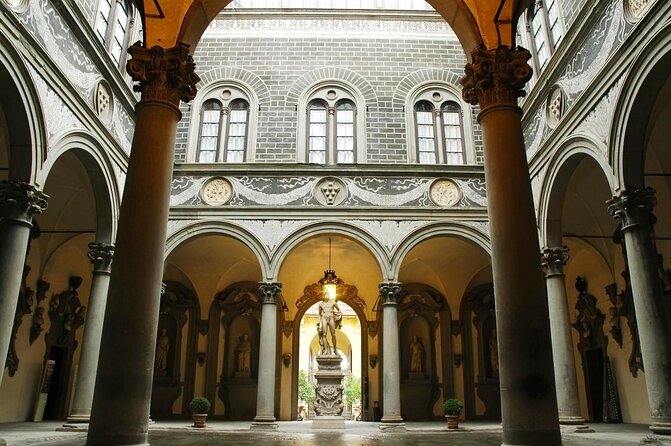
Stop 2 is Palazzo Medici Riccardi, another short stop (about 15 minutes). This is where the tour leans into the idea that history is made by people—specifically the Medici. The plan is to meet Laurence the Magnificent and other major figures from the Renaissance narrative, using the palace as your anchor.
This stop also has admission marked as not included, so again, you may choose to focus on the outside views and the guide’s framing, or consider buying tickets if you want more interior access.
What I like about this part is the framing. A palace can be just a pretty building if you look at it as architecture only. But if you understand it as a statement—of wealth, taste, influence—it changes how you notice details. The guide points you toward the cultural logic behind the Medici rise.
Also, this stop tends to work especially well if your interest is art history with human stakes: patronage, reputation, and the social mechanics that help art happen.
Duomo Time: A Majestic Giant Without the Ticket Stress
Stop 3 is the Duomo area, where the itinerary notes admission is free. You get about 20 minutes here. That extra time is useful because the Duomo is one of those “you need a few minutes to reset your eyes” landmarks. The guide answers the practical big question: why it’s so special.
This is the point where the tour shifts from family power to city-scale identity. The Duomo isn’t a private “Medici brand” building. It’s Florence declaring something to itself and the world. Seeing it through the Renaissance lens gives you more than a postcard view—you start noticing how religious and civic ambition overlap in public space.
No ticket hassle at this stop means less stress. You can spend your attention where it matters: looking, listening, and taking in the scale.
- The Best tour in Florence: Renaissance & Medici Tales – guided by a STORYTELLER
★ 5.0 · 12,316 reviews



Piazza della Signoria: Public Power and Medici Reach
Stop 4 is Piazza della Signoria (about 15 minutes), and it’s marked as free. This is a great choice for a guided walk because public squares are where power becomes visible. The guide ties the space back to Medici influence and brings in other family figures to connect the story to what’s in front of you.
The main value here is perspective. If you’ve only ever seen Renaissance art behind museum glass, it can be hard to imagine how political narratives lived in everyday streets. This stop helps you see that art and authority weren’t separate topics.
Look for details the guide calls out—small cues on buildings and the way the square functions as a stage. It’s the kind of listening that makes you start noticing without trying.
Palazzo Vecchio: Politics in Plain Sight, Color in the Stone
Stop 5 is Palazzo Vecchio, another paid admission stop (not included), with about 15 minutes allocated. The tour calls it Florence’s political heart and notes it’s one of the city’s most colorful palaces. In other words: this is where the Renaissance story stops being just about art patrons and becomes about how power got organized.
This is also where you can feel the difference between “knowing about the Renaissance” and actually understanding how a city ran. Palazzo Vecchio is the government building vibe turned into drama. Even if you don’t go inside, the guide’s commentary helps you interpret the exterior as a piece of political messaging.
A quick note: since admission isn’t included here, you’ll want to decide early whether you’re satisfied with an exterior-focused stop. The tour timing is tight, so don’t plan on long ticket lines unless your schedule is flexible.
Ponte Vecchio Finale: The Wow Factor by the River
If time allows, the tour ends at Ponte Vecchio (about 10 minutes), marked free. The itinerary’s “just one word: Wow” energy is fair. Ponte Vecchio is one of those places that feels instantly iconic, even if you’ve only seen it in photos.
The ending point is practical: you finish at Lungarno Anna Maria Luisa de’ Medici, 8, in the Renaissance corridor near the Uffizi area and right in front of Ponte Vecchio. That makes it easy to keep your day moving—either toward a museum visit or just a slow walk along the river afterward.
This final stop also works as a story closure. Your route began in Medici symbolic territory and ends in a public, scenic “Florence postcard with history underneath” moment. You’ll leave with the sense that Renaissance influence wasn’t confined to galleries. It shaped how the city moved and how people gathered.
The Best Part: Art History Told Through People (Not Just Places)
The biggest strength of this tour is the guide method. Several guide styles show up in the experience—like Deborah’s engaging delivery and Manuel Messina’s story-driven approach. Both points toward the same idea: the Renaissance becomes understandable when you follow human choices and ambitions.
In particular, I like that the guide approach highlights details people tend to miss on their own, including things like hidden passages and architectural cues you might walk right by. That’s not about being dramatic. It’s about training your eyes: if you know what to look for, Florence becomes a puzzle with answers.
You also get a “password” style of learning—storytelling as the main tool. The result is that history doesn’t feel like homework. It feels like plot, with patrons, artists, and political pressure all acting in the same drama.
And because the group is small, you’re more likely to get answers to your specific questions. If you’re the kind of person who wants the why behind the wow, this format fits.
Price and Tickets: How This $100 Tour Maps to Real Costs
Let’s talk value in plain terms. The tour costs $100 for about 2 hours, and the route focuses on key Renaissance landmarks. That’s not the cheapest thing you can do in Florence, but it’s not a rip-off either—especially because you’re getting an art historian-style guide who helps you interpret what you’re seeing.
Where value can vary for you is admissions. The itinerary labels some stops as ticket-free (Duomo, Piazza della Signoria, Ponte Vecchio) and others as admission ticket not included (Basilica di San Lorenzo, Palazzo Medici Riccardi, Palazzo Vecchio). So your total trip cost could rise if you choose to enter all the paid sites.
My advice: decide your focus before you go.
- If you mainly want explanations and exterior context, you can keep costs lower.
- If you want interiors at the paid stops, budget extra and arrive with a clear plan.
Either way, you’ll still get a guided experience from stop to stop. You’re not paying for a checklist of entrances—you’re paying for interpretation in place.
Route Timing and Comfort: Make It Easy on Yourself
The itinerary is structured as short segments: roughly 15 to 20 minutes at most stops, then a quick finish by the river. That timing works because you don’t get trapped in one location. Florence is a walking city, so the pace keeps you moving while the guide can reset your attention at each new scene.
Still, there are a few practical things that matter:
- Bring water. The guide request is clear, and Florence can surprise you with heat even when it feels mild.
- Wear shoes that can handle stone streets.
- Wear good vibes, because this tour runs on engagement, not silent head-down sightseeing.
Service animals are allowed, and the meeting point is near public transportation—good notes if you’re juggling a busy schedule.
Who Should Book This Medici and Renaissance Walk
This is a strong fit if you:
- want Renaissance art history that explains power and motivation, not just dates
- like walking tours that end near major sights for easy follow-up
- prefer small groups (max 15) over crowded big-bus pacing
- enjoy guides who make connections between people and places
You might skip it if you want a long museum-style visit or if you strongly prefer tours where every site entrance is included. Here, some entries are free on the route, and some aren’t.
Should You Book This Tour?
If you want a focused, two-hour way to understand why the Medici mattered to Florence, book it. The guide-driven storytelling angle is the real benefit, and the route is well chosen: you hit Medici-linked architecture, major public spaces, and a Duomo moment without turning the day into a marathon.
One final decision tip: if you’re on the fence about paying for interior entries at the “ticket not included” stops, decide your priority now. This tour still works as an excellent guided walk even if you only do exterior viewing where tickets are separate.
In short: if you want Florence to make sense while you’re still there, this is a smart use of a single afternoon.
FAQ
How long is the tour?
The tour lasts about 2 hours.
How much does the tour cost?
The price is $100.
Where does the tour start and when?
It starts at Piazza di San Lorenzo, 13, 50123 Firenze FI, Italy at 2:00 pm.
Where does the tour end?
It ends at Lungarno Anna Maria Luisa de’ Medici, 8, 038983 Firenze FI, Italy, near the Uffizi Gallery and in front of Ponte Vecchio.
Is this a walking tour, and what should I bring?
Yes, it’s a walking route. Bring water and wear comfortable shoes.
Is the ticket mobile?
Yes. The tour includes a mobile ticket.
What’s the group size limit?
The tour has a maximum of 15 travelers.
Are admissions included for every stop?
No. Some stops are marked as admission not included (like Basilica di San Lorenzo, Palazzo Medici Riccardi, and Palazzo Vecchio), while others are marked free (like the Duomo area, Piazza della Signoria, and Ponte Vecchio).
Is service animal access allowed?
Yes, service animals are allowed.
What happens if the weather is bad or I need to cancel?
The experience requires good weather. If it’s canceled due to poor weather, you’ll be offered a different date or a full refund. For cancellation, you can cancel up to 24 hours in advance for a full refund.
More Florence Tours We Have Reviewed
- Florence: Skip-The-Line Uffizi Gallery Timed Entry Ticket
★ 4.5 · 27,832 reviews - Tuscany Day Trip from Florence: Siena, San Gimignano, Pisa and Lunch at a Winery
★ 5.0 · 21,634 reviews - Florence: Timed Entry to Michelangelo’s David + Audio App
★ 4.6 · 19,496 reviews - Florence: Leonardo Interactive Museum Entry Ticket
★ 4.5 · 12,957 reviews - Florence: Michelangelo’s David Skip-the-Line Entry Ticket
★ 4.5 · 12,764 reviews
The Medici Story Continues
- The Best tour in Florence: Renaissance & Medici Tales – guided by a STORYTELLER
★ 5.0 · 12,316 reviews - The Best Tour in Florence: Renaissance and Medici Tales
★ 5.0 · 10,810 reviews - Uffizi Gallery: Renaissance Masterpieces Guided Tour
★ 4.6 · 6,070 reviews - Florence: Renaissance and Medici Tales Guided Walking Tour
★ 4.8 · 1,549 reviews - Guided Medici Tour Florence: Discover Mysteries & History
★ 4.3 · 1,077 reviews
Fresh from our Florence review desk
- Small-Group Pasta Cooking Class and Market Tour in Florence★ 5.0 · 3 reviews
- Palatina Gallery and Pitti Guided Tour in Florence★ 5.0 · 3 reviews
- Tuscan Evening Tour: Fiat 500, 8:30 to 10 PM★ 5.0 · 3 reviews
- Journey into Art: Florence’s Accademia★ 4.5 · 3 reviews
- Paint and Drink Florentine Hills★ 5.0 · 3 reviews
- Truffle hunting and lunch experience, with Vinci and winery.★ 4.5 · 3 reviews
Medici & Renaissance Tours, compared.
 ★ 5.0The Best tour in Florence: Renaissance & Medici Tales – guided by a STORYTELLERFrom $312,316 reviews
 ★ 5.0The Best Tour in Florence: Renaissance and Medici TalesFrom $310,810 reviews
 ★ 4.6Uffizi Gallery: Renaissance Masterpieces Guided TourFrom $886,070 reviews
 ★ 4.8Renaissance and Medici Tales Guided Walking TourFrom $21,549 reviews
 ★ 4.3Guided Medici Tour Florence: Discover Mysteries & HistoryFrom $571,077 reviews
 ★ 4.0Accademia Gallery: Michelangelo’s David and High Renaissance ArtFrom $43872 reviews
 ★ 4.7Guided Tour of Medici Family Secrets and ChapelsFrom $93512 reviews
 ★ 5.0Florence Private Tour: Renaissance, Famous Families & Hidden GemsFrom $199233 reviews
Browse the lists this tour appears in