
Reviewed · HISTORICAL TOURS
Florence Highlights: Guided Walking Tour of the Historic Center
Florence is best learned by walking its layers. This guided-plus-audio tour takes you through major sights and a few lesser-known stretches, with live English commentary and a Vox City app that helps you keep moving at your pace. I especially like the mix of big-hitters (Duomo and the Medici-era landmarks) with spots you might miss if you only chase the obvious photo stops. The other strong plus is how easy it is to use the audio while you go—so you’re not stuck waiting for a live explanation every minute. One possible drawback: if you prefer very structured, constant narration, you may feel the pace shift when other people fall behind or get sorted out.
I’ve found the best use of this kind of tour is simple: treat the guide as your compass, then lean on the audio when you want details without slowing the group. If you’re there for classic Florence highlights and want a little control over the rhythm, you’re in the right place. Just plan to arrive a few minutes early; timing hiccups can happen when you’re coordinating a small group in a dense historic center.
In This Review
- Key Points to Know Before You Go
- What This Florence Walk Really Feels Like (Guided + You-Control-It)
- Meeting at Café Firenze: The Start That Sets the Tone
- The Route: From a Donatello Church to Florence’s Most Famous Squares
- Palaces and Rivalry: Why Strozzi Versus Medici Matters
- Fountains and Statue Squares: Learning to Read Florence’s Details
- Duomo Area Time: Santa Maria del Fiore, Baptistery, and the Campanile
- Romanesque Churches, Roman Roots, and the Dante Connection
- The Chestnut Tower and Florence’s “City of Lilies” Mood
- Price and Value: Why $30.12 Can Make Sense
- Group Size, English, and the Reality of Walking Pace
- Who This Tour Suits Best (And Who Might Prefer Something Different)
- Should You Book This Florence Highlights Walking Tour?
- FAQ
- Do I get a live guide on this tour?
- Do I need to bring headphones or a mobile phone?
- What languages are available for the audio guide?
- Are tickets or entry to attractions included?
- Where do I meet the guide?
- How long is the tour, and how many people are in the group?
- What’s the cancellation policy?
- Is this tour suitable for most people?
Key Points to Know Before You Go
- Live English guide plus multilingual audio helps you follow the story even if you drift slightly ahead for photos
- Flexible walking format lets you step away for a bit and come back to continue your route
- Central meeting point at Café Firenze makes it quick to find your start without extra transit planning
- About 30 people max keeps it intimate enough for real landmark-scale sightseeing
- Duomo-and-Palaces coverage hits the Cathedral area, Medici symbolism, and Florence rivalry lore
- Quick device-dependent setup: you need your phone to use the sightseeing app and audio
Stretch your legs on more Florence walking tours

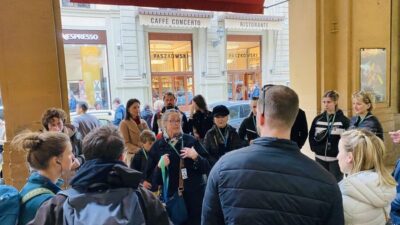
What This Florence Walk Really Feels Like (Guided + You-Control-It)
This tour is built for a common reality in Florence: you’ll see plenty, but you still want room to look up, stop for a photo, and duck into the flow of real streets. You start with a guided walking tour (about 90 minutes) and then you get a sightseeing app with multilingual audio, so the tour can feel partly guided and partly self-paced.
The live commentary is in English, and the audio is available in English, French, German, Italian, Spanish, and Chinese. That’s useful if you’re traveling with someone whose English is fine for conversation but who wants details in their own language. It also helps if you miss a sentence while you’re stopping to admire architecture you didn’t expect.
One extra practical perk: you can use the app to relocate the guide later. That flexibility is exactly why this tour works well when you hit a long queue or need a quick bathroom break. In my view, it’s a smart approach for a city where the sights don’t politely line up in one perfect order.
Meeting at Café Firenze: The Start That Sets the Tone
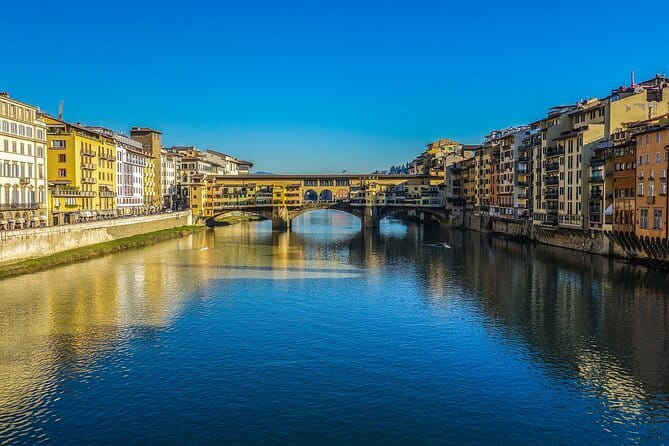
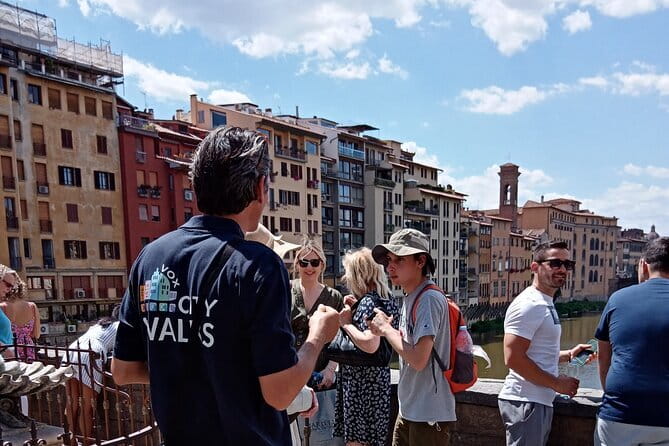
You meet at Café Firenze, Via de’ Martelli, 50/r, on the corner of Via de’ Pucci. Your guide wears a dark blue Vox City uniform, so you’re not playing guessing games in front of the wrong person holding the wrong sign.
Arrive around 5 minutes early if you can. That small buffer matters because Florence streets are tight and people show up with different travel-time rhythms. You’ll get better results if everyone starts together instead of spending the first minutes sorting logistics.
Also note the practical reality: this is a walking tour in a historic center where you’ll cover a lot of distance on foot. If you’re sensitive to crowds, bring comfortable shoes and plan to slow down for stairs, uneven pavement, and frequent photo stops.
The Route: From a Donatello Church to Florence’s Most Famous Squares
The walk has a satisfying arc. It begins with standout church art, then moves into the city’s civic heart—squares, palaces, and fountains—before shifting toward the Cathedral complex and the older layers of Florence.
Early on, you’ll admire a church connected with Donatello. The key detail in this stop is that the church is described as about 700 years old, built on the site of a monastery, and it houses art by Donatello. Even if you’re not chasing names, Donatello’s presence is a clear signal that this is not just street-level sightseeing.
Next comes the covered market atmosphere, with Renaissance-style arches and a piglet fountain that locals and visitors love for its charm. It’s a good palate cleanser between larger monuments because the market area feels more grounded in everyday Florence energy—food, chatter, and that “real city” feeling.
Then you move toward one of the main squares tied to Florence’s political importance, where you’ll notice the distinctive W shape. Nearby, you’ll look up at the town hall, a symbol of Florence heritage and its influence during the Renaissance era. I like these civic stops because they show how the city expressed power through art and design—not just through churches and museums.
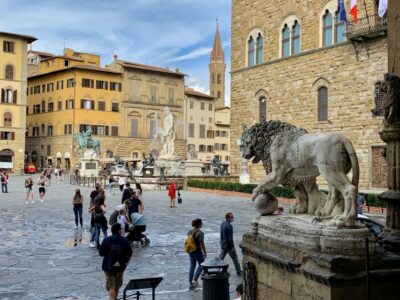
From there, you’ll take in a Medici-era fountain created almost 500 years ago, plus a step into an arched gallery area featuring historic statues. This string of stops is where the tour earns its keep: it links Florence’s ruling families to what you can still see today—sculpture placement, fountain themes, and the way public art becomes political messaging.
Palaces and Rivalry: Why Strozzi Versus Medici Matters
One of the tour’s smartest choices is including the “family rivalry” angle. You’ll spot the high Renaissance palace designed by Baccio d’Agnolo and then move on to the palace built by the Strozzi family, the long-standing rivals of the Medici.
If you’ve ever wondered why Florence feels so full of competing claims—different plaques, different facades, different family symbols—this is where it clicks. The Medici weren’t the only power in town, and the Strozzi weren’t just background characters. When you see their palace near the rest of the civic center, you feel how architecture becomes a kind of public argument.
You also pass through a triangular piazza lined with Gothic and Renaissance palaces. That geometry is part of what makes Florence special: small spaces compress big stylistic changes. In practice, it’s also a great photo moment because the façades create natural framing lines.
Fountains and Statue Squares: Learning to Read Florence’s Details

Florence is famous for major landmarks, but the city also rewards you for looking at the smaller story elements: statues, inscriptions, and recurring sculptural themes in public spaces.
In one square, you’ll take snapshots of statues lining the Fountain of the Naiads. This stop works especially well if you like to look up while you’re walking. The fountain and its surroundings make you slow down without needing a museum ticket.
You’ll also see a towering church that’s tied to the Medici family resting place. The data here matters: it’s framed as a final resting place for several Medici members. Even without going inside, that context changes how you look at the exterior—suddenly it’s not just a tall silhouette.
With a local guide, more of Florence to explore
- The Best tour in Florence: Renaissance & Medici Tales – guided by a STORYTELLER
★ 5.0 · 12,316 reviews



Duomo Area Time: Santa Maria del Fiore, Baptistery, and the Campanile

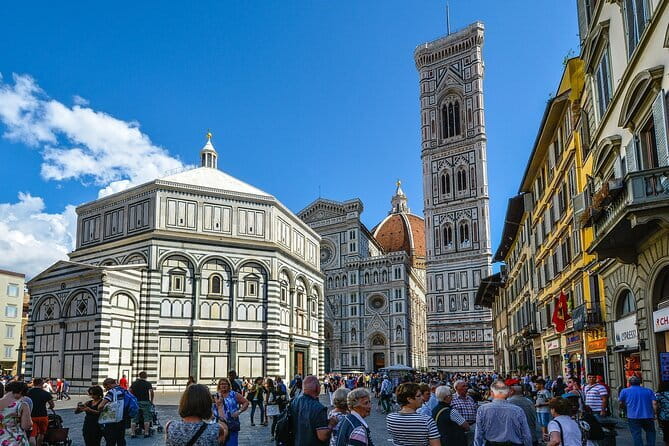
This is the part most people travel for, and this tour positions it late enough that you’re ready for the scale. You’ll get ready-to-photo moments for Santa Maria del Fiore, including the famous dome designed by Filippo Brunelleschi. The dome is described as dominating Florence’s skyline and the site is noted as a UNESCO World Heritage Site.
Next comes the octagonal baptistery building, described as the exclusive place for baptism in Florence for centuries. If you only associate the Duomo with the dome, this stop adds the missing context: Florence’s main religious life isn’t just about one church, it’s about a whole ritual complex.
Then you’ll look up at the bell tower, built almost 700 years ago and over 80 meters tall. When you’re standing there, the height feels immediate. The tower isn’t just a backdrop—it’s a key landmark that helps you orient yourself in Florence’s center streets.
Practical tip: this is also the zone where you’ll want to pause for photos even if you feel slightly behind schedule. The buildings are too large to do them justice at walking speed.
Romanesque Churches, Roman Roots, and the Dante Connection

The route includes one of Florence’s oldest churches with Romanesque style architecture. That’s a valuable contrast after you’ve been looking at Renaissance civic power and Medici-linked art. Romanesque tends to feel heavier, older, and less “light” than what you’ll see in later Renaissance design, so you feel the timeline in your feet and eyes.
You’ll also pass by what’s described as the oldest building still standing in the historic center of Florence, with origins uncertain but foundations dating back to the Roman era. Even if you can’t instantly identify the building by Roman-era details, the idea is powerful: you’re standing on foundations with a much longer backstory than most cities.
Then you’ll see the historic museum dedicated to Dante Alighieri, famed for the Divine Comedy. For me, it’s a good mental break from architecture-only focus. Dante gives Florence another kind of legacy—literature and imagination—not just stone and sculpture.
The Chestnut Tower and Florence’s “City of Lilies” Mood
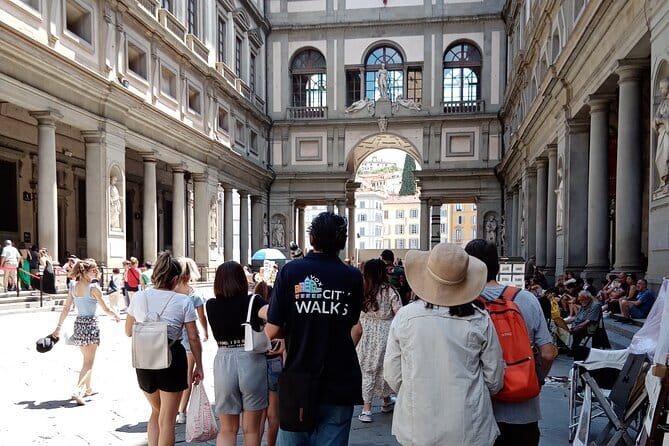
Toward the end, you’ll spot what’s called the Chestnut Tower, noted as one of the best preserved towers in Florence’s historic center. Towers in Florence are like punctuation marks—they signal old watch points and urban organization, even as the city evolves around them.
Finally, you’ll finish with a sense of the city’s cultural heritage, tied to the nickname City of Lilies. Florence’s branding may be centuries old in spirit, but on foot it feels more personal: you start seeing the city’s symbols as part of everyday design rather than souvenirs.
The tour ends back at the meeting point, so you don’t have to fight your way back across the center without a plan.
Price and Value: Why $30.12 Can Make Sense
At $30.12 per person, you’re not paying for museum tickets. Entry is explicitly not included, and that can be a dealbreaker if your ideal day is strict “ticket-and-line” sightseeing.
But you are paying for a smart mix:
- a live guide (90 minutes) in English
- plus a multilingual audio guide you can keep using as you walk
- plus the convenience of a central meeting spot
- plus a route that hits famous landmarks and some less predictable corners
For me, the value comes from the time-saving logic. Florence can overwhelm you if you’re bouncing between attractions with no sense of how they connect. This tour gives you a storyline that makes later visits feel less random.
If you’re the type who enjoys photos and big exteriors but doesn’t need to pay for entry every stop, this is one of the more budget-friendly ways to get your bearings fast.
Group Size, English, and the Reality of Walking Pace
The tour has a maximum of 30 travelers. That’s small enough to feel like a group, but it still means you’ll sometimes wait for the stragglers—especially around narrow streets and photo chokepoints.
The experience is offered in English, and the live commentary is English too. If you’re also using the app, you can switch audio to another language to match who you’re with.
One consideration: because it’s a guided walk plus app control, you’ll get the best results if you’re comfortable with mild stops and starts. On some days, a late start can happen due to coordination. If you’re strict about a reservation after the tour, give yourself extra buffer.
Who This Tour Suits Best (And Who Might Prefer Something Different)
This tour fits you if:
- you want major Florence highlights without spending your entire time in lines
- you like a mix of guided explanation and self-paced listening
- you want an easy, central way to learn the city’s symbolism—especially Medici-linked landmarks
- you’re okay with walking and stopping for photos outdoors
It might be less ideal if you want:
- an ultra-structured lecture feel with constant narration
- museum entry included in the price
- a pace designed for frequent sit-down breaks
If you do choose it, do yourself a favor and bring the basics that make walking tours pleasant: good shoes, water, and a phone that can run the app.
Should You Book This Florence Highlights Walking Tour?
Yes, if your goal is a practical overview with strong landmarks and helpful context, without paying for multiple tickets. The combination of a live English guide and multilingual audio makes it easy to keep your day moving, and the route structure gives you both civic Florence (squares and town-hall symbols) and spiritual Florence (Duomo complex and older churches).
I’d say book it especially if:
- you want to understand why Medici and Strozzi still matter visually
- you want Duomo-area landmarks but also care about what surrounds them
- you like the idea of using the app to adjust your rhythm instead of being trapped by one fixed pace
If you’re traveling with kids or you hate the thought of strict guided schedules, the app flexibility can be a lifesaver. Just arrive early, be ready for walking, and plan your next stop with a little cushion.
FAQ
Do I get a live guide on this tour?
Yes. The tour includes a guided walking tour (90 minutes) with live commentary in English.
Do I need to bring headphones or a mobile phone?
You’ll need your own mobile device to use the sightseeing app. Headphones are also not included, so plan to use what you have.
What languages are available for the audio guide?
The pre-recorded audio guide and the sightseeing app audio are available in English, French, German, Italian, Spanish, and Chinese.
Are tickets or entry to attractions included?
No. Entry to attractions is not included.
Where do I meet the guide?
Meet at Café Firenze, Via de’ Martelli, 50/r, on the corner of Via de’ Pucci. The guide wears a dark blue Vox City uniform.
How long is the tour, and how many people are in the group?
It’s listed as about 1 to 2 hours (approx.), with the guided portion at 90 minutes. The group size is capped at maximum 30 travelers.
What’s the cancellation policy?
You can cancel for a full refund up to 24 hours before the experience’s start time. If you cancel less than 24 hours before, the amount paid is not refunded.
Is this tour suitable for most people?
The information states that most travelers can participate.
More Florence Walks
- Florence: Highlights Walking Tour with Expert Guide
★ 4.6 · 4,662 reviews - Uffizi & Accademia Timed Entry: Small Group Duomo Walking Tour
★ 4.5 · 3,630 reviews - Florence: Duomo Complex with Tickets & City Walk Guided Tour
★ 4.7 · 2,057 reviews - Florence: Guided Walking Tour
★ 4.6 · 1,602 reviews - Florence: Renaissance and Medici Tales Guided Walking Tour
★ 4.8 · 1,549 reviews
More Florence Tours to Weigh Up
- The Best tour in Florence: Renaissance & Medici Tales – guided by a STORYTELLER
★ 5.0 · 12,316 reviews - The Best Tour in Florence: Renaissance and Medici Tales
★ 5.0 · 10,810 reviews - Florence: Chianti Wineries Tour with Wine Tasting
★ 4.5 · 10,071 reviews - Florence: Duomo Cathedral 60-Minute Guided Tour
★ 3.7 · 6,829 reviews - Florence: Hop-on Hop-off Bus Tour: 24, 48 or 72-Hour Ticket
★ 4.0 · 6,283 reviews
More Florence Tours We Have Reviewed
- Florence: Skip-The-Line Uffizi Gallery Timed Entry Ticket
★ 4.5 · 27,832 reviews - Tuscany Day Trip from Florence: Siena, San Gimignano, Pisa and Lunch at a Winery
★ 5.0 · 21,634 reviews - Florence: Timed Entry to Michelangelo’s David + Audio App
★ 4.6 · 19,496 reviews - Florence: Leonardo Interactive Museum Entry Ticket
★ 4.5 · 12,957 reviews - Florence: Michelangelo’s David Skip-the-Line Entry Ticket
★ 4.5 · 12,764 reviews
Fresh from our Florence review desk
- Small-Group Pasta Cooking Class and Market Tour in Florence★ 5.0 · 3 reviews
- Palatina Gallery and Pitti Guided Tour in Florence★ 5.0 · 3 reviews
- Tuscan Evening Tour: Fiat 500, 8:30 to 10 PM★ 5.0 · 3 reviews
- Journey into Art: Florence’s Accademia★ 4.5 · 3 reviews
- Paint and Drink Florentine Hills★ 5.0 · 3 reviews
- Truffle hunting and lunch experience, with Vinci and winery.★ 4.5 · 3 reviews
Historical Tours, compared.
 ★ 4.3Guided Medici Tour Florence: Discover Mysteries & HistoryFrom $571,077 reviews
 ★ 5.0Tipsy Tour: Guided Bar Crawl In Florence with Dark HistoryFrom $78271 reviews
 ★ 4.5Florence Cooking Course with Historic Local Market VisitFrom $95151 reviews
 ★ 4.9Florence to Fiesole golf cart tour:History & Panoramic viewsFrom $116121 reviews
 ★ 4.3Medici Family History TourFrom $13793 reviews
 ★ 3.5Historical Guided Tour of Florence’s Iconic CathedralFrom $1088 reviews
 ★ 4.2Fashion History Guided Walking Tour & Museum VisitFrom $9072 reviews
 ★ 5.0The History of Florence: The Renaissance Era Private TourFrom $19849 reviews
Browse the lists this tour appears in